

Khat Production and Rural Household Food Security

Abstract
This article examined the contribution of khat production to rural household food security in Igembe South Sub-County, Meru County, Kenya, where khat is deeply embedded in local livelihood systems. Using a cross-sectional household survey, the study analysed how households participate in the khat value chain, how khat proceeds are used to support food security, and how households perceive the importance of khat to their food welfare. The descriptive findings showed that most households used khat income to purchase both food and farm inputs, indicating that khat supports food security through immediate consumption and productive reinvestment. Most respondents also rated khat as important or highly important for household food security. Bivariate ordered logistic regression results showed no statistically significant differences in these perceptions across gender, education, marital status, or primary khat activity. Overall, the study concludes that khat functions as a broadly shared, income-mediated food security strategy, although its longer-term sustainability remains uncertain.
Introduction
Background
Food security remains a central measure of rural household welfare given that it reflects the extent to which households can secure sufficient and reliable access to food through own production, income, or market purchases. In Eastern Africa, and particularly in Kenya and Ethiopia, this issue has become increasingly important as smallholder livelihoods face growing pressure from land fragmentation, climate variability, and unstable agricultural markets. Within this context, khat (Catha edulis) production has emerged as a major livelihood strategy because it is a high-value perennial cash crop with relatively rapid and frequent returns compared to many staple crops. Existing evidence shows that income derived from khat production can strengthen household purchasing power and improve market-based access to food, especially where subsistence farming is constrained by limited land and rainfall uncertainty (Abafita & Bulga, 2020; Cafer, 2018; Hussein et al., 2023).
This articles is concerned with the relationship between khat production and rural household food security. It acknowledges khat production is understood not only as cultivation, but as participation in the wider khat value chain, including harvesting, selling, transportation, and related household livelihood activities. Food security is conceptualised as the household’s ability to secure food through both direct food purchases and income-mediated production support, such as the purchase of farm inputs that sustain future food access. This conceptual linkage is important because khat is not consumed as a staple food; rather, its contribution to food security is indirect, operating through cash earnings that households use to buy food and support agricultural production. In the current study area, this is reflected in the finding that most households reported using khat proceeds to purchase both food and farm inputs, indicating that khat contributes simultaneously to immediate consumption and longer-term livelihood resilience.
However, the relationship between khat production and food security remains contested in the literature. On the one hand, studies have shown that khat income can act as a short-term buffer against food shortages by increasing households’ ability to purchase food during difficult periods (Cafer, 2018; Hussein et al., 2023). On the other hand, other studies warn that the expansion of khat may displace food crops, reduce crop diversity, and increase dependence on market-mediated food access, thereby potentially weakening long-term food availability and nutritional resilience (Gebrehiwot et al., 2016; Ademe et al., 2017; Dessie, 2015). This tension makes the khat–food security relationship analytically important: the crop may simultaneously function as a source of food access and as a source of structural vulnerability, depending on how households allocate land, labour, and income.
The relationship is further mediated by household-level social and economic factors. Research on rural livelihoods indicates that cash income does not automatically translate into better food outcomes because expenditure behaviour, market access, and intra-household decision-making influence how income is converted into food quantity, food quality, and agricultural reinvestment (Ruel & Alderman, 2013; Barrett et al., 2001). Gendered divisions of labour are also relevant, since income from cash crops may be controlled differently from food provisioning responsibilities, affecting the extent to which cash earnings improve household food welfare (Bikketi et al., 2016). In this article these issues are important because respondents differ by education level, marital status, gender, and type of engagement in the khat value chain; yet the descriptive and empirical evidence indicates that the positive valuation of khat for food security is broadly shared across these groups rather than concentrated among one specific subgroup.
In this articles, structural functionalism and symbolic interactionism are used as theories to interprets economic activities such as khat production as parts of a wider social system that help households maintain stability under changing external conditions. From this perspective, khat can be viewed as an adaptive livelihood subsystem that supports food access by generating income. Symbolic interactionism complements this view by emphasising that household decisions are also shaped by shared meanings, social norms, and locally embedded understandings of what khat represents within the rural economy. Together, these theories help explain why khat’s contribution to food security cannot be understood only in economic terms; it is also a socially embedded livelihood practice whose role is shaped by community meanings, household priorities, and welfare strategies.
Against this background, thIs article examine the contribution of khat production to rural household food security in Igembe South Sub-County by specifically: (i) describing the main forms of household participation in the khat value chain and the principal ways in which khat proceeds support food security; (ii) assessing how households rate the importance of khat to their food security; and (iii) testing whether that perceived importance varies across household characteristics such as gender, education, marital status, and primary khat activity. The article advances the claim that khat functions as a broad-based, income-mediated food-security mechanism in the study area, supporting both immediate food access and productive reinvestment, while its positive value is widely shared across household groups rather than being confined to a narrow social or occupational category.
Problem Statement
Despite the growing importance of khat in rural household economies, there is limited context-specific evidence on how khat production affects access to formal education in rural Kenya. Existing work has often focused either on khat’s contribution to income and welfare or on its negative social consequences, but rarely on the contradiction between education support through income and education disruption through labour participation and school-related behavioural effects. While some studies suggest that cash-crop income can enhance schooling by easing financial constraints, others show that rural households may trade schooling for labour when economic pressures intensify (Islam & Hoque, 2022; Hussein et al., 2023). In Igembe South, where khat is structurally embedded in household livelihoods, the absence of empirical evidence on this education paradox creates a significant gap in understanding whether khat enables, constrains, or simultaneously does both in relation to formal education access.
Literature Review
Cash crop adoption is commonly linked to income growth and livelihood diversification in rural economies, but its implications for food security remain contested because the mechanisms are multi‑directional. One strand of scholarship argues that cash income improves households’ ability to purchase food, smooth consumption, and manage risk, particularly when subsistence production is uncertain. Yet diversification can also increase exposure to market volatility, dependence on purchased food, and susceptibility to price shocks. In their foundational synthesis on rural Africa, Barrett, Reardon, and Webb (2001) show that diversification outcomes depend on assets, market access, and the “push–pull” factors that shape households’ entry into cash and non‑farm activities. This implies that the cash crop–food security nexus cannot be assumed beneficial; it is conditional on structural and institutional contexts that shape households’ capacity to convert income into stable food access.
Within food security frameworks, improvements in income and agricultural productivity are often expected to enhance food access and potentially dietary quality, yet evidence shows that income gains do not automatically translate into nutrition improvements. Nutrition‑sensitive agriculture literature emphasises that food security involves not only availability and access but also utilisation and stability, which require attention to care practices, health services, women’s time, and intra‑household allocation. Ruel and Alderman (2013) demonstrate that agricultural and social programmes frequently show weak or inconsistent nutritional impacts because they are not designed with explicit nutrition goals, gender responsiveness, and behavioural pathways. This is relevant for cash crops like khat because income effects may raise food purchases without improving diet diversity or child nutrition outcomes, especially when household allocation norms weaken the income‑to‑nutrition pathway. Consequently, rigorous household‑level evidence is needed to distinguish “more food” from “better diets,” and short‑term consumption smoothing from long‑term resilience.
Khat (Catha edulis) occupies a distinctive position among cash crops because it is high‑value, frequently traded, and socially embedded in producing regions, which can shape both production incentives and consumption patterns. While khat is widely discussed in health and policy arenas, fewer studies focus directly on its association with food security using validated or comparable measures. Cafer (2018) specifically addresses this gap by demonstrating a positive association between khat production and food security among surveyed farmers in Ethiopia, challenging the dominant narrative that centres only on the displacement of food crops. However, Cafer (2018) also cautions that positive food security outcomes may mask vulnerability pathways created through natural‑resource pressures (notably irrigation), unregulated extraction, and the longer‑term social costs of khat consumption. This dual framing suggests khat can function as an adaptive livelihood strategy while also reproducing structural risks that threaten sustainability.
Complementary empirical work indicates that khat can contribute substantially to rural household income, strengthening food purchasing power during periods of production shortfalls. Hussein, Wondimagegnhu, and Misganaw (2023) report that khat constitutes a major share of farm income in northwest Ethiopia and that household characteristics such as land allocation, working capital, and farming experience shape income dependence on khat. These findings reinforce the income pathway argument: households that successfully commercialise khat can improve consumption capacity and potentially stabilise food access. Yet the same study notes broader concerns associated with expanded khat production market and resource implications which can destabilise benefits when shocks occur. From a food security perspective, this points to a tension between immediate consumption smoothing and longer‑term vulnerability created by specialisation and exposure to price fluctuations.
A major counter‑argument centres on land‑use substitution, where khat expansion may reduce staple production and increase dependence on purchased food. Gebrehiwot et al. (2016) document a shift in Ethiopian agroforestry home gardens from diverse self‑subsistence systems toward greater khat orientation, driven by favourable markets, shrinking farm sizes, irrigation access, and reduced supports for food crop inputs. Importantly, they argue that such changes may conflict with national poverty and hunger reduction objectives because they alter local production systems and potentially weaken food availability at the household level. This suggests that even when households experience income gains, the broader food system may become more fragile if food crop diversity declines and if households become structurally dependent on cash income. The land‑use substitution literature therefore emphasises long‑term resilience and diet quality risks that may not appear in short‑term income metrics.
Household‑level survey evidence complicates a simple displacement narrative by showing that khat engagement may interact with land allocation and crop diversity in nuanced ways. Ademe et al. (2017) examine khat production/consumption implications for land used in crop production and on‑farm crop variety and report statistically significant differences across household categories, indicating that khat can shape production portfolios and cropping decisions. While such results can be interpreted as supporting displacement concerns in contexts where khat mono‑cropping grows, they also imply that some households may maintain or even adjust crop mixes strategically depending on land tenure and local constraints. The key implication is that substitution effects are not uniform; they vary across ecological zones, household assets, and governance conditions. Therefore, evidence from different settings (including Kenya) is essential to avoid over‑generalising from one context
Environmental and resource pathways represent an additional mechanism through which khat production can influence long‑term food security. Dessie and Kinlund (2008) show that khat expansion interacts with forest frontiers and can alter settlement patterns and local crop production dynamics, intensifying human–environment pressures. Although khat expansion does not fully explain forest decline on its own, it can accelerate land conversion and increase human activity in sensitive areas, with implications for ecosystem services and agricultural sustainability. Food security outcomes are thus shaped not only by household income and land allocation but also by changes in environmental conditions that affect productivity and resilience. This is particularly relevant where irrigation and water withdrawals enable intensive khat cultivation, potentially generating resource competition that undermines other agricultural activities. Such pathways highlight why short‑term welfare gains may coexist with long‑term ecological vulnerability.
Beyond khat‑specific studies, broader evidence on industrial/cash crops in Sub‑Saharan Africa indicates that food security impacts are strongly dependent on the dominant impact mechanism being studied. Jarzebski et al. (2020) systematically review industrial crop production and show that much of the literature focuses on food access and availability, while utilisation and stability are less examined, limiting conclusions about comprehensive food security outcomes. This is directly relevant to khat because many studies infer “food security improvements” from income or consumption quantity without measuring dietary diversity, nutritional status, or stability under shocks. The systematic review also underscores that governance and institutional arrangements shape who benefits and how, suggesting that market structures and policy oversight are central moderators. Therefore, khat research should explicitly map mechanisms (income, land substitution, resource pressure, gender allocation) to the four food security dimensions to avoid partial interpretations.
Khat’s role as a livelihood resilience strategy is best understood in settings where food crops are unreliable due to climate variability or constrained resources. Cafer (2018) frames khat as potentially adaptive in such contexts, enabling households to secure cash in environments where subsistence crops face production risk. Yet resilience is conditional: if khat production increases dependence on irrigation and intensifies resource depletion, then resilience can erode over time through environmental degradation. Moreover, unregulated extraction of water resources and the health/social vulnerabilities linked to khat consumption may create compounding risks that undermine welfare. Thus, resilience is not simply the presence of income, but the sustainability of the livelihood system and the capacity to withstand shocks. This reinforces the need for studies that capture both short‑term consumption improvements and long‑term vulnerability pathways.
Food security outcomes are also mediated by expenditure patterns and financial behaviour, shaping whether cash incomes are used to strengthen diets or diverted toward non‑food consumption. While khat income can increase household purchasing power, evidence across cash‑crop systems shows that income is not always allocated to nutrition‑enhancing goods such as diverse foods, health services, or productive inputs that improve long‑term food availability. Nutrition‑sensitive programme evidence highlights that weak nutrition outcomes often stem from missing behavioural pathways and insufficient attention to women’s empowerment and time constraints. Ruel and Alderman (2013) argue that enhancing nutrition outcomes requires deliberate design features targeting, actions, and service quality rather than relying on income growth alone. Applied to khat, this means the same income stream can generate divergent food security outcomes depending on household decision rules, knowledge, and bargaining dynamics.
Gender dynamics significantly complicate the conversion of khat income into household food security because responsibilities for food provisioning and control over cash income can be unevenly distributed. Evidence from Kenya on gendered divisions of labour indicates that women often bear disproportionate household and care responsibilities, which can influence food preparation, dietary decisions, and the labour available for subsistence production. Where men control cash crop revenue, households may experience allocation inefficiencies, weakening the income‑to‑food pathway even when overall earnings rise. This gendered structure can also shape labour allocation decisions that reduce time for food crop farming or household food preparation. Therefore, any analysis of khat and food security must consider intra‑household power relations, not only aggregate income.
Recent evidence also suggests that crop switching toward khat can be associated with heightened food insecurity under certain conditions, indicating the importance of context and governance. A farm household analysis in eastern Ethiopia shows that households shifting from coffee to khat experienced higher food insecurity rates than non‑shifting households, implying that khat adoption may not universally secure food outcomes. This finding strengthens the argument that cash crop transitions can have mixed welfare effects depending on agronomic conditions, market access, labour costs, and institutional support. Importantly, it underscores that khat’s income advantages do not necessarily translate into improved food security when broader constraints or vulnerabilities dominate. Such evidence makes a strong case for country‑ and region‑specific analysis rather than generalising across the Horn of Africa.
Overall, the literature reveals three critical gaps that justify the present study in Kenya. First, although khat is shown to increase income and sometimes correlate with improved food security, few studies disaggregate the income‑to‑food pathways distinguishing food quantity, diet quality, and stability across shocks particularly in Kenyan rural settings (Cafer, 2018; Jarzebski et al., 2020). Second, land substitution and resilience perspectives are often treated as competing narratives rather than interacting mechanisms within the same household livelihood system (Gebrehiwot et al., 2016; Ademe et al., 2017). Third, socio‑relational factors gender allocation, norms, and behavioural drivers are under‑integrated into empirical measurement of food security outcomes (Ruel & Alderman, 2013; Bikketi et al., 2016).
Methods
3.1 Research Design
An exploratory cross‑sectional survey design using quantitative household data was used. The exploratory approach was appropriate because empirical evidence on khat production–welfare linkages (including food security) remains limited and context‑specific in rural Kenyan settings, and exploratory designs are well suited to generating empirically grounded hypotheses and clarifying “what, why, and how” relationships in under‑studied social phenomena. The cross‑sectional structure enabled the study to capture household characteristics and welfare indicators at a single point in time, providing a snapshot of how engagement in the khat value chain relates to food security outcomes among rural households.
3.2 Participants and Sampling
The study was conducted in Igembe South Sub‑County, Meru County, Kenya, a predominantly agrarian setting where khat is widely cultivated and traded; the site was purposively selected because khat production is intensive across the sub‑county and is widely perceived to shape rural household welfare, including food access and livelihood stability. The unit of analysis was the rural household engaged in khat‑linked activities (production, business/trading, and brokerage/agency), while the unit of observation comprised household‑level welfare and livelihood indicators, including food security status, household income, asset ownership, and core socio‑demographic characteristics. The target population included adult household heads (≥18 years) who participate in the khat value chain as farmers, traders/business actors, or brokers/agents; household heads were selected because they typically make key decisions regarding production choices and household expenditure allocation (including food purchases).
A total of 147 households was targeted using stratified sampling across three heterogeneous strata of khat engagement: khat farming households (n=90), khat business/trading households (n=44), and khat brokers/agents (n=13). Sampling followed a multi‑stage approach: first, clusters (villages/locations) were selected using probability proportional to size (PPS) to reduce operational cost while retaining representativeness; subsequently, the sample was distributed across selected communities as followsAkachiu (11), Antubeiga (13), Athi (12), Athiru Gaiti (10), Kibuline (9), Kangeta (9), Kanthiari (8), Kiengu (10), Kirimampio (12), Mukululu (12), Maua (10), Mioli (9), Muringene (8), Nguyuyu (7), and Njia (8)yielding the planned total n=147. Within each selected village, households were drawn from village lists using random selection procedures, with purposive identification applied only where necessary to locate households that matched specific strata (e.g., broker/agent households), while maintaining proportional representation across the sub‑county.
Although 147 households were targeted, the field dataset indicated that 125 respondents participated, while 120 cases were used in several analyses. This implies that some questionnaires had incomplete responses; therefore, results are interpreted using the valid n for each analysis. The participant profile shows a respondent pool that was predominantly male (63.20% male; 36.80% female) and largely composed of older household heads, with the largest proportion falling in the 51–60 years bracket. In terms of marital status, 47.30% were married, 14.50% widowed, 14.30% divorced, 12.70% separated, and 11.20% single. Education attainment was distributed as 27% secondary, 23% primary, 16% undergraduate, 14% college, 10% no education, 7% vocational training, and 3% postgraduate, indicating that most respondents had at least basic schooling.
3.3 Data Collection instruments
The study collected primary data using a structured household survey questionnaire administered to adult household heads in Igembe South Sub‑County. The questionnaire was appropriate for this study because it enables consistent measurement of household‑level characteristics and welfare indicators across a geographically dispersed rural population, while also allowing standardised comparison across households engaged in different khat value‑chain activities (farming, business/trading, brokerage/agency). Consistent with the broader exploratory design, the instrument combined closed‑ended items (to support quantification and modelling) with a limited number of open‑ended prompts (to capture brief explanatory responses on household welfare pathways).
The questionnaire was organised into thematic modules aligned with the study objectives on khat production and household welfare. A first module captured household socio‑demographic characteristics, including respondent gender, age category, marital status, and highest education attainment. A second module captured khat value‑chain engagement, measuring the household’s primary role(s) in khat activities (for example, picking/harvesting, farming scale, selling scale, transport, brokerage/agency, and multiple‑activity engagement). A third module measured economic and livelihood indicators relevant to food security such as income category ranges, banking access, saving versus spending behaviour, borrowing trends, and the perceived importance of khat to household income and welfare.
Crucially, the food security component of the instrument was designed to capture both the presence and the pathway of khat’s contribution to food security, rather than relying on a single indicator. Key items included: whether households reported that khat contributes to food security (Yes/No); the nature of contribution, measured by household use of khat proceeds (buying food directly; buying farm inputs; buying both food and inputs); and the importance rating of the khat value chain for household food security using an ordered response scale (unimportant; lowly important; moderately important; important; highly important). In addition to food security, the instrument captured welfare‑relevant outcomes that are conceptually linked to food security in rural livelihoods such as household participation in schooling (school fees financing), access to healthcare expenditures, and selected welfare indicators (e.g., savings/investments).
3.4 Data Collection Procedures
Data were collected using a structured household questionnaire administered to household heads at their residences. The instrument included both closed‑ended and limited open‑ended items to capture socio‑demographics, household livelihood engagement in the khat value chain, and welfare outcomes particularly food security indicators. Prior to participation, enumerators explained the study purpose and obtained informed consent. Only respondents who voluntarily consented were interviewed.
3.5 Data Analysis
3.5.1. Descriptive analysis
The analysis starts with descriptive statistics to present a clear picture of how rural households report khat’s contribution to food security and how they evaluate its importance. Two survey‑based indicators are summarised using counts and percentages: (i) the nature of contribution to food security (buying food directly; buying farm inputs; buying both food and farm inputs), and (ii) the importance rating of the khat value chain to household food security, recorded on an ordered five‑category scale from unimportant to highly important. Reporting percentages makes the descriptive results easy to interpret for non‑statisticians because it answers the question “out of all households interviewed, what share reported each response?”
To compute percentages for any category k we divide the number of households in that category by the total number of valid responses for that question and multiply by 100. The same rule applies to all descriptive distributions in this article (including the food‑security contribution categories and the importance rating categories). This is expressed in Formula [1].
| Percentk = | nk | X 100 | (1) |
|---|---|---|---|
| N |
The nk is the frequency (number of households) observed in category k, and N is the total number of households with valid responses for that particular question (for example, N=120).
3.5.2. Empirical model
After the descriptives, the study estimated one regression model to explain household differences in the importance rating of khat to food security. The dependent variable is ordinal (ranked), so the appropriate single model is Ordered Logistic Regression. This model is suitable because it respects the natural ordering of the outcome without assuming that the “distance” between categories is equal. First, define the dependent variable. Let Yi denote household iii’s importance rating:
Yi∈{1,2,3,4,5} [2]
Meaning of the coding (what the numbers represent): 1= Unimportant 2= Lowly important 3= Moderately important 4=Important 5=Highly important. Next, we define the predictors. Let Xi represent the set of household characteristics used to explain variation in Yi. In this study, Xi contains variables already collected (gender, age group, marital status, education attainment, and optionally khat value‑chain role):
Xi = (Male i , AgeGroup i , MaritalStatus i, EducationLevel i , KhatRolei ) (3)
Meaning of the predictors in equation (3):Male i = 1 if respondent is male, 0 if female. AgeGroup i = respondent’s age category (as recorded in the survey). MaritalStatus I = marital category (single, married, separated, divorced, widowed. EducationLevel i = highest education category (no education, primary, secondary, vocational, college, undergraduate, postgraduate) . KhatRolei = khat value‑chain engagement category (if included)Now the ordered logit model is written in a simple, readable way as “odds of being at or above a threshold.” For each threshold j (moving upward in the ordered scale), the model estimates:
The understanding of equation (4) is that: is the probability that household rates khat as at least category (e.g., "important or highly important") given its characteristics . are model thresholds (one for each cut-point in the ordered outcome). are the effects of the predictors (gender, age, education, etc.). If a predictor increases the left-side quantity, it increases the likelihood of being in higher importance categories.Finally, because non-statisticians interpret odds ratios more easily than raw coefficients, results will be reported as odds ratios obtained by exponentiating each coefficient:
Interpretation of equation (5):If , predictor increases the odds of reporting higher importance of khat for food security. 1If , predictor reduces those odds. For instance, (interpretation only): means " higher odds," holding other variables constant.
3.6 Ethical Considerations
The study adhered to core ethical principles in social research. Participation was voluntary and based on informed consent obtained prior to data collection. Respondents were assured of anonymity and confidentiality, and no personally identifying information was reported in outputs. Data were used strictly for academic purposes and handled to minimise any risk of harm or disclosure to participants.
4. Findings
This section presents the findings in two complementary stages. First, the descriptive results summarise the sample profile, the main forms of engagement in the khat value chain, and the two core food-security indicators used in the study: the nature of khat’s contribution to food security and the perceived importance of the khat value chain to household food security. Second, the empirical results examine whether these perceptions vary systematically across respondent groups using bivariate ordered logistic regression models fitted from the cross-tabulated counts supplied for the ordered outcome variable. This two-step approach is appropriate because the descriptive results establish the overall response pattern, while the regression analysis assesses whether the tendency to rate khat as more important for food security differs by gender, education, marital status, or primary khat activity.
4.1 Descriptive Results
Table 1 presents a descriptive overview of the key variables relevant to this manuscript. The table consolidates four blocks of information: respondent characteristics, primary activity in the khat value chain, the nature of khat’s contribution to food security, and the importance rating assigned to khat in relation to household food security. This overview is important because it shows both the structure of the sample and the distribution of the food-security indicators before inferential modelling is undertaken.
| Variable | Category | n | % |
|---|---|---|---|
| Gender | Male | 79 | 63.20 |
| Female | 46 | 36.80 | |
| Marital status | Married | 59 | 47.30 |
| Widowed | 18 | 14.50 | |
| Divorced | 18 | 14.30 | |
| Separated | 16 | 12.70 | |
| Single | 14 | 11.20 | |
| Education attainment | Secondary | 34 | 27.00 |
| Primary | 29 | 23.00 | |
| Undergraduate | 20 | 16.00 | |
| College | 17 | 14.00 | |
| No education | 12 | 10.00 | |
| Vocational training | 9 | 7.00 | |
| Postgraduate | 4 | 3.00 | |
| Primary khat activity | Picking/harvesting | 31 | 26.10 |
| Small-scale selling | 27 | 22.40 | |
| Multiple activities | 20 | 17.10 | |
| Large-scale selling | 20 | 16.30 | |
| Small-scale farming | 10 | 8.20 | |
| Large-scale farming | 8 | 6.70 | |
| Transportation | 4 | 3.20 | |
| Nature of khat contribution to food security | Buying food directly | 31 | 25.83 |
| Buying farm inputs | 15 | 12.50 | |
| Buying both food and farm inputs | 74 | 61.67 | |
| Importance of khat to food security | Unimportant | 5 | 4.23 |
| Lowly important | 10 | 8.18 | |
| Moderately important | 21 | 17.52 | |
| Important | 49 | 41.21 | |
| Highly important | 35 | 28.86 |
Note. Of the 147 households targeted, 125 respondents participated; however, valid responses for several food-security analyses were based on N = 120 due to incomplete questionnaires. Frequencies for the importance-rating categories were derived from the reported percentages using the valid base N = 120 and rounded to the nearest whole number.
The descriptive results show that the respondent pool was predominantly male (63.20%, n = 79) and that married respondents formed the largest marital category (47.30%, n = 59). Education levels were relatively broad, but the largest proportions were those with secondary education (27.00%, n = 34) and primary education (23.00%, n = 29), indicating that most respondents had at least basic schooling. These characteristics suggest that the sample reflects household decision-makers with varied but generally adequate educational exposure to understand livelihood choices and welfare outcomes.
With respect to participation in the khat value chain, picking/harvesting was the most commonly reported primary activity (26.10%, n = 31), followed by small-scale selling (22.40%, n = 27). A further 17.10% (n = 20) reported involvement in multiple khat-related activities, indicating that many households are not restricted to a single role within the value chain. The prominence of labour and trading roles suggests that khat functions not only as an agricultural commodity but also as a broader livelihood platform capable of supporting income generation across multiple points in the local economy.
The food-security indicators strongly underscore khat’s perceived value in the study area. Most households reported that khat contributes to food security by enabling the purchase of both food and farm inputs (61.67%, n = 74), whereas fewer households used khat proceeds for food only (25.83%, n = 31) or inputs only (12.50%, n = 15). This pattern suggests that khat income supports food security through both consumption and production pathways. At the attitudinal level, the majority of respondents rated khat as either important (41.21%, n = 49) or highly important (28.86%, n = 35) for household food security, with only a very small minority rating it as unimportant (4.23%, n = 5). Collectively, these findings indicate that khat is widely regarded as a central pillar of household welfare and food access in the study context.
4.2 Empirical Results
To assess whether the perceived importance of khat to household food security varies across respondent groups, the study estimated bivariate ordered logistic regression models using the supplied cross-tabulated counts. The dependent variable was the five-level ordered response measuring the importance of khat to household food security, coded from 1 = unimportant to 5 = highly important. Because the available information consisted of cross-tabs rather than a row-level dataset, each predictor was entered separately in its own ordered logit model. The resulting estimates therefore represent unadjusted bivariate associations, not a full multivariable model with simultaneous controls.
| Predictor | Category | β | SE | p | OR [95% CI] |
|---|---|---|---|---|---|
| Gender | Female (reference) | 0.000 | 0.000 | Ref. | |
| Male | 0.143 | 0.346 | .678 | 1.154 [0.586, 2.272] | |
| Education | No education (reference) | 0.000 | 0.000 | Ref. | |
| Primary | 0.335 | 0.634 | .598 | 1.397 [0.403, 4.840] | |
| Secondary | 0.175 | 0.620 | .778 | 1.191 [0.353, 4.014] | |
| Vocational | 0.538 | 0.846 | .525 | 1.713 [0.326, 8.996] | |
| College | 0.235 | 0.691 | .734 | 1.265 [0.326, 4.905] | |
| Undergraduate | 0.088 | 0.676 | .896 | 1.092 [0.290, 4.107] | |
| Postgraduate | 0.330 | 1.012 | .745 | 1.390 [0.191, 10.101] | |
| Primary khat activity | Picking (reference) | 0.000 | 0.000 | Ref. | |
| Small-scale seller | 0.016 | 0.480 | .974 | 1.016 [0.397, 2.600] | |
| Multiple activities | -0.114 | 0.518 | .825 | 0.892 [0.323, 2.461] | |
| Large-scale seller | -0.022 | 0.527 | .967 | 0.978 [0.348, 2.749] | |
| Small-scale farmer | 0.041 | 0.659 | .950 | 1.042 [0.286, 3.790] | |
| Large-scale farmer | 0.261 | 0.747 | .726 | 1.299 [0.301, 5.612] | |
| Transportation | -0.490 | 0.971 | .614 | 0.612 [0.091, 4.109] | |
| Marital status | Single (reference) | 0.000 | 0.000 | Ref. | |
| Married | -0.352 | 0.543 | .517 | 0.703 [0.243, 2.038] | |
| Widowed | -0.359 | 0.658 | .585 | 0.698 [0.192, 2.536] | |
| Divorced | -0.664 | 0.659 | .314 | 0.515 [0.142, 1.872] | |
| Separated | -0.517 | 0.678 | .445 | 0.596 [0.158, 2.251] |
Note. β = ordered logit coefficient; SE = standard error; OR = odds ratio; CI = confidence interval; Ref. = reference category. Higher outcome values indicate greater perceived importance of khat to household food security. ** denotes statistical significance at p < .05. No coefficient met the p < .05 threshold in the current bivariate models, so no estimate is marked with **. These models were estimated from the supplied cross-tabulated counts and therefore represent unadjusted bivariate associations, not a single multivariable model.
The empirical results indicate that none of the tested predictors had a statistically significant association with higher perceived importance of khat to household food security at the conventional 5% threshold. For example, the coefficient for male respondents was positive (β = 0.143), corresponding to an odds ratio of 1.154, but the association was not statistically significant, p = .678. This suggests that male respondents had slightly higher estimated odds of placing khat in a higher food-security importance category than female respondents, but the evidence is insufficient to conclude that this difference is systematic in the wider study population.
A similar pattern was observed for education. Relative to respondents with no education, all education categories produced odds ratios greater than 1.00, implying a general tendency toward higher importance ratings among more educated groups; however, none of these effects reached statistical significance. The largest odds ratio was recorded for vocational education (OR = 1.713), but its confidence interval was wide and crossed 1.00, indicating substantial uncertainty around the estimate. In practical terms, this means that although education may appear descriptively aligned with stronger perceptions of khat’s importance, the available data do not support a statistically reliable education gradient.
The same conclusion applies to primary khat activity and marital status. None of the activity categories differed significantly from the picking/harvesting reference group, and none of the marital categories differed significantly from the single reference group. Some categories, such as transportation (OR = 0.612) and divorced status (OR = 0.515), showed lower estimated odds of assigning higher importance to khat, but these effects were statistically non-significant and imprecise. Overall, the empirical evidence suggests that the positive valuation of khat as a contributor to food security is widely shared across household groups, rather than being concentrated among specific demographic or occupational categories.
Short implication. The lack of statistically significant group differences suggests that khat’s perceived role in food security may be structurally embedded across the local livelihood system. As a result, food-security interventions in khat-producing areas should not assume that reliance on khat is concentrated only among a narrow subset of households; instead, it appears to function as a broadly normalised livelihood strategy within the sampled community.
Figure 1 displays the empirical results as a black-and-white scatter plot of odds ratios with 95% confidence intervals. The x-axis shows the estimated odds ratio, while the y-axis lists the predictor categories (excluding reference categories). The dashed vertical line at OR = 1.0 marks the point of no difference relative to the reference group. Points to the right of the line represent higher estimated odds of rating khat as more important for food security, whereas points to the left indicate lower estimated odds. Confidence intervals that cross the null line indicate non-significant effects.
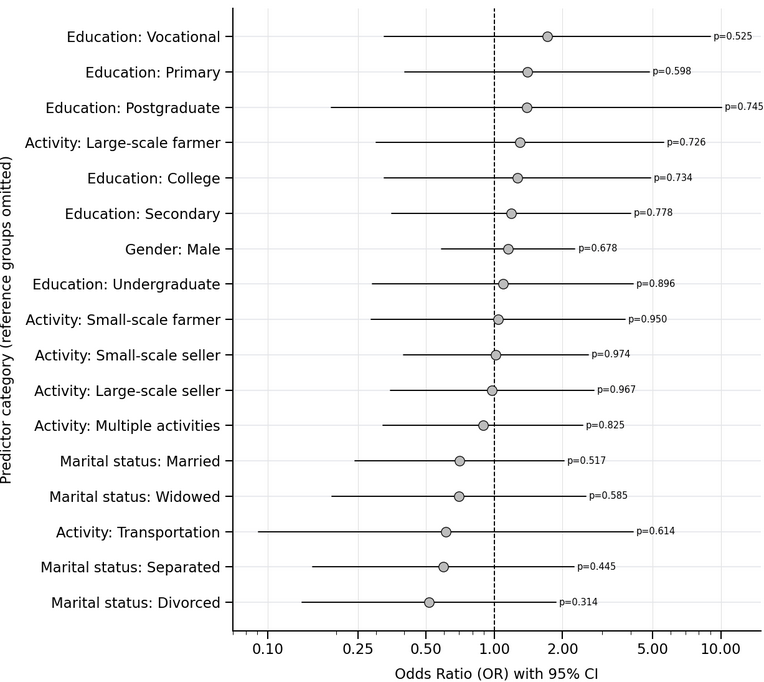
Figure 1 achoes the interpretation of Table 2. Most odds-ratio estimates cluster relatively close to the null line at OR = 1.0, and all confidence intervals cross that line, visually confirming the absence of statistically significant differences across the available predictors. The figure is useful because it allows the reader to compare the direction, magnitude, and precision of each estimate at a glance. For instance, vocational education lies furthest to the right among the education categories, while divorced status lies furthest to the left among the marital-status categories, yet both intervals remain wide and overlap the null line. The visual pattern therefore supports the conclusion that perceptions of khat’s food-security importance are generally positive and broadly similar across respondent subgroups.
5. Discussion
The findings suggest that the contribution of khat to rural household food security in Igembe South is best understood as an income-mediated livelihood mechanism rather than as a direct agricultural food source. The pattern shown in Table 1where most households reported using khat proceeds to purchase both food and farm inputs indicates that khat supports food security through a dual pathway: it improves immediate access to food while also strengthening the productive base through reinvestment in agriculture. This matters analytically because it shifts the debate away from a narrow question of whether khat “feeds” households directly and toward a broader understanding of how cash-crop income sustains food access and production capacity simultaneously. In practical terms, the evidence implies that households are not using khat income merely for short-term consumption; they are also treating it as a resource for maintaining future livelihood continuity, which is a central feature of rural food-security resilience.
This interpretation is consistent with the strand of literature that presents khat as an adaptive livelihood strategy in contexts where food-crop production is uncertain. Cafer (2018) argues that khat can function as a resilience mechanism by improving household food security through cash earnings, while Hussein et al. (2023) likewise show that khat contributes substantially to rural household income in Ethiopia, thereby strengthening household welfare and consumption capacity. The present findings speak directly to that argument because the high share of households purchasing both food and farm inputs suggests that khat income is being translated into both present and future food-security needs. At the same time, the findings also point to the importance of recognising how khat income is used, not simply whether it is earned. This is important because agriculture-to-nutrition research shows that income gains alone do not guarantee improved food outcomes unless households allocate resources in ways that support food access, care, and productive reinvestment (Ruel & Alderman, 2013).
The strong positive skew in the food-security importance ratings shown in Table 1 and Figure 1 further suggests that khat’s role in household welfare is not marginal but deeply embedded in everyday livelihood practice. Most respondents rated khat as either important or highly important for food security, and only a very small minority considered it unimportant. Error! Filename not specified.The meaning of this pattern is not simply that households “like” khat economically; rather, it indicates that khat has acquired the status of a normalised welfare resource within the local rural economy. In other words, households appear to perceive khat not as a supplementary crop, but as a central mechanism through which they manage food access, livelihood stability, and production maintenance. This interpretation fits well with symbolic interactionism, because the crop’s perceived value is shaped not only by economic returns but also by locally shared meanings and practical understandings of what khat represents within the community.
The empirical results in Table 2 and Figure 1 deepen this interpretation by showing that the positive valuation of khat for food security does not vary significantly across the social and livelihood categories tested in the available models. None of the bivariate ordered logistic regressions for gender, education, marital status, or primary khat activity produced statistically significant differences in the odds of rating khat as more important for food security. Substantively, this means that the perceived value of khat is not concentrated only among one privileged group such as better-educated households, male-headed households, or traders but appears to be broadly shared across the sampled community. This is an important finding because it suggests that khat’s contribution to food security in Igembe South is systemic rather than subgroup-specific. Viewed through a structural-functionalist lens, this indicates that khat has become part of the wider social and economic arrangement through which households maintain welfare under local rural constraints.
At the same time, the results should not be interpreted as evidence that khat is unambiguously beneficial in all respects. The literature reviewed earlier cautions that khat expansion can displace food crops, narrow agricultural diversity, and weaken longer-term food-system resilience even when short-term purchasing power improves (Gebrehiwot et al., 2016; Ademe et al., 2017). The present findings do not refute those concerns; rather, they refine them. In this study area, households clearly experience khat as a positive food-security resource, but that positive valuation may coexist with longer-term structural trade-offs that are not fully captured by perception-based or short-term welfare indicators. This means the study aligns with the literature showing short-run food-access benefits from khat income, while also leaving room for the argument that heavy dependence on khat could produce future vulnerabilities through land-use substitution or reduced crop diversification.
A further implication concerns the social distribution of food-security benefits within the household. Prior literature suggests that cash-crop income can fail to improve household food outcomes when intra-household allocation patterns favour non-food uses or when the control of income and the responsibility for food provisioning are separated (Bikketi et al., 2016). In the current study, however, the widespread use of khat proceeds for both food and farm inputs suggests that, at least at the reporting level, households are allocating khat income in welfare-supporting directions. This does not eliminate the possibility of hidden inequalities in control over income, but it does indicate that khat earnings are visibly tied to food-security functions at the household level. From a practical standpoint, this implies that development interventions should not focus only on discouraging khat dependence; they should also improve how khat income is managed for example, through household budgeting, agricultural input support, and food-security planning so that the welfare gains from the crop are better protected and possibly expanded.
Overall, the discussion points to a clear conclusion: in Igembe South, khat appears to operate as a widely normalised, income-based food-security strategy that is recognised across household groups and linked to both consumption and production needs. The study therefore contributes to the literature by showing that the significance of khat for food security is not only economic but also social and systemic. This helps explain why khat remains deeply embedded in rural livelihoods despite the wider policy and scholarly debate over its long-term effects. For policy and practice, the implication is that any attempt to improve food security in khat-producing regions must engage with khat’s actual role in household survival strategies rather than treating it as an external or marginal livelihood activity.
6. Conclusion
6.1. Summary
The article concludes that khat production contributes positively to short-term rural household food security in Igembe South Sub-County through income generation, particularly by enabling households to purchase both food and farm inputs. The descriptive findings showed that most households used khat proceeds to support both immediate food access and productive reinvestment, while the majority also rated khat as important or highly important for food security. The empirical results further indicated that this positive perception did not differ significantly across the household categories examined, suggesting that khat’s food-security value is broadly shared across the sampled community rather than concentrated in one specific demographic or occupational group.
These findings suggest that khat functions as a widely embedded livelihood mechanism that supports food security through market-based food access and farm-level reinvestment. However, this contribution should be interpreted cautiously, since the wider literature and the study’s analytical framing indicate that dependence on khat income may also carry longer-term risks related to land-use substitution, reduced food-crop diversity, and household reliance on cash-mediated food access. The study therefore concludes that khat is neither simply beneficial nor wholly detrimental; rather, it plays a complex and structurally embedded role in rural household food security.
6.2 Limitations and Future Research
This study is limited by its cross-sectional design and by the use of cross-tabulated counts for the regression analysis, which means the empirical models are bivariate and unadjusted rather than fully multivariable. In addition, the outcome used in the regression reflects perceived importance of khat to food security, which does not capture all objective dimensions of food security such as dietary diversity or seasonal food stability. Future research should therefore use household-level longitudinal data and more direct food-security measures to assess whether khat’s short-term benefits are sustained over time or offset by longer-term livelihood and land-use risks.
References
Rights and permissions

Disclaimer
All claims expressed in this article are solely those of the author and do not necessarily represent those of the publisher, editors, reviewers, or affiliated institutions. Any product, service, or claim that may be evaluated in this article is not guaranteed or endorsed by the publisher.
Publisher’s note
The publisher remains neutral with regard to jurisdictional claims.
Additional information
Data availability
Funding
Peer review
Article Timeline
 Publication record
Cite this article
- Received
- February 4, 2026
- Revised
- March 18, 2026
- Accepted
- April 15, 2026
- Published
- May 10, 2026
- Version of record
- May 10, 2026
Share this article
Share the article record with colleagues and readers worldwide.
Explore research across our journalsDiscover more research

Recent Publications

Most Read

Recommended
Save this article as a bookmark
Use your browser’s secure bookmark shortcut. Both desktop options are shown below.
Press Ctrl+D
In Chrome, Edge or Firefox, choose a folder if needed, then select Done.
Press ⌘ Command+D
In Safari, Chrome or Firefox, choose the bookmark location and confirm.
Cite this article
Copy a formatted citation or download a reference file.
Cited by
Crossref citation count for this DOI.