
Khat Production and Rural Household Access to Formal Education


Abstract
This article examines the dual role of khat production in shaping rural household access to formal education in Igembe South Sub-County, Meru County, Kenya. Using a cross-sectional survey (N=125), the study analyses how participation in the khat value chain influences educational investment and school attendance. Descriptive findings reveal a significant "education complexities": while 74% of households have members in formal education and 82.8% credit khat income as a vital financial pillar for school fees, the labour-intensive nature of the crop drives substantial schooling disruptions, including absenteeism (30%) and cognitive fatigue. Bivariate regression results indicate that access to education remains relatively uniform, with no statistically significant differentiation across gender, marital status, or the household head's educational level. Therefore, khat functions as a critical but precarious income-mediated support mechanism, where financial enablement is frequently offset by labour-related costs that undermine educational quality and consistency.
1. Introduction
1.1. Background
Access to formal education remains a fundamental dimension of rural household welfare because it reflects a household’s ability to invest in human capital, sustain intergenerational mobility, and reduce long-term vulnerability. In rural sub-Saharan Africa, however, access to schooling is often mediated by household livelihood conditions, labour demands, and the stability of income sources rather than by educational aspiration alone. Recent regional evidence shows that rural children frequently combine schooling with productive work and that agricultural dependence continues to shape whether households can sustain regular school participation, progression, and completion. In such contexts, the question is not only whether households value education, but whether their livelihood systems generate the income and time conditions needed to support it.
Within eastern Africa, khat (Catha edulis) production has become one of the most important rural cash-crop systems, especially in Kenya and Ethiopia, where it supports household income through cultivation, harvesting, transport, and trade. The relevance of khat to education lies in the fact that it is not merely an agricultural crop; it is a value-chain livelihood that can both finance access to schooling and draw young people into labour-intensive economic activities that disrupt schooling. Recent evidence from Ethiopia shows that khat cultivation can constitute a substantial share of annual household income and improve household living standards, thereby strengthening the resource base through which households may fund school fees, uniforms, transport, and other educational costs (Hussein et al., 2023). Likewise, recent syntheses on khat and household economies show that producer settings such as Kenya and Ethiopia tend to experience khat as an economically enabling crop, even while debates persist about its broader social effects (Gudata, 2022).
This article is concerned with the relationship between khat production and rural household access to formal education. In this paper, khat production is understood broadly to include participation in the wider khat value chain harvesting, farming, small- and large-scale selling, transport, and mixed activity engagement because households derive education-supporting income from more than cultivation alone. Access to formal education is conceptualised as the presence of household members in the formal education system and the household’s ability to sustain their participation across levels of schooling. This conceptualisation is important because khat does not improve education directly; rather, its educational effect is mediated through household income and expenditure decisions. In the present study area, this linkage is reflected in the empirical pattern that a majority of households had members currently in school and many respondents rated khat’s contribution to household education as medium or high, indicating that khat income is actively connected to schooling support.
Yet the relationship between khat production and formal education is not unambiguously positive. Literature on schooling–labour trade-offs in rural households shows that children’s education can be compromised when household economic systems depend on child labour, early income opportunities, or work routines that interfere with attendance and concentration in school (Islam & Hoque, 2022). This tension is highly relevant in khat-producing settings, where the crop can generate school fees on the one hand, but also expose school-going children to picking, hawking, transport, and related trade activities on the other. Broader African evidence on children’s work in agriculture similarly stresses that schooling and work often coexist in rural settings, and that educational participation is shaped by context-specific household survival strategies rather than by a simple opposition between “school” and “work” (Dunne et al., 2023).
The relationship is further mediated by socio-demographic and household-level factors. Research on child labour and schooling shows that educational access and continuity are influenced by the education level of the household head, household structure, livelihood insecurity, and gendered responsibilities within the family (Islam & Hoque, 2022; Mehari & Tadesse, 2020). In khat-producing communities, these mediating factors are particularly relevant because school decisions are made within households where resources, labour demands, and educational aspirations intersect. For example, more educated household heads may be better positioned to prioritise children’s schooling, while certain khat roles may intensify demands on household labour or expose children to early earnings. At the same time, gendered and marital dynamics can shape who controls khat income and how education expenditures are prioritised within the household (Bikketi et al., 2016).
The study is guided by structural functionalism and symbolic interactionism. Structural functionalism is useful because it interprets livelihood systems as interconnected components of a wider social order; in this sense, khat production can be understood as an adaptive rural subsystem that generates income used to sustain school participation and broader household welfare. Symbolic interactionism complements this perspective by emphasising that household decisions are shaped by local meanings, norms, and everyday interpretations of what khat represents as livelihood, as opportunity, and, in some cases, as a route to early income that competes with schooling. These lenses are particularly relevant in Igembe South, where khat is both economically central and socially normalised, meaning that its relationship to education must be analysed as a socially embedded process rather than as an income variable alone.
Against this background, this article examines the contribution of khat production to rural household access to formal education in Igembe South Sub-County, Meru County, Kenya by: (i) describing household participation in the khat value chain and the extent to which households currently have members in formal education; (ii) examining the degree to which khat income contributes to household education; and (iii) testing whether access to formal education varies across household characteristics such as gender, education level of the household head, marital status, and primary khat activity. The study advances the claim that khat operates as a dual educational mechanism in the study area: it supports schooling through income-mediated fee payment and household educational investment, yet it also generates labour and behavioural pressures that may undermine educational participation and quality.
1.2. Problem Statement
Despite the growing importance of khat in rural household economies, there is limited context-specific evidence on how khat production affects access to formal education in rural Kenya. Existing work has often focused either on khat’s contribution to income and welfare or on its negative social consequences, but rarely on the contradiction between education support through income and education disruption through labour participation and school-related behavioural effects. While some studies suggest that cash-crop income can enhance schooling by easing financial constraints, others show that rural households may trade schooling for labour when economic pressures intensify (Islam & Hoque, 2022; Hussein et al., 2023). In Igembe South, where khat is structurally embedded in household livelihoods, the absence of empirical evidence on this education paradox creates a significant gap in understanding whether khat enables, constrains, or simultaneously does both in relation to formal education access.
2. Literature Review
Cash-crop participation is commonly linked to rural welfare improvement because it can diversify income sources and strengthen household purchasing power, yet its effects on education are less straightforward than its effects on income alone. In rural Africa, livelihood diversification has long been recognised as central to household survival, but the ability of households to convert cash earnings into schooling outcomes depends on broader structural conditions such as asset ownership, labour needs, and market access (Barrett et al., 2001). More recent work on rural transformation in sub-Saharan Africa similarly shows that agricultural income can support social investment, but that the effects of such investment vary according to household constraints and the quality of surrounding institutional systems (Giller et al., 2021; Geffersa, 2023).
Within education research, access to formal schooling is increasingly understood as a product of household economic capacity, labour allocation, and the schooling–work nexus. Islam and Hoque (2022) show that in rural households, schooling is often traded off against labour when subsistence needs, credit constraints, or labour demand intensify, especially among economically vulnerable households. Their analysis is not khat-specific, but it is highly relevant to khat-producing communities because it identifies the same mechanisms income insecurity, labour-intensive livelihoods, and cultural rationales that can shape parental choices regarding schooling. In the African context more broadly, recent work on children’s education and agricultural work also shows that school access and participation are strongly conditioned by the realities of rural labour systems, rather than by educational preferences alone (Dunne et al., 2023).
Khat occupies a distinctive place in this literature because it is both a cash crop and a socially embedded stimulant economy. Recent khat-focused work shows that households in producing regions often interpret khat as an economically enabling crop because of its regular cash turnover and relative market strength. Gudata’s (2022) synthesis of khat and household economies concludes that in producer countries such as Kenya and Ethiopia, khat is often associated with positive household economic outcomes, whereas consumer settings emphasise its negative economic implications. Similarly, Hussein et al. (2023) show that khat can constitute a major share of household income in Ethiopia, thereby improving living standards and strengthening the capacity of rural households to finance basic welfare needs. These findings imply that khat could plausibly support school access by relaxing household financial constraints, including school-fee payment burdens. However, the educational consequences of khat cannot be inferred from income effects alone. Recent research on young people and substance use in sub-Saharan Africa shows that khat remains a significant psychoactive substance among youth, and among school-going populations it is associated with behavioural and schooling risks that include absenteeism, concentration problems, and other forms of educational disruption (Ebrahim et al., 2024; El Moubchiri et al., 2024/2025). Although these studies do not focus on household educational access per se, they are relevant because they demonstrate that khat-related practices may affect the quality and continuity of school participation, especially among adolescents in educational settings. The implication is that khat can create an educational paradox: the same crop that finances education may also generate conditions that weaken schooling performance and engagement.
This issues is also reflected in khat-specific qualitative evidence from Kenya. Nyaga (2024) shows that students and residents in khat-growing areas of Meru County simultaneously perceive khat as a source of income, identity, and local development, while also associating it with school dropouts and related social challenges. The importance of this finding is that it aligns strongly with the architecture of the present study: khat is not experienced as simply “good” or “bad” for education, but as a livelihood system with overlapping welfare and schooling effects. This duality supports the need for empirical work that explicitly separates school-support pathways, for instance, school-fee financing from school-disruption pathways.
A related body of literature concerns child labour in agriculture and its consequences for schooling. Rural children’s work in agriculture is not automatically harmful, but a substantial body of evidence shows that when agricultural work becomes intensive, hazardous, or time-consuming, it interferes with school participation and learning. FAO and ILO frameworks emphasise that agricultural child labour can undermine education when it affects attendance, energy, concentration, or progression, even where children remain nominally enrolled (FAO, 2023; ILO, n.d.). In Ethiopia, recent child labour evidence confirms that children continue to work in agricultural sectors that include khat-related activities, highlighting the continuing relevance of the schooling–labour trade-off in rural agrarian settings (U.S. Department of Labor, 2022; Mehari & Tadesse, 2020).
Gender and household structure further complicate the link between cash-crop income and education. Bikketi et al. (2016) show that in Kenyan agrarian contexts, women and men often occupy different positions in the household economy, with implications for who controls income and who carries responsibility for everyday household welfare. In education terms, this matters because the use of khat income for school-related purposes may depend not only on how much income the household receives, but also on who makes schooling decisions and how income is prioritised relative to other household needs. Similarly, evidence on schooling and labour trade-offs shows that family structure and gendered labour expectations can influence whether children remain in school or are drawn into work (Islam & Hoque, 2022).
The education level of the household head is also a potentially important moderator of school access. More educated household heads may be more likely to value formal education, understand its long-term returns, and allocate resources accordingly. Recent work on household welfare and agricultural productivity in Ethiopia suggests that better-informed and better-resourced households are more capable of converting livelihood gains into broader welfare improvements, though such gains are not evenly distributed (Geffersa, 2023). Applied to khat-producing households, this implies that the educational impact of khat income may depend not only on the crop itself, but also on the educational and strategic capacities of the household head who manages that income.
At the same time, recent khat and welfare research continues to caution against overly positive interpretations of cash-crop effects. Abafita and Bulga (2020) argue that although khat production may improve food consumption and some dimensions of welfare, it can also generate trade-offs that weaken broader household outcomes if resources are diverted away from alternative productive or social investments. Similarly, recent evidence on child growth and parental khat use in Ethiopia suggests that positive income effects from khat production can be offset by behavioural and caregiving effects associated with khat use itself (Roba et al., 2023). These studies reinforce the importance of analysing khat through multiple pathways rather than assuming that higher income automatically translates into uniformly better welfare outcomes, including educational access.
The literature reveals three major gaps that justify the present study. First, although recent evidence shows that khat can strengthen household income and welfare, there is still limited empirical work on how those income gains translate specifically into formal education access in rural Kenya. Second, the literature often treats khat either as an economic opportunity or as a social problem, but rarely analyses the education paradox whereby the same crop may simultaneously finance schooling and undermine it through labour participation, absenteeism, fatigue, or performance-related effects. Third, the role of household-level mediators especially household-head education, marital structure, gender, and primary khat activity remains under-specified in the education literature on khat. Assessing rural households in Igembe South Sub-County, thus, addresses these gaps since it will examine both the access-support and access-disruption pathways linking khat production to formal education.
3. Methods
3.1 Research Design
This articles used an exploratory cross-sectional survey design using quantitative household data. The exploratory approach was appropriate because empirical evidence on the relationship between khat production and rural household access to formal education remains limited and context-specific in rural Kenyan settings. The cross-sectional structure enabled the study to capture household characteristics, livelihood participation in the khat value chain, and education-related outcomes at a single point in time, thereby providing a snapshot of how khat-based livelihoods relate to educational access in the study area (Dessie & Kinlund, 2008).
3.2 Participants and Sampling
The study was conducted in Igembe South Sub-County, Meru County, Kenya, a predominantly agrarian region where khat is intensively cultivated and traded. The site was purposively selected because khat production forms a central component of local household livelihoods and is widely associated with welfare outcomes, including the ability to support children’s schooling. The unit of analysis was the rural household, while the unit of observation included household-level measures of access to formal education, respondent characteristics, and household participation in khat-related activities.
The target population comprised adult household heads (18 years and above) who were engaged in the khat value chain as producers, traders, or brokers/agents. A total of 147 households was targeted through a stratified multi-stage sampling design. Of these, 125 respondents participated, although valid responses for the education analysis were based on N = 125, using the cross-tabulated counts you provided. The respondent profile was predominantly male, and the sample included diverse levels of education attainment, marital statuses, and khat activity roles, thereby allowing the study to examine whether household access to formal education varies across these categories.
3.3 Data Collection instruments
The study used a structured household survey questionnaire designed to capture both general socio-demographic information and education-specific welfare outcomes. The instrument combined predominantly closed-ended questions, to support quantification and model estimation, with a limited number of open-ended items that allowed respondents to explain in brief how khat affects schooling in their households.
The questionnaire was organised into thematic modules. The first module captured respondent socio-demographic characteristics, including gender, age group, marital status, and education attainment. The second module captured household engagement in the khat value chain, including the main activity role (e.g., picking/harvesting, small-scale selling, multiple activities, farming, transportation). The third module focused on access to formal education, with key questions asking whether the household currently had members in the education system, what level of education those members had reached (primary, secondary, college/technical, university), and whether khat income was used to pay school fees. A final module captured negative educational effects of khat activities, including absenteeism, sleeplessness, lack of concentration in class, and other school-related disruptions. In this way, the instrument captured both the positive contribution of khat to school access and the negative pathways through which khat-related activities may undermine educational participation.
3.4 Data Collection Procedures
Data were collected using a structured household questionnaire administered to household heads at their residences. Before the interview, respondents were informed of the purpose of the study and participation proceeded only after voluntary informed consent had been obtained. The household-head approach was appropriate because household heads are generally responsible for key decisions regarding school-fee payment, labour allocation, and the use of khat income in supporting household welfare, including education.
3.5 Data Analysis
3.5.1. Descriptive Analysis
The analysis will proceed in two stages. First, descriptive statistics will be used to summarise respondent characteristics, participation in khat activities, household access to the formal education system, the levels of education attained by household members, the degree of khat’s contribution to education, and the reported negative schooling effects of khat activities. Frequencies and percentages will be used because they provide an accessible overview of the distribution of the main education-related variables. For any category kkk, the percentage will be calculated as:
The nk is the frequency (number of households) observed in category k, and N is the total number of households with valid responses for that particular question (for example, N=120).
3.5.2 Empirical model
Second, the study will estimate a binary logistic regression model in which the dependent variable is household access to formal education. The empirical analysis focuses on household access to formal education as the main dependent variable. This outcome was operationalised as a binary variable:
This coding is directly supported by your crosstab data, which show that 93 households had members currently in school, while 32 households did not.
Because the outcome is binary, the appropriate model is a binary logistic regression, estimated separate for each predictor using the available cross-tabulated counts. The predictors Xi are:
where:
Gender i= male or female household head
HeadEdui= education level of the household head
KhatActivity i= primary khat value-chain role
MaritalStatus i= marital category of the respondent
EduAccess i = 1 if household i has at least one member in formal education, and 0 otherwise.
The empirical model is:
where Xi includes gender, age group, marital status, education attainment, primary khat activity, and the degree of khat’s contribution to household education. Results are presented as odds ratios (ORr = eβr), where values above 1 indicate increased odds of household access to formal education and values below 1 indicate reduced odds.
3.6 Ethical Considerations
The study adhered to standard ethical principles in social research. Participation was voluntary and based on informed consent, and respondents were assured of anonymity and confidentiality. No personally identifying information was reported, and the data were used strictly for academic purposes.
4. Findings
This section presents the findings in two complementary stages. First, the descriptive results summarise the respondent profile, household participation in khat-related activities, and the education-specific welfare indicators that define rural household access to formal education in the study area. Second, the empirical results examine whether household access to formal education varies systematically across gender, education level of the household head, primary khat activity, and marital status using bivariate binary logistic regression models estimated from the cross-tabulated counts you supplied. This sequencing is important because the descriptive stage shows the overall structure of access to formal education, while the regression stage evaluates whether those access patterns differ meaningfully across household characteristics.
4.1 Descriptive Results
Table 1 presents a descriptive overview of the variables most relevant to the education paper. Specifically, the table summarises respondent background characteristics, primary khat activity, household access to formal education, the school level of enrolled household members, the perceived degree of khat’s contribution to education, and the negative schooling effects associated with khat-related activities. The purpose of presenting these indicators together is to show both the positive educational pathways linked to khat (for example, school-fee financing and school participation) and the negative educational pathways linked to khat activities (for example, absenteeism and lack of concentration).
| Variable | Category | n | % |
|---|---|---|---|
| Gender | Male | 79 | 63.20 |
| Female | 46 | 36.80 | |
| Age group | 20–30 | 5 | 4.20 |
| 31–40 | 6 | 5.00 | |
| 41–50 | 40 | 32.00 | |
| 51–60 | 63 | 50.00 | |
| 61+ | 11 | 8.80 | |
| Marital status | Married | 59 | 47.30 |
| Widowed | 18 | 14.50 | |
| Divorced | 18 | 14.30 | |
| Separated | 16 | 12.70 | |
| Single | 14 | 11.20 | |
| Education attainment of household head | No education | 13 | 10.00 |
| Primary | 29 | 23.00 | |
| Secondary | 34 | 27.00 | |
| College | 17 | 14.00 | |
| Undergraduate | 20 | 16.00 | |
| Vocational training | 9 | 7.00 | |
| Postgraduate | 4 | 3.00 | |
| Primary khat activity | Picking khat | 33 | 26.10 |
| Small-scale seller | 28 | 22.40 | |
| Multiple activities | 21 | 17.10 | |
| Large-scale seller | 20 | 16.30 | |
| Farming (L/S & S/S) | 19 | 14.90 | |
| Transportation | 4 | 3.20 | |
| Household access to formal education | Access (in school) | 93 | 74.00 |
| No access/finished | 32 | 26.00 | |
| Education level of household members in school | Primary | 32 | 35.56 |
| Secondary | 31 | 34.44 | |
| College/Technical institution | 20 | 22.22 | |
| University | 7 | 7.78 | |
| Degree of khat contribution to household education | Low | 21 | 17.18 |
| Medium | 47 | 37.48 | |
| High | 57 | 45.34 | |
| Negative educational effects of khat | Absenteeism | 36 | 30.00 |
| Sleepless nights | 26 | 21.67 | |
| Lack of concentration in class | 21 | 17.50 | |
| Sleeping in class | 16 | 13.33 | |
| Lateness due to oversleeping | 9 | 7.50 | |
| Poor class performance | 7 | 5.83 | |
| Peer pressure | 5 | 4.17 |
Note. The descriptive table is based on the cross-tabulated and percentage summaries you provided. Valid responses for the education-access analysis were based on N = 125 households.
The descriptive results show that the respondent pool was predominantly male (63.20%, n = 79), with the largest age category concentrated in the 51–60 years bracket (50.00%, n = 63), indicating that the study mainly captured the perspectives of mature household decision-makers. Most respondents were married (47.30%, n = 59), and the distribution of household-head education suggests that the majority had at least basic schooling, with secondary education (27.00%, n = 34) and primary education (23.00%, n = 29) forming the largest categories. These patterns matter for the education paper because they indicate that the sample was composed largely of heads of households with both family responsibilities and some minimum educational exposure, which are relevant to school-enrolment decisions.
The table further shows that household engagement in the khat value chain was concentrated in labour and trading roles, with picking khat (26.10%, n = 33) and small-scale selling (22.40%, n = 28) being the most common activities. This suggests that khat is not only a crop but a livelihood system through which households generate income at several points in the value chain. In relation to formal education, the most important descriptive result is that 74.00% of households (n = 93) had members currently in school, while 26.00% (n = 32) did not. Among the 93 households with members in formal education, the largest shares were in primary (35.56%, n = 32) and secondary (34.44%, n = 31) education, followed by college/technical education (22.22%, n = 20) and university (7.78%, n = 7). This distribution suggests that khat-producing households are not only accessing basic education but, in some cases, supporting educational progression into post-secondary levels.
The same table also makes clear that khat’s educational role is two-sided. On the positive side, 45.34% of respondents rated khat’s contribution to household education as high, and 37.48% rated it as medium, implying that most households view khat as an important source of school-related support, likely through school-fee financing. On the negative side, respondents identified several schooling disruptions associated with khat activities, the most common being absenteeism (30.00%, n = 36), sleepless nights (21.67%, n = 26), and lack of concentration in class (17.50%, n = 21). This indicates that khat may simultaneously enable school access while also undermining educational participation and quality through labour demands and activity-related fatigue.
Household access to formal education and the perceived degree of khat’s contribution to household education. The left panel shows the proportion of households with members currently in school, while the right panel shows whether respondents rated khat’s contribution to education as low, medium, or high.
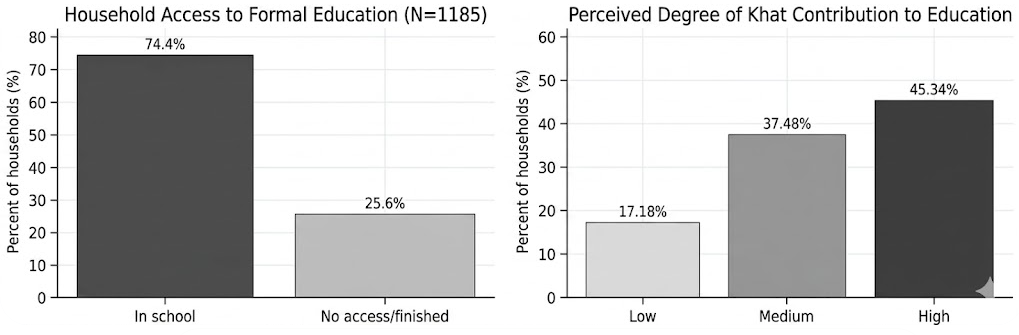
Figure 1 supports the descriptive patterns reported in Table 1. The left panel shows a clear imbalance in favour of education access, with the majority of households reporting that they currently have members in the formal education system. The right panel similarly shows that most respondents rated khat’s contribution to education as medium to high, with the “high” category forming the single largest share. Taken together, the figure suggests that khat is widely perceived as a relevant educational resource within household livelihood systems, even though the negative educational effects reported in Table 1 complicate this otherwise positive picture.
4.2 Empirical Results
To examine whether household access to formal education varies across respondent and livelihood categories, the study estimated bivariate binary logistic regression models using the cross-tabulated counts supplied for the education-access variable. The dependent variable was household access to formal education, coded 1 = household has at least one member currently in school and 0 = no current household member in school / education finished. Because the available data were aggregated by predictor categories rather than provided as a single row-level dataset, each predictor was entered separately in its own binary logistic model, meaning that the results represent unadjusted bivariate associations rather than one fully adjusted multivariable model.
| Predictor | Category | β | SE | p | OR [95% CI] |
|---|---|---|---|---|---|
| Gender | Female (reference) | 0.000 | 0.000 | Ref. | |
| Male | 0.040 | 0.424 | .924 | 1.041 [0.454, 2.390] | |
| Education of household head | No education (reference) | 0.000 | 0.000 | Ref. | |
| Primary | 0.495 | 0.705 | .483 | 1.641 [0.412, 6.538] | |
| Secondary | 0.709 | 0.699 | .311 | 2.031 [0.516, 7.992] | |
| College/Vocational | 0.734 | 0.736 | .319 | 2.083 [0.492, 8.815] | |
| University/Postgrad | 0.811 | 0.762 | .287 | 2.250 [0.505, 10.017] | |
| Primary khat activity | Picking khat (reference) | 0.000 | 0.000 | Ref. | |
| Small-scale seller | 0.118 | 0.586 | .841 | 1.125 [0.357, 3.547] | |
| Multiple activities | 0.182 | 0.644 | .777 | 1.200 [0.339, 4.243] | |
| Large-scale seller | 0.118 | 0.648 | .856 | 1.125 [0.316, 4.003] | |
| Farming (L/S & S/S) | 0.049 | 0.651 | .940 | 1.050 [0.293, 3.763] | |
| Transportation | 0.118 | 1.219 | .923 | 1.125 [0.103, 12.269] | |
| Marital status | Single (reference) | 0.000 | 0.000 | Ref. | |
| Married | -0.223 | 0.717 | .756 | 0.800 [0.196, 3.259] | |
| Widowed | -0.344 | 0.837 | .681 | 0.709 [0.137, 3.660] | |
| Divorced | -0.344 | 0.837 | .681 | 0.709 [0.137, 3.660] | |
| Separated | -0.201 | 0.870 | .818 | 0.818 [0.149, 4.505] |
Note. β = logistic regression coefficient; SE = standard error; OR = odds ratio; CI = confidence interval; Ref. = reference category. Higher values of the dependent variable indicate greater likelihood that the household currently has at least one member in formal education. ** denotes statistical significance at p < .05. None of the coefficients met the p < .05 threshold in the current bivariate models, so no estimate is marked with **. These models were estimated from the supplied cross-tabulated counts and therefore represent unadjusted bivariate associations, not a single multivariable model.
The empirical results indicate that none of the predictors tested in the bivariate binary logistic regressions had a statistically significant association with household access to formal education at the conventional 5% level. For instance, the coefficient for male household heads was positive (β = 0.040), corresponding to an odds ratio of 1.041, but the effect was not statistically significant (p = .924). This means that, relative to female-headed households, male-headed households had only slightly higher estimated odds of having members currently in school, and the evidence is far too weak to conclude that gender systematically shapes educational access in the sampled households.
A broadly similar pattern is visible for the education level of the household head. Relative to households whose heads had no education, all higher education categories produced odds ratios above 1.00, suggesting a descriptive tendency toward greater educational access among more educated household heads. The largest point estimate was observed for University/Postgrad (OR = 2.250), followed by College/Vocational (OR = 2.083) and Secondary (OR = 2.031). However, none of these estimates was statistically significant, and all confidence intervals were wide and crossed 1.00. This suggests that although more educated household heads may appear descriptively more likely to support school access, the available data do not support a statistically reliable educational gradient in access.
The same conclusion applies to primary khat activity and marital status. None of the primary khat activity categories differed significantly from the picking khat reference group, and none of the marital categories differed significantly from the single reference group. Some categories, such as multiple activities (OR = 1.200) and small-scale seller (OR = 1.125), showed slightly higher odds of household school access than the reference activity, whereas categories such as widowed (OR = 0.709) and married (OR = 0.800) showed slightly lower odds relative to the single reference group, but none of these differences was statistically significant. Overall, the empirical results suggest that household access to formal education is not strongly differentiated by the respondent categories included in the available cross-tabulations; instead, access appears to be relatively broad across household types.
The absence of statistically significant group differences implies that access to formal education in the study area may not be concentrated within one narrow type of household. Rather, the findings suggest that school access is fairly widespread across gender, education, marital, and khat-activity categories, which reinforces the descriptive evidence that khat-related households broadly support formal education, even if khat activities may still generate schooling disruptions.
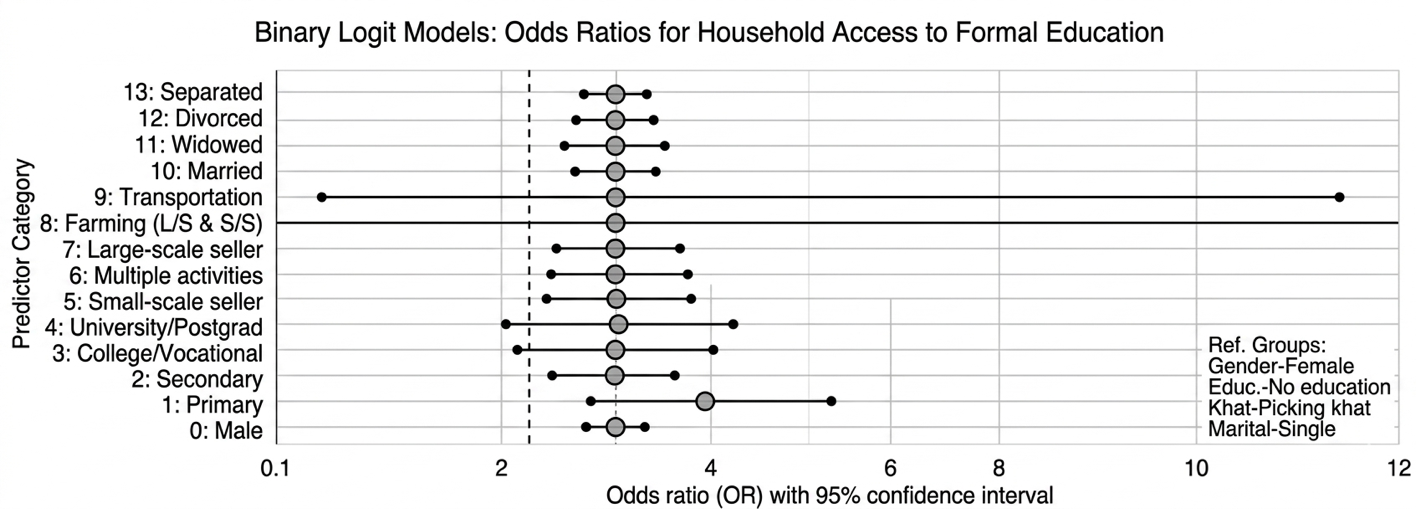
The x-axis shows the odds ratio, while the y-axis lists the predictor categories (excluding reference groups). The dashed vertical line at OR = 1.0 indicates no difference from the reference category. Points to the right of the line indicate higher estimated odds of household access to formal education, while points to the left indicate lower odds. Confidence intervals that cross OR = 1.0 indicate non-significant effects.
Figure 2 echoes the interpretation of Table 2. Most odds-ratio estimates cluster fairly close to OR = 1.0, and all confidence intervals cross the null line, visually confirming that none of the available predictors had a statistically significant relationship with household access to formal education. The figure is especially helpful because it shows the direction, magnitude, and precision of each effect at a glance. For example, the education categories lie furthest to the right, indicating a descriptive tendency toward higher school access among more educated household heads, while some marital-status categories lie modestly to the left, indicating lower estimated odds relative to single respondents. However, the wide confidence intervals confirm that these differences are not statistically reliable in the available data.
5. Discussion
The findings indicate that the relationship between khat production and rural household access to formal education in Igembe South is best understood as a dual-process livelihood mechanism: khat appears to support school access through income generation, but it also creates conditions that may weaken educational participation and quality. This interpretation follows directly from Table 1, where a large majority of households reported having members currently in the formal education system and where most respondents rated khat’s contribution to household education as medium or high. In substantive terms, this suggests that khat income is functioning as a practical educational resource within the household economy, likely by covering school fees and other schooling costs. This interpretation is consistent with recent work showing that khat contributes substantially to rural household income in producing settings and can therefore strengthen the financial base from which households fund welfare investments (Hussein et al., 2023; Gudata, 2022).
A particularly important implication of Table 1 is that the educational effect of khat is not limited to school entry alone; it appears to extend across multiple levels of formal education. The distribution of household members across primary, secondary, college/technical, and university levels indicates that khat-linked households are not only accessing basic education but, in some cases, sustaining progression into post-secondary education. This matters because it suggests that khat income may be supporting educational continuity rather than merely initial enrolment. In the broader rural livelihoods literature, cash-based livelihood systems are often associated with improved capacity to maintain long-term social investments, but only when income is sufficiently stable and households prioritise those expenditures (Barrett et al., 2001; Giller et al., 2021). The present findings speak directly to that point: khat appears to provide households with the regularised earnings necessary to maintain educational participation over time.
At the same time, the study’s descriptive evidence also reveals a clear contradiction. The section on negative educational effects of khat in Table 1 shows that respondents strongly associated khat-related activities with absenteeism, sleepless nights, and lack of concentration in class, among other schooling disruptions. This means that khat is not simply a school-support crop; it is also embedded in labour and behavioural patterns that may undermine the very educational gains its income helps to finance. This finding resonates strongly with the broader literature on schooling–labour trade-offs, which shows that rural households often face a tension between sustaining children’s schooling and meeting labour or subsistence needs, especially in settings where income-generating activities absorb substantial household time and energy (Islam & Hoque, 2022; Dunne et al., 2023). In other words, the present study confirms that access to formal education cannot be interpreted narrowly as a financing issue; it must also be viewed in relation to the labour routines that structure household livelihoods.
This duality helps explain why the study finds a positive overall contribution of khat to education while also documenting education-related harms. The right panel of Figure 1 shows that most respondents still rated khat’s contribution to household education as high or medium, despite the negative effects reported elsewhere in the findings. The meaning of this pattern is that households seem to distinguish between khat’s role as a source of school access and its role in generating schooling risks. That distinction is theoretically important because it suggests that households may perceive educational participation primarily through a resource lenswhether children can be kept in school at alleven when they are simultaneously aware of problems in attendance, concentration, or performance. This interpretation aligns with recent qualitative evidence from Meru County showing that khat is widely viewed as an economic necessity and a driver of local development, even while it is also associated with school dropout and youth-related social problems (Nyaga, 2024).
The empirical results presented in Table 2 and Figure 2 add an important layer to this interpretation. None of the tested predictorsgender, education level of the household head, marital status, or primary khat activityshowed a statistically significant association with whether the household had members currently in formal education. This suggests that access to formal education is not strongly differentiated across the household categories available in the current data. In practical terms, the educational value of khat appears to be relatively broad-based rather than concentrated only among more advantaged or more specialised households. That finding is significant because it implies that khat’s schooling function may be structurally embedded across the local household economy, rather than operating as a selective advantage for one subgroup. This interpretation is compatible with structural functionalism, which would read khat as an adaptive subsystem supporting household continuity under local rural constraints.
The non-significant regression pattern also offers a meaningful contrast with parts of the schooling and child-labour literature. Studies of rural schooling often find that household education, family vulnerability, or labour-intensive occupations sharply differentiate which children stay in school and which do not (Islam & Hoque, 2022; Mehari & Tadesse, 2020). In the present study, however, the estimated odds ratios for the education categories were all above 1.00, even though they were not statistically significant, suggesting a directional tendency toward greater school access among households with more educated heads. This means that the present results do not reject the relevance of household-head education; rather, they show that, in this particular dataset, the difference is not strong enough to be statistically reliable. One interpretation is that the widespread importance of khat income in the study area may reduce some of the educational inequalities that would otherwise arise from differences in household background. Another possibility is that the available cross-tabulated data are too limited to detect more subtle multivariable patterns.
The finding that primary khat activity is not significantly associated with education access is especially revealing. One might expect that households engaged in more commercially advantageous rolessuch as large-scale selling or multiple activitieswould be better positioned to support schooling than those primarily engaged in harvesting or lower-return activities. Yet Table 2 and Figure 2 show no statistically reliable differences across these roles. This suggests that even lower-tier or labour-based positions within the khat economy may still generate enough income to support basic educational access. At the same time, the descriptive evidence on absenteeism and concentration problems warns that these same roles may impose burdens on school-going children through labour participation, time competition, or fatigue. The implication is that income position in the khat chain and educational vulnerability do not necessarily move in opposite directions; households can experience school-support and school-risk simultaneously.
The marital-status results are also informative. Although none of the marital categories differed significantly from the single reference group, the direction of the coefficients generally suggested lower estimated odds of school access for married, widowed, divorced, and separated households. This could reflect the fact that more complex household structures often carry higher dependency burdens and greater expenditure pressure, which may make it harder to sustain schooling consistently. Such a reading is broadly consistent with the literature showing that family structure and caregiving burdens affect schooling continuity in rural households, especially when educational participation depends on irregular or labour-intensive income sources (Islam & Hoque, 2022; Bikketi et al., 2016). However, because the current results are not statistically significant, these differences should be interpreted cautiously as suggestive rather than conclusive.
A major practical implication of the findings is that interventions in khat-producing communities should not frame education policy in a one-dimensional way. If policy treats khat only as a schooling problem, it risks ignoring the fact that many households rely on khat income to finance school participation. If policy treats khat only as an educational enabler, it risks overlooking the labour and behavioural effects that can reduce attendance, concentration, punctuality, and classroom engagement. The evidence instead points to the need for dual-response interventions: measures that protect and stabilise the educational financing role of khat income while also reducing the child-labour, sleep, and attendance disruptions associated with khat-related work. This could include targeted school-fee support, educational bursaries in khat-growing areas, household financial planning support, and stronger local safeguards against school-age participation in intensive khat labour.
Overall, the discussion points to a nuanced conclusion. In Igembe South, khat appears to function as a widely normalised livelihood resource that helps households secure formal education access, yet this same livelihood system also generates negative pressures on educational participation and performance. The study therefore contributes to the literature by showing that the relationship between khat and education is not adequately captured by a simple “supports schooling” or “causes dropout” narrative. Instead, khat should be understood as a livelihood mechanism with simultaneous enabling and constraining effects on formal education. This is precisely why policy and scholarship must analyse khat through both access-support and access-disruption pathways rather than assuming a single educational effect.
6. Conclusion
6.1. Summary
This article finds that khat production in rural households functions as a dual-mechanism livelihood, simultaneously enabling and undermining formal education. While the khat value chain provides the essential liquidity required to finance school fees and facilitate educational progression evidenced by a 74% enrollment rateit simultaneously imposes a "labour tax" on households. This situation is characterised by a conflict between the income-mediated support path and the activity-mediated disruption path, where labor demands lead to significant absenteeism (30%) and cognitive fatigue.
The empirical evidence further suggests that this relationship is structurally embedded across the community. The lack of statistically significant differentiation in access across gender, marital status, or the household head's educational level indicates that the benefits and burdens of the khat economy are broadly shared. Consequently, while khat serves as a robust financial safety net for rural schooling, it creates a precarious educational environment where enrollment does not necessarily translate into academic quality or consistent participation.
6.2 Limitations and Future Research
The primary limitation of this research is its cross-sectional design, which captures educational access at a single point in time rather than tracking longitudinal progression or completion. Furthermore, the use of unadjusted bivariate models limits the ability to control for complex confounding variables inherent in rural socio-economics. Future research should prioritise longitudinal cohort studies to assess the long-term impact of khat-related schooling disruptions on lifetime earnings and human capital. Also, mixed-methods research could further elucidate the symbolic meanings households attach to the trade-offs between immediate khat income and long-term educational investment
References
Rights and permissions

Disclaimer
Publisher’s note
Additional information
Funding
Peer review
Article Timeline
 Publication record
Cite this article
- Received
- February 6, 2026
- Revised
- March 27, 2026
- Accepted
- April 25, 2026
- Published
- May 10, 2026
- Version of record
- May 10, 2026
Share this article
Copy the canonical link to share this article with colleagues and readers.
Discover more research

Recent Publications

Most Read

Recommended
Save this article as a bookmark
Use your browser’s secure bookmark shortcut. Both desktop options are shown below.
Press Ctrl+D
In Chrome, Edge or Firefox, choose a folder if needed, then select Done.
Press ⌘ Command+D
In Safari, Chrome or Firefox, choose the bookmark location and confirm.
Cite this article
Copy a formatted citation or download a reference file.
Cited by
Crossref citation count for this DOI.