

How School Leaders Drive Quality Improvement in Early Childhood Education
A Systematic Review of Leadership Practices, Mechanisms, and Contexts


Abstract
Quality improvement in early childhood education (ECE) depends on more than resources and curriculum; it also depends on how educational leaders exercise their role. This systematic review examined how school and ECE leaders drive quality improvement, the mechanisms through which their influence operates, and the contextual conditions that enable or constrain it. Following PRISMA 2020, the review synthesised 28 empirical and scholarly studies published between 2020 and 2026 through narrative thematic synthesis. Effective leadership was characterised by pedagogical guidance, distributed decision-making, professional learning, collaboration, relational trust and a shared vision. Its influence on quality ran chiefly through teacher learning, professional agency, collaboration, organisational climate, resource coordination and teacher retention, while limited resources, inadequate preparation, staffing pressures and unfavourable policy conditions constrained implementation. The evidence supports pedagogically focused, collaborative and context-responsive leadership, sustained by adequate workforce, financial and institutional conditions. Stage-specific search counts were not retained, and the findings should be read with that limitation in mind.
Highlights
- ObjectiveNo reliable short passage identified. Please consult the full article. Read full text
- MethodsThis article reports a systematic review of empirical evidence on how school and ECE leaders contribute to quality improvement. Read source
- FindingsThe 28 studies, all published between 2020 and 2026 although the eligibility window opened in 2015, comprised 14 quantitative, 10 qualitative and one mixed-methods study, together with three intervention or programme evaluations. Read source
- ConclusionFor theory, the findings support an indirect-effects account of the link between leadership and quality. Read source
About this reading aid
These are complete passages selected automatically from the abstract and full text using section labels and study-specific wording. Selection runs locally on the journal server, without an external AI service. It may miss nuance or select an imperfect passage; it is not an independent assessment or an editor-reviewed summary. Missing points are identified explicitly.
Introduction
Early childhood education (ECE) is widely recognised as a foundation for children’s later learning, development and wellbeing. Outcomes depend not only on whether programmes exist but also on the quality of the interactions, teaching, learning environments and relationships that children experience (Ha et al., 2025; von Suchodoletz et al., 2023). Higher-quality early childhood education and care (ECEC) has been linked to more positive developmental outcomes, although the strength of that association varies by quality dimension and setting (von Suchodoletz et al., 2023). Quality is multi-dimensional. It spans structural conditions (staff qualifications, staffing arrangements, resources and physical environments) and process experiences such as educator-child interaction, pedagogical practice and relationships (OECD, 2017; Ha et al., 2025).
Process quality matters because it captures what children actually experience. Ha et al. (2025), reviewing 21 Australian studies, found that process quality was associated with child outcomes and shaped by educator characteristics and features of the learning environment. Egert et al. (2020) meta-analysed 15 studies covering 18 professional-development interventions and found significant positive effects on the quality of teacher-child interaction across emotional support, classroom organisation and instructional support. The meta-analysis by von Suchodoletz et al. (2023), which drew on almost 9,000 identified records, found that ECEC quality was meaningfully related to developmental outcomes, but the evidence came largely from the United States and may not apply to other contexts.
Educational leadership shapes the conditions in which quality can improve. Douglass (2019) argued that leaders can influence organisational conditions, staff development, collaboration and pedagogical practice, all of which bear on process quality. Effective ECEC leadership fosters conditions that support process quality, staff engagement and professional learning, which in turn benefit children’s outcomes (OECD, 2020). Leadership is therefore more than administration: it involves leading instruction, supporting teachers, setting direction and building a culture of continuous improvement (Douglass, 2019; OECD, 2020).
Intervention research supports this view. Siraj et al. (2023) evaluated the Leadership for Learning intervention in a cluster randomised controlled trial involving 83 ECEC services and 1,346 preschool children, and found significant improvements in teaching quality and in children’s language, numeracy and social-emotional outcomes. Lee et al. (2022) reported that a leadership development programme strengthened participants’ perceived leadership role, confidence in leading change and capacity to act as change agents. Together, these findings suggest that leadership capacity can be developed deliberately and can become a resource for organisational and pedagogical improvement (Lee et al., 2022; Siraj et al., 2023).
Leadership practice also extends beyond a single formal leader. Heikka et al. (2020) examined pedagogical leadership plans written by Finnish centre directors and found a strong emphasis on pedagogical issues and professional development structures, which reflects a distributed approach. Heikka et al. (2025) analysed data from 453 staff members in 35 Finnish centres. They linked structural quality to distributed responsibilities and power relations, and process quality, child wellbeing and pedagogical activities to shared vision and distributed pedagogical development.
Professional learning, collaborative decision-making, shared vision, reflective practice, staff empowerment and strategic resource organisation appear to be among the mechanisms through which leaders affect quality (Egert et al., 2020; Lee et al., 2022). Yang and Lim (2023) likewise found distributed pedagogical leadership and communities of practice critical to ongoing learning and improvement in a Singaporean childcare centre. Collectively, these studies suggest that leaders influence quality less by supervising teachers than by creating conditions in which teachers can learn and refine their practice.
Context, however, strongly conditions the relationship between leadership and quality. Fonsén et al. (2024) compared South Africa and Finland and found that pedagogical leadership remained significant in both, although practices and challenges differed by country and organisation. In Kajiado County, Kenya, Ngare (2024) found that head teachers supported quality management through resource management, teaching strategies and supportive environments, while limited government support, sociocultural factors and inadequate leadership training constrained them. Leadership practices therefore cannot be transferred wholesale without attention to institutional, cultural and resource contexts.
Three gaps remain. First, few studies have examined the direct effects of leadership on ECEC quality and child outcomes (Douglass, 2019). Second, existing reviews have tended to address single strands of the field: Okiri and Hercz (2025) identified only 10 English-language studies on distributed pedagogical leadership published between 2010 and 2021, with some approaches resting on little empirical evidence, and Ha et al. (2025) focused on process quality in Australia. Third, the evidence is geographically uneven. Most research originates in Europe, Australia and North America, and systematic syntheses of African evidence are limited.
This article addresses these gaps by synthesising leadership practices, the mechanisms through which they operate and the contextual conditions that shape them, with particular attention to African settings. It advances the claim that school leadership drives quality improvement in early childhood education in a substantive way and is not merely an administrative function. Three objectives guided the review: (1) to examine leadership practices associated with quality improvement in ECE; (2) to identify the mechanisms through which leadership influences teaching, organisational and process quality; and (3) to explore the contextual factors that shape leadership effectiveness across settings. The review also considers what is known, where the evidence is thin, and what this means for policy, leadership preparation, and practice.
Methods
Study Design
This article reports a systematic review of empirical evidence on how school and ECE leaders contribute to quality improvement. A systematic review suited the question because it allows evidence to be identified, critically assessed and integrated explicitly and transparently, and because it exposes patterns, gaps, and points of agreement and disagreement between studies (Page et al., 2021). The review followed the PRISMA 2020 statement, a 27-item reporting guideline intended to improve the transparency and completeness of systematic reviews (Page et al., 2021).
Narrative thematic synthesis was used because the included studies differed widely in design, conceptualisation of leadership, geographical context, quality measures, and setting, which made statistical pooling inappropriate. Findings were grouped under three headings: leadership practices, mechanisms of influence, and contextual conditions and barriers.
The review question used an adapted PICO framework (Table 1), which treats leadership as the phenomenon of interest, as advised for non-interventional questions (Stern et al., 2014).
| Element | Specification |
|---|---|
| Population | School, centre and ECE leaders (heads, principals, directors, pedagogical leaders) and the educators and children in their settings |
| Intervention | Leadership practices and leadership development (pedagogical, distributed, instructional, transformational) |
| Comparison | Variation across approaches, settings and regions; no pooled control condition |
| Outcome | Quality improvement: process and structural quality, teaching, teacher and child outcomes |
Data Sources
The final sample comprised 28 studies, listed in Table 2 and grouped by the objective each primarily addresses.
| Study | Design, sample and context |
|---|---|
| Objective 1 – Leadership practices (n = 13) | |
| Uzliva et al. (2025) | Quantitative correlational, n = 35, Indonesia |
| Alnuaimi et al. (2025) | Quantitative survey, n = 151 school leaders, UAE |
| Syarifudin & Muttaqin (2025) | Quantitative multilevel survey, n = 290, Indonesia/Malaysia |
| Shah et al. (2023) | Quantitative survey, stratified sampling, Pakistan |
| Adegoroye et al. (2025) | Survey, 39 head teachers and 127 caregivers, Abuja, Nigeria |
| Fonsén et al. (2022) | Observation of children plus staff and director evaluations, Finland |
| Heikka et al. (2020) | Content analysis of nine leadership plans, Finland |
| Heikka et al. (2025) | Survey, regression, 453 staff in 35 centres, Finland |
| Denee & Thornton (2021) | Qualitative study, New Zealand |
| Zhou & Fenech (2022) | Qualitative case study of two educational leaders, Australia |
| Siraj et al. (2023) | Cluster randomised trial, 83 services, 1,346 children, Australia |
| Bratsch-Hines et al. (2023) | Mixed-methods professional-learning initiative, 18 programmes, USA |
| Denee (2023) | Qualitative study of a network learning community, New Zealand |
| Objective 2 – Leadership mechanisms (n = 8) | |
| Larosa et al. (2025) | Quantitative correlational, n = 144 teachers, Indonesia |
| Kurniasih and Suparno (2025) | Quantitative causal-associative, n = 90 teachers, Indonesia |
| Fairos & Mydin (2022) | Cross-sectional survey, PLS-SEM, n = 150, Malaysia |
| Kim & No (2024) | Quantitative mediation study, 927 teachers, South Korea |
| Kang et al. (2020) | Quantitative survey, child-care centres, South Korea |
| Fabry et al. (2022) | Three case studies (shadowing, interviews), Western Australia |
| Markowitz et al. (2026) | Quantitative study of early-learning sites, Louisiana, USA |
| Lee et al. (2022) | Leadership development initiative evaluation, USA |
| Objective 3 – Contextual factors (n = 7) | |
| Fonsén et al. (2024) | Comparative case study, discourse analysis, Finland and South Africa |
| Brandisauskienė et al. (2024) | Survey, 461 educators in 79 institutions, Lithuania |
| Yang & Lim (2023) | Case study of a childcare centre, Singapore |
| Ngare (2024) | Mixed-methods case study, Kajiado County, Kenya |
| Blose & Muteweri (2021) | Qualitative study of principals, South African townships |
| Ackah-Jnr (2022) | Qualitative single case study, Ghana |
| Gioko & Mongina (2025) | Qualitative descriptive study, 800+ alumni, Kenya, Uganda and Tanzania |
Studies were included if they (1) examined educational, school, centre, pedagogical, instructional or distributed leadership in ECE or ECEC settings; (2) related leadership to quality improvement, teaching quality, educator practice, organisational quality or children’s learning outcomes; (3) were empirical studies or scholarly reviews that contributed directly to the review question; (4) were published in a peer-reviewed journal; (5) were published between 2015 and 2026, except for foundational methodological sources; and (6) had full text available in English. Studies were excluded if they concentrated solely on primary, secondary or higher education; did not discuss leadership in relation to ECE quality; described leadership without any quality-related outcome; were editorials or non-scholarly material; or reported too little methodological detail. Five records were removed at full-text screening, all concerning primary-school or non-ECE populations.
Data Collection Procedure
Reporting followed PRISMA 2020 (Page et al., 2021), and the search was documented according to PRISMA-S (Rethlefsen et al., 2021). A Boolean search string was applied to each source, and a standardised extraction matrix recorded each study’s design, sample, measurement method and stated limitations. No formal risk-of-bias score was assigned, because the designs ranged from randomised trials to single cases, and tools such as ROBINS-I (Sterne et al., 2016) suit only non-randomised studies of interventions.
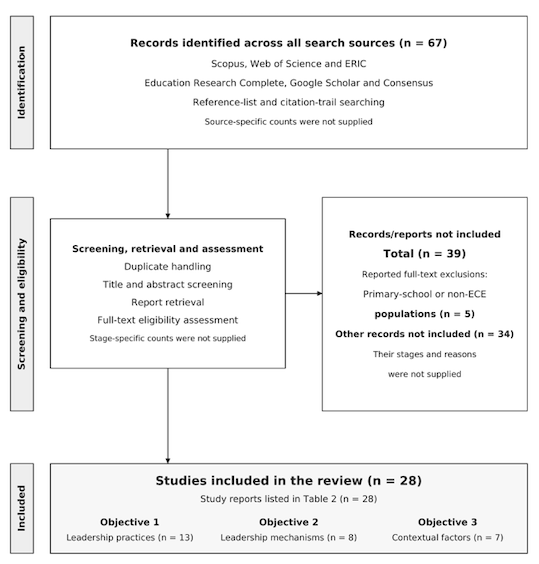
The PRISMA 2020 flow diagram summarises the study selection process. Only aggregate totals could be verified: 67 records were identified across all sources, 39 were not included and 28 studies were retained. Of these 28 empirical studies, 13 examined leadership practices, eight explored leadership mechanisms and seven addressed contextual factors influencing quality in early childhood education. Five reports were excluded at full-text screening because they focused on primary-school or other non-ECE populations.
The search covered Scopus, Web of Science, ERIC, Education Research Complete and Google Scholar. Targeted searches in Consensus, an AI-assisted index of peer-reviewed literature, were added to locate African ECE studies, and reference lists and citation trails were also searched. Records retrieved through Consensus were checked against publisher pages and DOIs. The search strategy combined three conceptual blocks (leadership, early childhood education and quality improvement) using Boolean operators: ("educational leadership" OR "school leadership" OR "instructional leadership" OR "pedagogical leadership" OR "distributed leadership" OR "early childhood leadership" OR "centre leadership") AND ("early childhood education" OR ECE OR ECEC OR preschool OR kindergarten) AND ("quality improvement" OR "process quality" OR "structural quality" OR "teaching quality"). The search covered literature published from 2015 to 2026. Older methodological sources were retained as foundations where appropriate, following PRISMA-S guidance on documenting sources, strategies and supplementary procedures (Rethlefsen et al., 2021).
Data were extracted into the standardised matrix under author(s), year, country or context, study design, sample, and key findings on leadership practices, mechanisms or contextual factors, in line with the three objectives (see Tables 2–5).
Searches were run across several platforms, and the export logs were not retained, so source-specific and stage-specific counts could not be reconstructed. Figure 1 therefore presents a reduced PRISMA 2020 flow diagram that reports only the totals available (see Limitations). Screening proceeded in stages: duplicate and relevance checks, title and abstract screening for eligibility, and full-text assessment of the evidence on leadership practices, mechanisms, contextual conditions or barriers. This process yielded 28 studies for thematic synthesis. The included studies used quantitative, qualitative, mixed-methods, and intervention designs and came from Europe, Oceania, North America, Asia, the Middle East , and Africa.
Analytical Framework
Data were analysed using thematic synthesis (Thomas & Harden, 2008). Findings were coded line by line and developed into analytical themes aligned with the three objectives. Figure 2 shows the conceptual framework that guided coding, informed by Douglass (2019) and OECD (2020). Leadership practices formed the exposure construct, mechanisms the mediating constructs, quality outcomes the outcome constructs, and contextual conditions the moderating constructs. No statistical model was estimated, and effect statistics are reported as stated in the source studies.
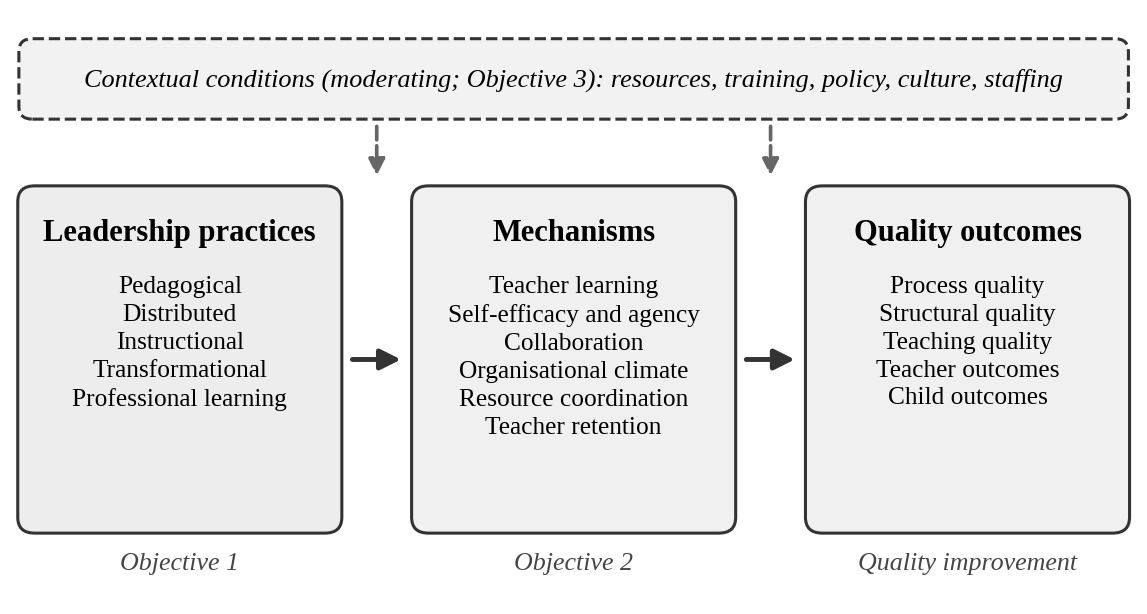
Note. Arrows show the assumed direction of influence; dashed arrows show moderation by context.
Results
The 28 studies, all published between 2020 and 2026 although the eligibility window opened in 2015, comprised 14 quantitative, 10 qualitative and one mixed-methods study, together with three intervention or programme evaluations. Asia and the Middle East contributed 10 studies, Oceania and Africa five each, Europe four and North America three; one study compared Finland with South Africa (Figure 3).
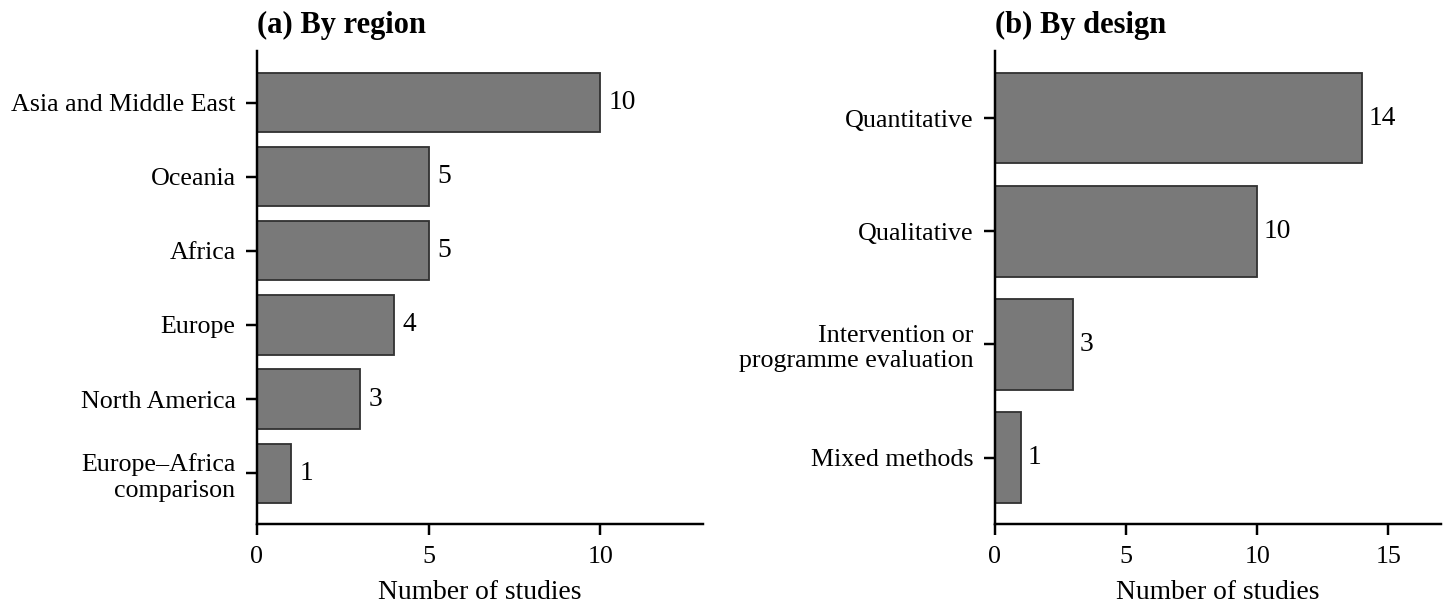
Note. Counts are drawn from Table 2. Design categories are mutually exclusive.
Leadership Practices
This subsection examines how specific leadership practices relate to ECE quality outcomes. Table 3 summarises the main quantitative and intervention evidence.
| Source | Results |
|---|---|
| Uzliva et al. (2025) | Principal leadership had a positive, significant effect on service quality (β = 0.79, p < .001). |
| Alnuaimi et al. (2025) | Heuristic leadership was positively related to the quality of inclusive practices. |
| Syarifudin & Muttaqin (2025) | Digital leadership, tech-supported management and play-based learning each significantly predicted quality improvement; play-based learning was strongest. |
| Shah et al. (2023) | Leadership played a significant role in promoting early childhood care and education, including parental involvement. |
| Adegoroye et al. (2025) | Head teachers’ communication and motivation skills were reported to improve caregiver performance. |
| Siraj et al. (2023) | A leadership-for-learning trial significantly improved teaching quality and children’s language, numeracy and social-emotional outcomes. |
Pedagogical leadership emerged as a recurring theme. Fonsén et al. (2022) found that Finnish pedagogical leadership was associated with children’s involvement in learning, positive emotions, physical activity and participation, while Heikka et al. (2020) found that staff expertise and pedagogical development were generally treated as central tasks in Finnish leadership plans. Distributed leadership was a second prominent practice. Denee and Thornton (2021) found that leadership in high-quality New Zealand ECE services was understood as a practice that teachers could also exercise, and Heikka et al. (2025) associated distributed responsibilities, shared vision and distributed participation in pedagogical development with different dimensions of quality. Zhou and Fenech (2022) found that distributed and transformational leadership enabled continuing improvement in highly rated Australian centres. Professional learning was a third principal practice. Siraj et al. (2023) provided experimental evidence (Table 3). Bratsch-Hines et al. (2023) found that a professional learning initiative based on distributed leadership improved educators’ knowledge and interaction quality and promoted equity of voice, and Denee (2023) found that networked professional learning could support distributed leadership and the application of new learning. The Nigerian evidence was more limited: Adegoroye et al. (2025) linked head teachers’ communication and motivation to caregiver performance, but used descriptive statistics.
Leadership Mechanisms
Table 4 summarises studies of the pathways through which leadership operates.
| Source | Results |
|---|---|
| Larosa et al. (2025) | Instructional leadership had a positive, significant effect on teacher professionalism and self-efficacy. |
| Kurniasih and Suparno (2025) | Leadership (β = 0.61) and self-efficacy (β = 0.36) significantly predicted teaching performance, jointly explaining 78.3% of variance. |
| Fairos & Mydin (2022) | All dimensions of transformational leadership positively influenced teacher self-efficacy. |
| Kim & No (2024) | Collaborative activities mediated the link between principal leadership and teacher-child interaction, via self-efficacy. |
| Kang et al. (2020) | Directors’ leadership and organisational climate significantly predicted teacher professionalism. |
| Markowitz et al. (2026) | Teachers’ perceptions of leadership were linked to interaction quality, intentions to stay and retention. |
Leadership affected quality mainly through educator learning and collaboration. Fabry et al. (2022) found that pedagogical leaders fostered sustainable change through relational trust, communities of practice, teacher empowerment and early-childhood champions. Lee et al. (2022) reported that a leadership development initiative strengthened educators’ leadership confidence and change-agent role, and Bratsch-Hines et al. (2023) associated distributed professional learning with equity of voice and better interaction quality. Heikka et al. (2025) further found that distributed leadership was associated with structural-quality dimensions such as physical environments and human resources, whereas shared vision and distributed pedagogical development were related to process quality and child wellbeing. Leadership therefore appears to operate across both structural and process dimensions.
Contextual Factors
Table 5 summarises the studies examining contextual influences on leadership.
| Source | Results |
|---|---|
| Fonsén et al. (2024) | Pedagogical leadership stayed central in Finland and South Africa, but practices and challenges differed by context. |
| Brandisauskienė et al. (2024) | Distributed leadership explained 61.3% of variance in curriculum quality; collaboration mattered most. |
| Yang & Lim (2023) | Staff shortages, power struggles and policy changes constrained distributed pedagogical leadership. |
| Ngare (2024) | Head teachers supported quality through resource management; limited training, government support and sociocultural factors constrained them. |
| Blose & Muteweri (2021) | Principals’ leadership was constrained by scarce resources, community expectations and uneven regulation. |
| Ackah-Jnr (2022) | A headteacher’s scaffolding leadership coordinated school and community actors for inclusive practice. |
| Gioko & Mongina (2025) | A leadership course increased instructional leadership, mentoring and collaborative planning, but resource barriers persisted. |
Leadership practices are not context-free. A pedagogical focus persisted across settings, but resources, training, staffing and policy shaped what leaders could achieve. The five African studies were qualitative, mixed-methods or descriptive, and only Gioko and Mongina (2025) evaluated a leadership development programme.
Discussion
The findings indicate that educational leadership contributes to ECE quality mainly through indirect, relational and capacity-building routes rather than through administration. Leaders shaped the professional and organisational context in which teachers taught, collaborated and reflected on their practice. Pedagogical guidance, shared decision-making, professional learning, relational trust and a common educational vision recurred across the studies as the means through which leadership was translated into better educational processes. Heikka et al. (2025), who examined distributed pedagogical leadership and the structural and process aspects of quality among 453 staff members in Finland, support this account. Pedagogical leadership also kept the educational purpose of ECE at the centre of organisational decision-making, in contrast to leadership centred on administration and compliance (Fonsén et al., 2022; Heikka et al., 2020).
The evidence also suggests that leadership is a collective process in which educators participate in improvement, rather than a one-way flow from decision to implementation. Denee and Thornton (2021) identified trust, mentoring and collaboration as the elements of distributed leadership in high-quality New Zealand services, and Fabry et al. (2022) identified pedagogical leadership, relationships of trust, communities of practice and teacher empowerment as the elements of the pedagogical leader’s role in sustaining change. The strongest causal evidence comes from the cluster randomised controlled trial by Siraj et al. (2023), which covered 83 services and 1,346 children and in which leadership-oriented professional development improved teaching quality and children’s language, numeracy and social-emotional outcomes. The meta-analysis by Egert et al. (2020), which found positive effects of professional development on the quality of teacher-child interaction, points in the same direction, although it concerns professional development in general rather than leadership. The trial is, however, a single study conducted in one country, and the remaining evidence is largely correlational, cross-sectional or qualitative; the causal claim should therefore be held with caution.
These results add to existing evidence that ECE quality is multi-dimensional (Ha et al., 2025; von Suchodoletz et al., 2023) and extend earlier work on distributed leadership. Collaboration emerged as a recurring point of emphasis. In Lithuania, distributed leadership accounted for 61.3 per cent of the variance in perceived curriculum quality among 461 educators, with collaboration the most influential element (Brandisauskienė et al., 2024), and Heikka et al. (2025) linked distributed responsibilities to structural quality and shared vision to process quality. The evidence diverges, however, on what distribution achieves. Yang and Lim (2023) found that staff shortages and power struggles in Singapore constrained distributed pedagogical leadership, which suggests that distribution without support may increase responsibility without increasing capacity. The contrast with the Lithuanian and Finnish findings may reflect differences in staffing, institutional structures and policy conditions, but the included studies do not test this directly. Lee et al. (2022) add that leadership capacity can be built deliberately and need not rest with formal leaders alone.
Leadership was also linked to staff retention. Markowitz et al. (2026), using data from early learning sites in Louisiana, found that teachers’ perceptions of leadership were associated with teacher-child interaction quality and with teacher retention. Leadership may therefore affect quality in two connected ways: through the quality of teacher-child interaction and through work environments that help skilled teachers to stay.
Leadership Practices and Mechanisms
A continuous professional learning culture tied to real instructional problems was the best-supported leadership practice (Bratsch-Hines et al., 2023; Egert et al., 2020; Siraj et al., 2023). Teacher collaboration was a second mechanism. Kim and No (2024) showed that collaborative activities mediated the relationship between principal leadership and teacher-child interaction, which suggests that principals shape interaction quality indirectly. This pathway resembles findings from wider school contexts, where collaboration and collective efficacy transmitted the effect of principal leadership to teacher self-efficacy (Karakose et al., 2024; Xie et al., 2022). Teacher self-efficacy and agency formed a third mechanism, consistent with Kang et al. (2020), who found that directors’ leadership and organisational climate predicted teacher professionalism. Taken together, the studies suggest a sequence in which shared vision supports professional learning and collaboration, these in turn strengthen teacher knowledge and agency, and the result is better classroom interaction and, under supportive conditions, higher teacher retention. This sequence is inferred from separate studies, and no single included study tested it.
Contextual Differences, Particularly African Contexts
Leadership is strongly situational. Much of the strongest evidence comes from Finland, Australia, New Zealand, Singapore and South Korea, where professional structures are comparatively well developed, so the findings generalise only cautiously to African contexts, where such structures are less developed. In South African townships, leadership in early childhood development (ECD) centres was not confined to a pedagogical role, and scarce resources and community expectations constrained it (Blose & Muteweri, 2021). In Kenya, Ngare (2024) found that inadequate training, limited government support, and sociocultural factors restricted what leaders could contribute to teaching and learning, suggesting that leadership development cannot indefinitely offset structural failures. Other African studies illustrate both the potential and the limits of leadership in these settings. A Ghanaian head teacher coordinated school and community actors to sustain inclusive practice (Ackah-Jnr, 2022), and a practice-based course moved teachers-in-charge in Kenya, Uganda and Tanzania towards instructional leadership, although resource limits persisted (Gioko & Mongina, 2025). The only included Nigerian study relied on descriptive evidence (Adegoroye et al., 2025). The Singaporean case (Yang & Lim, 2023) shows that such constraints are not confined to Africa, since staff shortages and policy changes also limited distributed leadership there. Leadership practices therefore need to be tailored to local conditions, and locally led African research on leadership is needed (Blose & Muteweri, 2021; Fonsén et al., 2024; Ngare, 2024).
Implications for Theory, Practice and Policy
For theory, the findings support an indirect-effects account of the link between leadership and quality. On this account, leadership influences quality by building teacher learning, self-efficacy and collaboration (Kim & No, 2024; Kurniasih & Suparno, 2025; Larosa et al., 2025), and distributed leadership appears to depend on teacher capacity and support (Kim & No, 2024; Yang & Lim, 2023). Leadership theories that treat the leader’s own behaviour as the main explanatory variable therefore need to incorporate teacher-level mediators and contextual moderators, as in the framework shown in Figure 2.
For practice, the findings suggest several concrete strategies for school leaders. Leaders can keep pedagogical purpose at the centre of planning, as the Finnish leadership plans did (Heikka et al., 2020). They can structure collaborative activities among teachers, which mediated the effect of principal leadership on teacher-child interaction (Kim & No, 2024), and sustain communities of practice and mentoring (Denee & Thornton, 2021; Fabry et al., 2022). When responsibility is distributed, it must be matched with support, because distribution without capacity may add to workloads rather than improve quality (Yang & Lim, 2023). Leaders can also treat teacher retention as a quality concern, since teachers’ perceptions of leadership were linked to their intentions to stay (Markowitz et al., 2026). The strategy that suits a given setting will depend on its resources, staffing, and policy context.
For policy, leadership preparation should be embedded in quality-improvement work and supported by ongoing professional learning and mentoring, rather than delivered as a single training event (Gioko & Mongina, 2025; Siraj et al., 2023). Training alone cannot remove structural constraints. Where resources are scarce, as in the Kenyan and South African settings reviewed here, policy must also provide funding, staffing, and regulatory support alongside leadership development (Blose & Muteweri, 2021; Ngare, 2024).
Limitations
This review has some limitations. First, most included studies came from Finland, Australia, New Zealand, Singapore, South Korea and Indonesia, and leadership-specific empirical research from Sub-Saharan Africa was limited to five mostly descriptive studies. Second, heterogeneity in designs, leadership conceptualisations and quality measures made statistical pooling inappropriate, so the review relied on narrative thematic synthesis rather than meta-analysis. Third, most quantitative studies (for example, Uzliva et al., 2025; Alnuaimi et al., 2025; Larosa et al., 2025; Kurniasih & Suparno, 2025) were correlational or cross-sectional, so causal claims about the effect of leadership on quality cannot be made with confidence. Fourth, several quantitative studies had modest sample sizes and relied on self-reported measures of leadership and quality, which may introduce common-method bias. Fifth, the export logs from the searches were not retained, so stage-specific counts could not be reconstructed, and Figure 1 reports only aggregate totals.
Several features of the review’s design limited the effect of these constraints. Narrative thematic synthesis allowed studies with different designs and measures to be compared without imposing a common effect metric, and effect statistics were reported as stated in the source studies. Claims were calibrated to the strength of the evidence: causal language was confined to the cluster randomised trial by Siraj et al. (2023), the sequence linking leadership to teacher learning, collaboration and retention was presented explicitly as an inference from separate studies, and the African findings were described as descriptive rather than causal. Retrieval was extended beyond bibliographic databases through reference lists, citation trails and targeted searches for African ECE studies, and records retrieved through Consensus were checked against publisher pages and DOIs. All 28 studies were screened against the same inclusion criteria and extracted into a single standardised matrix that recorded each study’s design, sample, measurement method and stated limitations, so that methodological weaknesses remained visible when findings were compared.
The findings nevertheless remain relevant, for three reasons. First, the same mechanisms (professional learning, collaboration and teacher self-efficacy) recurred across experimental, quantitative and qualitative designs and across Europe, Oceania, Asia, North America and Africa, and convergence of this kind is less likely to reflect the weakness of any single design. Second, the single randomised trial, although limited to one country, points in the same direction as the correlational and qualitative evidence. Third, the thinness of the African evidence does not invalidate the review. It identifies where the findings should be applied with most caution and where locally led research is most needed.
Conclusion
The claim that school leadership drives quality improvement in early childhood education in a substantive, non-administrative way was largely supported. Across the three objectives, leadership practices, mechanisms, and contextual conditions were linked to process and structural quality indicators, teacher self-efficacy, collaboration, and, in the African studies, community coordination, instructional practice, and quality management. Support was strongest for the mechanisms objective (Objective 2), where quantitative evidence linked leadership to teacher self-efficacy and collaboration. For the contextual objective (Objective 3), support was more descriptive than causal, because the African evidence was qualitative, mixed-methods or descriptive.
Leadership influenced quality chiefly through teacher self-efficacy, collaboration and professional learning, and the strength of that influence depended on resources, staffing and policy conditions. This pattern suggests that leaders matter for ECE practice because they shape the conditions, professional relationships and organisational climate in which teaching and learning occur, rather than simply administering programmes. For Nigeria and the wider African context, the evidence remains small and largely descriptive (Ackah-Jnr, 2022; Adegoroye et al., 2025; Blose & Muteweri, 2021; Gioko & Mongina, 2025; Ngare, 2024).
This systematic review suggests that school and educational leaders contribute substantially to quality improvement in early childhood education. Leadership affects quality through teachers, professional relationships and organisational processes, not through authority and administration alone. Pedagogical leadership, distributed decision-making, professional learning, collaboration, relational trust and a shared vision characterised effective leadership across the studies.
Pedagogical leadership is especially significant because it links leadership more directly to curriculum implementation, teaching practice and children’s learning and wellbeing. Distributed leadership supports the same process by giving teachers a real voice in decision-making. The mechanisms are interwoven: professional learning, collaboration, self-efficacy, agency, climate, trust and resource coordination.
For practice and policy, leadership development should form part of broader quality-improvement efforts in early childhood education. Policymakers should also address staffing, infrastructure, funding and institutional support, particularly in under-resourced settings, where contextual factors may prevent leaders from implementing effective practices.
References
Rights and permissions

Disclaimer
All claims expressed in this article are solely those of the author and do not necessarily represent those of the publisher, editors, reviewers, or affiliated institutions. Any product, service, or claim that may be evaluated in this article is not guaranteed or endorsed by the publisher.
Publisher’s note
The publisher remains neutral with regard to jurisdictional claims.
Declarations & editorial transparency
Data availability
Data availability is not applicable to this article because no new data were created or analysed.
Funding
This research received no specific grant from any funding agency in the public, commercial, or not-for-profit sectors.
Ethics declarations
Ethics approval was not required for this study.
Conflict of interest
The authors declare that they have no competing interests.
Peer review statement HRL Journal Service Policy
HRL Journal Service uses the following process for manuscripts sent for external peer review. An associate editor screens scope and eligibility; an academic editor assesses subject relevance and scholarly quality. The Editor-in-Chief and academic editor appoint suitable reviewers and manage conflicts of interest. Review is double blind: author and reviewer identities are concealed from one another during review. Authors respond to the feedback, with further review where needed. Once satisfied with the revisions, the academic editor recommends approval and forwards the manuscript for copyediting, reference checks and correction of typographical errors. The Editor-in-Chief makes the final publication decision. Article-specific review records and any exceptions are reported separately below.
Article-specific review status not recorded
Academic editor names are published according to the journal’s disclosure policy and the editor’s consent. An editor may request non-display; authors may raise a reasoned concern, which the journal assesses for privacy, safety and conflicts of interest. A missing name alone does not establish the reason for non-display or imply an ethics concern. Reviewer anonymity during double-blind review is a separate matter.
AI use & language assistance HRL Journal Service Policy
Authors and copyeditors may use language-assistance tools, including Grammarly, to improve spelling, grammar and readability under human supervision. Edits must preserve scientific meaning, uncertainty and the authors’ interpretation. Authors remain responsible for the accuracy, originality, references and integrity of their work; AI tools cannot qualify as authors or replace editorial judgement. Authors must disclose AI assistance at submission. Generative rewriting, content creation or use in research methods, analysis or figures requires an article-specific statement identifying the tool and its purpose; no use may fabricate data, sources or findings. Confidential manuscripts and personal data must not be shared with external tools without appropriate permission and confidentiality safeguards. This shared policy does not establish whether a tool was used in this article; any supplied article-specific disclosure appears below.
No separate AI-use disclosure has been supplied in this record. This does not establish that AI was or was not used.
Publication timeline
Recorded milestones for this article. Only supplied dates are shown.
- Received
- Revised
- Accepted
- Published
How the HRL review process works
The standard route for manuscripts sent for external peer review; this illustration does not certify individual stages or supply missing dates.
- 01Scope & eligibilityAssociate editor
- 02Subject assessmentAcademic editor
- 03Double-blind peer reviewReviewers appointed by the editorial team
- 04Revisions & academic approvalAuthors respond; academic editor evaluates
- 05Copyediting & reference checksCopyeditor
- 06Final publication decisionEditor-in-Chief
 Publication record
Cite this article
Share this article
Share the article record with colleagues and readers worldwide.
Explore research across our journalsDiscover more research

Recent Publications

Most Read

Recommended
Save this article as a bookmark
Use your browser’s secure bookmark shortcut. Both desktop options are shown below.
Press Ctrl+D
In Chrome, Edge or Firefox, choose a folder if needed, then select Done.
Press ⌘ Command+D
In Safari, Chrome or Firefox, choose the bookmark location and confirm.
Add to Mendeley
Save this article’s reference using either option below.
Import a reference file
Download the RIS file, then import it in Mendeley Reference Manager using Add new → Import library, or drag the file into your library.
Download RIS for MendeleyUse Mendeley Web Importer
With the extension installed, return to this article and select the Mendeley icon in your browser toolbar. Review the detected reference before saving.
Get the official Web ImporterYou choose what to import. Opening this dialog does not sign you in or send article content to Mendeley.
Cite this article
Copy a formatted citation or download a reference file.
Cited by
Crossref citation count for this DOI.