

Indigenous Religious Knowledge and Environmental Ethics Stewardship
A Case of the Wakara in Ukara Island
Abstract
This article reconstructs how Wakara religiosity in Ukara Island constitutes a coherent moral ecology that binds Wakara religiosity to environmental practice. Using a hybrid design ethnographic case study integrated with African philosophical analysis the article synthesizes 58 participants’ testimonies (KIIs, FGDs, observation) into four interrelated domains: (i) totemic reverence for isatu (python) that sacralizes species and landscapes; (ii) animistic engagements with sacred stones (Bulebeka, Mkwaya) whose perceived agency organizes healing, obligation, and place based restraint; (iii) taboos over sacred waters (lijibha) where spiritual sanctions and mythic enforcement create effective community water governance; and (iv) ritual life (cleansing, death practices, sacred woodlots) that translates cosmology into embodied environmental limits. The findings validate a metaphysics, axiology, deontology chain: beliefs generate value commitments (life, purity, danger) that issue in binding duties (taboos, ritual prohibitions). The article’s novelty lies in documenting intensified Wakara religiosity ecologies (vital force loss, responsive sacred objects), ethically ambivalent conservation, and intergenerational ritual governance advancing biocultural conservation and African eco philosophy.
Introduction
Across contemporary African scholarship, there is growing recognition that Indigenous religious worldviews constitute sophisticated ecological knowledge systems rather than remnants of pre‑modern superstition. African Indigenous Religions (AIR) have long been documented as embedding environmental values in African Religious beliefs such as sacred species, animistic presence, ancestral agency, taboo‑governed landscapes, and ritual governance. Recent work emphasises that these systems form deeply relational ontologies that structure human responsibilities toward land, water, animals, and sacred places (Nche & Michael, 2024). Increasing evidence shows that Indigenous institutions totems, sacred groves, tabooed waters, and ritual custodianship can function as effective environmental management regimes precisely because they are grounded in spiritual authority rather than statutory law (Kanu & Ndubisi, 2022; Sinthumule, 2024).
In this broader intellectual landscape, the Wakara of Ukara Island present a compelling case. Their cosmology sacralises species such as the python (isatu), animates objects like Bulebeka and Mkwaya, governs water sources through strict taboo systems, and organises ritual life through cleansing practices, death rites, and sacred woodlots. These beliefs coincide with ecological effects woodlots protected from logging, catchments preserved through taboo, species safeguarded through spiritual reverence, and ritual sites conserved through communal fear or respect. Such dynamics reflect what African environmental thought identifies as Indigenous “moral ecologies”: systems in which Wakara religiosity ideas about life‑force, purity, danger, and ancestral presence translate directly into ecological restraint and environmental care (Amanze, 2024).
However, unlike many accounts that treat African religiosity generically, this article provides a fine‑grained reconstruction of how African religious categories are embodied, transmitted, contested, and ecologically enacted within a single community. The Wakara case demonstrates that sacred species, taboo waters, animistic stones, and ritual landscapes form an integrated moral and ecological framework one that continues to function despite demographic change, youth knowledge erosion, and the coexistence of Christianity and Islam. By situating these findings within contemporary debates on Indigenous environmentalism, sacred ecologies, and spiritual governance, the article argues that Wakara religiosity is not merely cultural heritage, but a living ecological ethic embedded in practices that sustain biodiversity, regulate extraction, and maintain communal wellbeing.
The central claim of this article is that Wakara religiosity constitutes a coherent moral ecology in which African religious beliefs expressed through totemism, animism, taboo systems, and ritual life generate axiological commitments and deontic constraints that structure environmental stewardship in Ukara Island.Accordingly, the objective of the article is threefold: (i) to reconstruct the religious foundations of Wakara religiosity; (ii) to analyse how these beliefs produce shared moral valuations of species, places, purity, and danger; and (iii) to demonstrate how these valuations translate into concrete ecological obligations expressed through taboos, rituals, sacred‑site governance, and everyday environmental practice.
Literature Review
2.1 Totemic Beliefs and Sacred Species
Totemism has re‑emerged in contemporary African scholarship as a critical axis for understanding the intersection of Indigenous spirituality, ecological ethics, and cultural identity. Recent analyses emphasise that totems are not merely emblematic markers of clan belonging but function as religious guardians regulating human interaction with the natural world. Mandillah and Ekosse’s (2018) study on totems in Kenya and South Africa confirms that sacred species are protected due to their spiritual associations, which are reinforced by taboos preventing their harm or consumption, resulting in long-term biodiversity preservation. Their examination reveals that totemic animals retain cultural and ecological significance even in communities experiencing rapid social transformation, illustrating that totemism actively shapes the ethical landscape of resource use. This holistic integration of Wakara religious belief and ecological function mirrors patterns found across sub-Saharan Africa, demonstrating the persistence and adaptive resilience of Indigenous ecological knowledge.
The conservation implications of totemism are further substantiated by comprehensive reviews of sacred landscapes. Rai and Mishra (2024) argue that sacred landscapes including totemic species territories are sites where Indigenous ecological knowledge intersects with spiritual authority to produce sustainable resource management practices. Their work shows that communities conceptualise sacred landscapes as socio-symbolic environments where ritual activity, moral restraint, and ecological care intertwine. This insight helps explain why totemic species such as the python (isatu) in Wakara cosmology confer protection not only on themselves but on the habitats, they occupy, anchoring ecological behaviour within the African religious worldviews.
Recent empirical studies in Uganda confirm that totems directly influence wildlife conservation outcomes. Muyiira et al. (2025) document how Buganda totemic clans shape wildlife protection through spiritual norms that restrict hunting, harvesting, and disturbance of sacred species, creating zones of ecological stability within otherwise threatened habitats. Their cross-sectional analysis shows that totemic communities exhibit higher ecological awareness and stronger behavioural commitment to forest and species protection. These findings reflect broader continental patterns, establishing totemism as an Indigenous conservation mechanism rooted in ritual obligation, fear of spiritual sanction, and communal identity.
Scholars have noted that totemism also plays a pedagogical role in intergenerational transmission of ecological knowledge. Bhurekeni (2022) found that children who understand their clan totems exhibit higher levels of ecological reasoning and environmental stewardship, demonstrating that spiritual identity is tied to moral formation and ecological sensitivity in early childhood education. This aligns with Wakara concerns about younger generations misidentifying sacred species, highlighting how the erosion of totemic knowledge undermines both cultural continuity and biodiversity protection.
Additionally, contemporary philosophical literature situates totemism within African relational ontology. Kanu’s 2022 work on Indigenous ecological knowledge frames totemic species as religious entities that embody life-force, spiritual power, and moral authority, structuring community obligations toward ecological restraint. His argument that sacred species are “spiritualised ecological regulators” resonates strongly with the Wakara conceptualisation of isatu as a being capable of conferring misfortune or diminished vitality when improperly encountered, reinforcing behaviours that preserve sacred habitats.
Finally, global environmental literature increasingly recognises totemic systems as “shadow conservation networks.” Pearce (2023) describes sacred-species territories across Africa as ecologically intact zones that persist despite the absence of formal conservation frameworks because spiritual prohibitions function as persistent governance mechanisms. This conceptualisation captures the essence of Wakara totemism, in which sacred species serve as Africanreligious anchors for the protection of forests, hills, and woodlots, functioning as de facto conservation areas driven by spiritual belief rather than statutory law.
2.2 Animistic Beliefs and Sacred Objects
African animism has garnered renewed scholarly attention as an ontological system that attributes agency, vitality, and moral significance to natural objects, generating powerful ecological ethics. Kanu’s African Indigenous Ecological Spirituality framework describes animism as a tradition that conceptualises nature as spiritually alive, interconnected, and morally responsive, offering an alternative paradigm to Western notions of inert materiality. This relational framework provides a compelling lens through which to understand Wakara beliefs in Bulebeka and Mkwaya, where stones are treated as spiritual presences capable of responding to human petition, offering healing, or imposing sanctions.
Contemporary eco-spirituality research reveals that animistic beliefs constitute the backbone of Indigenous religious ecologies across Africa. Ogolla and Karanja (2026) document the rise of eco-spirituality movements across the continent, tracing them to Indigenous cosmologies that consider natural objects, stones, forests, hills, rivers as dwellings of spiritual beings or embodiments of sacred presence. Their work demonstrates that ecological activism emerging from African religious traditions is grounded in African religious beliefs about the personhood of the natural world. This theoretical development strongly supports Wakara claims that sacred stones “shake” when called upon, indicating a recognised spiritual responsiveness embedded in landscape features.
Sacred stone traditions in African mythology further illuminate the cosmological role of animistic landscapes. The “Myth of the Stone” research (2025) identifies sacred rocks as mediators between humans and ancestors, channels of divine communication, and repository sites for mythic histories across multiple African societies. Such interpretations closely mirror Wakara conceptualisations of Bulebeka and Mkwaya as spiritually endowed objects whose proper engagement maintains community wellbeing.
Scholars emphasise that animistic sacred objects often function as ecological refugia. Nature Research Intelligence (2025) shows that sacred natural objects often foster ecological stability because their sacrality restricts deforestation, quarrying, or agricultural conversion, preserving native vegetation and ecological processes. Wakara sacred stones are surrounded by intact vegetation, confirming this pattern and demonstrating how animistic belief translates into practical environmental preservation.
Ecological governance literature increasingly views animism as an Indigenous environmental management system. Nche and Michael’s 2024 article on African Indigenous Religion and the environment argues that sacred objects anchor communal norms, moral expectations, and behavioural constraints, effectively regulating environmental use through spiritual authority rather than external enforcement. This resonates with Wakara practices in which offerings, prayers, and behavioural restrictions around Mkwaya or Bulebeka maintain both moral order and ecological protection.
Finally, animism contributes to intangible cultural heritage preservation. Rai and Mishra (2024) note that sacred objects are not merely religious symbols but cultural institutions that embody historical narratives, ecological knowledge, and collective identity, enabling communities to sustain socio-ecological memory even amid modern pressures. Wakara sacred stones therefore represent more than spiritual actors; they are cultural archives anchoring community identity, ecological ethics, and intergenerational continuity.
2.3 Taboos, Sacred Waters and Spiritual Sanctions
Contemporary scholarship widely recognises African taboo systems as robust Indigenous ecological governance frameworks. Kanu (2023), writing on the nexus of African religion and environmentalism, argues that taboos derive their regulatory power from spiritual authority, shaping behaviour through African religiosity deterrence rather than codified law. This resonates with Wakaralijibha, where strict prohibitions against washing, fishing, vegetation cutting, or speaking loudly protect sacred water bodies through fear of ancestral retribution.
Indigenous water governance studies reinforce this understanding. Masika et al. (2022) document how Luo and Banyala communities in Kenya maintain sacred wells and water catchments through traditional norms that forbid polluting activities and prescribe ritual engagement with water sources. Their work demonstrates that such practices produce measurable ecological benefits, mirroring Wakara observations that water from Kwabhuki remains pure due to ritualised methods of collection and restricted access.
UNESCO’s 2025 Indigenous water knowledge report emphasises that many African communities conceptualise water as a living entity, cultural archive, and moral teacher, resulting in sustained, community-led conservation initiatives grounded in spiritual meaning. This ontology aligns with Wakara hydro-spirituality, where wells like Kwabhuki or Mwikokwe are treated as abodes of spiritual beings whose power determines health, misfortune, or community wellbeing.
Ayeni et al.’s “Hydro-Epistemology” (2026) further advances this perspective by framing African water imagination as a knowledge system based on flow, memory, and ritual engagement. Their research shows that rivers and wells act as mediators between the living, ancestors, and the divine, shaping ethical water use through ritual, silence, and moral reverence. This conceptualisation is directly reflected in Wakara healing rituals, requiring silence and non-retrospection when collecting sacred water.
Environmental governance literature also underscores the significance of customary authority in ecological stewardship. Schwaiger et al. (2024) find that customary leaders play pivotal roles in managing, enforcing, and supporting environmental norms across sub-Saharan Africa, with tabooed landscapes showing particularly strong governance outcomes. Wakara elders and custodians of lijibha enact similar roles, ensuring compliance through spiritual authority rather than statutes.
Finally, Indigenous wetlands conservation research confirms that taboos, myths, and sacred traditions maintain ecological stability in the absence of formal governance frameworks. Mureri et al. (2026) show that sacred wetlands in Zimbabwe are preserved through spiritual restrictions, mythic narratives, and ritual practices that reinforce socio-ecological resilience. This parallels Wakara belief that violating Mwikokwe taboos leads to catastrophic consequences, illustrating how spiritual sanction functions as a powerful conservation deterrent.
2.4 Ritual Life, Cleansing, Death Practices and Sacred Woodlots
Current African scholarship positions rituals as central mechanisms through which religious principles, community ethics, and environmental care are enacted. Mphephu et al. (2025) demonstrate that death-cleansing rituals across African societies serve as moral technologies for restoring spiritual equilibrium, managing pollution, and guiding behaviour around dangerous or sacred sites. This framework strongly aligns with Wakara cleansing rituals (jamalalufu, kukwera), which preserve sacred woodlots and regulate behaviour around sites associated with dangerous deaths (lichumu).
Studies on sacred groves underscore the ecological significance of ritual landscapes. Imarhiagbe and Ogwu (2022/2024) show that sacred groves across the Global South function as in situ biodiversity reservoirs, protected for centuries due to their spiritual significance, ritual prohibitions, and mythic histories. Wakara ritual woodlots, where twins and other ritually dangerous individuals were historically placed, similarly remain untouched due to ritual fear, demonstrating how ritual significance protects landscape integrity.
Generational research highlights the fragility and resilience of ritual governance systems. Mgaya (2026) documents how sacred grove management among the Bena of Tanzania is threatened by generational shifts, material pressures, and youth disengagement, but also notes emerging hybrid conservation approaches combining spiritual and ecological rationalities. Wakara concerns about declining ritual adherence echo these continental patterns, revealing the vulnerability of ritual landscapes in the face of sociocultural change.
Ecological spirituality scholars further emphasise that rituals embody Wakara religiosity translating spiritual values into concrete ecological practices. Nche and Michael’s (2024) analysis of African Indigenous Religion shows that rituals create behavioural boundaries, reinforce communal cohesion, and regulate environmental use through an African religious meaning rather than external enforcement. This provides a solid theoretical foundation for understanding Wakara rituals’ ecological functions.
Ethnobotanical literature reveals that ritual plant use contributes significantly to conservation. Manka et al. (2026) show that ritual reliance on trees and herbs preserves species that might otherwise be harvested or cleared, embedding ecological protection within ritual life. Wakara cleansing ceremonies that use herbs, leaves, and tree bark similarly sustain the preservation of specific ecological resources.
Finally, scholarship on Indigenous sacred geography positions ritual spaces rocks, wells, groves as foundational elements of environmental ethics. These ritual environments act as moral ecologies where religion danger, ancestral authority, and communal identity converge, shaping land-use patterns and sustaining ecological integrity. Wakara ritual landscapes thus exemplify a wider African pattern in which rituals serve as both spiritual obligations and ecological governance systems.
Methods
3.1 Research Design
This study adopts a research design that integrates a qualitative case‑study approach, ethnographic fieldwork, and philosophical analysis. A purely qualitative design would have been inadequate for a study of this nature because Wakara religiosity is not only a cultural system but also a Wakara religiosity and ethical framework that demands philosophical interpretation. Likewise, a strictly philosophical analysis would risk abstraction and ignore lived ritual contexts, ecological behaviours, and communal interpretations essential to understanding Wakara cosmology in practice. The hybrid design therefore enabled the researcher to move fluidly between empirical documentation through interviews, focus groups, and participant observation and conceptual analysis, drawing on African religiosity to examine how beliefs about ancestors, spirits, sacred species, taboos, and ritual purity generate moral obligations. This integrative approach allowed the study to illuminate not only what Wakara religious practices are, but also why they carry normative force and how they shape ecological stewardship across generations.
3.2 Study Area
Ukara Island, located in the eastern section of Lake Victoria in Tanzania, serves as the bounded social and ecological context for this study. Covering approximately 80 km², the island is characterised by a blend of rocky hills, freshwater catchments, sacred groves, thick woodlots, and densely settled agricultural homesteads. The Wakara people, the island’s primary ethno linguistic community, inhabit spatial environments that are deeply infused with religious meaning: forests may double as ritual spaces; stones such as Bulebeka or Mkwaya are treated as living presences; and wells or springs are governed by elaborate taboo systems. These sacred landscapes hold social, moral, and ecological authority, making them ideal for studying how the Wakara religious beliefs inform environmental behaviour.
Historically, the Wakara maintain a clan‑based system, with each clan acting as custodian of specific sacred sites, ritual practices, and ecological responsibilities. Social organisation revolves around lineage heads, councils of elders, and age‑graded responsibilities that govern land use, conflict mediation, ritual processes, and spiritual oversight. Economically, residents engage in small‑scale agriculture, artisanal fishing, livestock keeping, weaving, and Indigenous herbal medicine. Politically, village governments coexist with clan structures, producing a hybrid governance system in which spiritual authority and administrative authority intersect in everyday decision‑making. Religiously, the Wakara exhibit a plural landscape in which Indigenous cosmology exists alongside Christianity and Islam. Christian priests and Muslim sheikhs were included in the study not because they are custodians of ATR, but because their teachings and interactions influence ritual behaviour, sacred‑site reverence, and moral discourse among Wakara households. The study area thus presents a rich, multilayered context in which religion, ecology, and social organisation continually interact.
3.3 Study Population
The study population included individuals deeply enmeshed in Wakara religious life or custodians of knowledge relevant to sacred species, sacred sites, ritual practices, and ecological norms. Participants were drawn from six primary categories: elders, lineage heads, traditional healers, ritual specialists (including rainmakers and custodians of sacred wells or stones), adult community members, youth, and leaders of Christian and Islamic congregations. Elders were prioritised because they carry intergenerational memory, maintain ritual genealogies, and hold authority in taboo enforcement and ritual oversight. Traditional specialists were selected due to their expertise in healing, spiritual causation of illness, interpretation of misfortune, and ritual cleansing. Adult community members contributed perspectives on household‑level rituals, gendered taboos, and everyday environmental practices, while youth offered insight into knowledge erosion, reinterpretation of sacred species, and emerging value shifts. Religious leaders were included because Wakara religiosity is hybrid, and their interpretations often coexist rather than conflict with Indigenous cosmology. This inclusive population was necessary to capture the full spectrum of belief, practice, and negotiation that characterises contemporary Wakara religion.
3.4 Participant Demographics
A total of 58 participants were involved in the study. Table 3.1 below summarises their demographic characteristics, age distribution, gender composition, and social–religious roles.
| Category | N | Gender Distribution | Age Range | Roles Represented |
|---|---|---|---|---|
| Elders (FGDs + KIIs) | 18 | 13M / 5F | 55–87 | Clan custodians, lineage heads, ritual knowledge keepers |
| Traditional Specialists | 8 | 6M / 2F | 40–79 | Healers, rainmaker, ritual practitioners |
| Adult Community Members | 22 | 12F / 10M | 30–65 | Farmers, fishers, mothers’ groups, craft workers |
| Youth Representatives | 7 | 4M / 3F | 18–29 | Students, fishers, apprentices |
| Christian Leaders | 2 | 2M | 45–60 | Catholic priest, Lutheran pastor |
| Muslim Leader | 1 | 1M | 50 | Sheikh responsible for mosque community |
| Total Participants | 58 |
This table clarifies the structured nature of sampling, demonstrating that participants were intentionally distributed across age, gender, religious identity, and ritual authority. It directly addresses concerns that elders were not clearly identified or that sampling appeared haphazard.
3.5 Data Collection Methods
Data collection proceeded through in‑depth Key Informant Interviews (KIIs), Focus Group Discussions (FGDs), participant observation, and spatial–ecological documentation. These methods were selected to generate rich qualitative data, capture layered interpretations, and triangulate findings across individual, communal, and environmental perspectives.
3.5.1 Key Informant Interviews (KIIs)
Twelve KIIs were conducted with individuals recognised by their communities as custodians of ritual knowledge, interpreters of spiritual phenomena, or leaders in moral and ecological decision‑making. Table 3.2 summarises the categories of key informants.
| KII Category | Number | Role and Relevance |
|---|---|---|
| Clan Elders & Lineage Heads | 4 | Hold genealogical memory, interpret sacred species, oversee rituals |
| Traditional Healers | 3 | Experts in Indigenous medicine, vital‑force interpretation, healing rites |
| Rainmaker | 1 | Specialist in Wakara religiosity mediation of rain and climate events |
| Christian Leaders | 2 | Influence moral discourse; negotiate ATR–Christian boundaries |
| Muslim Leader | 1 | Provides Islamic ethical perspectives within a plural Wakara setting |
| Environmental Officer | 1 | Offers administrative insight on land use and conservation norms |
KII participants were reached through village chairpersons and councils of elders, who identified individuals with recognised authority over ritual processes, sacred sites, or religious teaching. This multi‑layer recruitment ensured cultural legitimacy and prevented random or self‑selected participation. Individuals were approached in their homes or ritual spaces, briefed on the study, and interviewed in semi‑structured sessions lasting 60–90 minutes. Interviews were conducted in Kikara or Kiswahili, depending on participant preference.
3.5.2 Focus Group Discussions (FGDs)
FGDs were conducted to explore shared knowledge, communal interpretations, and group reasoning around sacred beliefs, ritual systems, taboo enforcement, and ecological practices. Because Wakara religiosity is communal rather than individualistic, FGDs allowed insight into how beliefs are collectively negotiated and transmitted.
| FGD Type | Number | Participant Profile | Purpose |
|---|---|---|---|
| Elders’ FGDs | 2 | Men and women aged 55–87 | Discuss ritual history, taboos, sacred sites |
| Mixed Adult FGDs | 3 | Adults aged 30–65 | Explore household rituals, fishing/farming taboos |
| Ritual Specialist FGD | 1 | Healers, custodians, ritual mediators | Examine cleansing rites, spiritual causation |
| Women’s FGD | 1 | Women aged 30–60 | Explore gendered rituals, purity restrictions |
| Youth FGD | 1 | 18–29 years | Understand knowledge erosion and belief changes |
FGD participants were selected through household recommendations, women’s groups, youth networks, and elder nominations. This ensured that each discussion captured depth, experience, and generational continuity. Sessions lasted 90–120 minutes and involved storytelling, reflection, and explanation of ritual procedures.
3.5.3 Participant Observation
Participant observation allowed the researcher to directly witness ritual spaces, taboo boundaries, and ecological outcomes. The researcher visited sacred stones (Bulebeka, Mkwaya), taboo wells (Kwabhuki, Mwikokwe), python habitats, cleansing sites along the lake shore, and sacred woodlots. Observations captured how people behave in these spaces, the environmental conditions shaped by taboo restrictions, and the ways in which cosmology is embedded in daily practice. This method also permitted the verification of claims made during interviews, such as the pristine condition of Mwikokwe or the carefully preserved vegetation surrounding woodlots.
3.5.4 Spatial and Material Documentation
Sacred landscapes were photographed and mapped to analyse how belief structures shape ecological patterns. This included documenting plant density, erosion avoidance, absence of clearing, and indicators of long‑term site preservation. Spatial documentation strengthened triangulation by linking verbal accounts with visible environmental patterns.
3.6. Data Collection Instruments and Tools
The study employed a suite of carefully designed qualitative instruments that were specifically tailored to elicit the Wakara religiosity, ecological, and ritual dimensions of Wakara religiosity rather than rely on generic interview guides. These instruments were developed after preliminary engagement with community elders and leaders, who advised on culturally appropriate ways to ask about sacred species, taboo spaces, ritual objects, and cleansing practices. The aim was not merely to collect descriptive information, but to generate thick, conceptually rich accounts capable of supporting both ethnographic interpretation and philosophical analysis. The instruments therefore combined semi‑structured interview guides, focused group prompts, observation protocols, spatial‑mapping templates, and oral‑narrative elicitation frames each permitting participants to articulate not only what practices exist, but also why they hold Wakara religiosity authority and how they regulate ecological behaviour in Ukara Island.
The Key Informant Interview guide was crafted around open‑ended questions supported by layered sub‑questions designed to draw out deeply embedded knowledge. For example, the central question regarding sacred species“What makes the python (isatu) sacred?”included prompts that asked the interviewee to recount personal experiences, observed consequences of harming the python, and the ritual procedures required after contact with it. These follow‑up questions were critical in producing the detailed explanations found in the Findings, such as the belief in vital‑force depletion, the burning of clothing after contact, and the ritual isolation imposed on affected individuals. Similar structure was used for inquiring into sacred stones like Bulebeka and Mkwaya.
The general question“What is the significance of this stone?”was followed by more probing ones such as “Can it respond or move?”, “What offerings are expected?”, and “What happens when rituals are neglected?”. These sub‑questions enabled respondents to narrate stories about the stones’ movements, healing interventions, and the reciprocal relationship between people and sacred landscapes. Interviews regarding tabooed water sources were guided by questions that asked participants to detail specific prohibitions, recount oral histories of spiritual retribution, and explain healing procedures, thereby ensuring that layers of ritual sequencing and narrative detail were captured.
Focus Group Discussions were similarly guided by thematic prompts designed to stimulate collective reflection and intergenerational dialogue. FGDs began with broadly phrased opening questions for instance, “Tell us about creatures that your people consider sacred” or “Describe a place in your village where spirits dwell”which then transitioned into more specific follow‑up questions aimed at surfacing moral reasoning, communal experiences, and shared norms. These discussions proved indispensable for uncovering the social dynamics of taboo enforcement, the communal logic behind healing rituals, and variation in knowledge between elders and youth. The FGD instrument allowed participants to challenge each other, correct misremembered details, or expand on one another’s statements, thereby producing insight into how cosmology is negotiated collectively rather than individually. This tool was particularly useful in reconstructing the ritual use of woodlots, the fear associated with lichumu deaths, and the communal obligations around cleansing ceremonies.
Participant observation was guided by an observational protocol that helped ensure consistency across site visits. The protocol directed attention to the physical condition of sacred sites, the behavioural expectations governing movement around them, the presence of ritual objects, gendered patterns of access, and environmental indicators such as vegetation density or evidence of human disturbance. The approach permitted the researcher to recognise, for example, that Mwikokwe’s lush vegetation corroborated participant claims about strict taboo enforcement, or that python‑associated woodlots remained untouched due to their perceived spiritual danger. Observations were also essential for capturing unspoken norms, for instance, how individuals lower their voices when approaching a sacred stone, or how women avoid certain paths during cleansing cycles.
Spatial‑mapping instruments were used to record the geographical placement of sacred sites, ritual paths, tabooed wells, and woodlots. These tools allowed the researcher to document how belief systems are inscribed onto the landscape, where areas of ecological preservation correspond to zones of spiritual significance, and how ritual geography influences everyday movement on the island. Photographs and hand‑drawn maps created a record of spatial relationships between sacred objects, ecological features, and settlement patterns, enabling the integration of visual analysis with verbal testimony.
Finally, because Wakara cosmology is heavily encoded in stories, myths, proverbs, and ancestral narratives, an oral‑narrative elicitation tool was employed. This instrument consisted of prompts designed to invite personal storytelling rather than structured responses. Participants were asked to recount stories they heard from elders, describe remembered warnings or blessings associated with sacred sites, or narrate community events that confirmed or challenged ritual expectations. These narrative prompts yielded some of the most vivid data in the study, including the tale of the overflowing Mwikokwe well, the shaking of Bulebeka, and stories of misfortune following taboo violations.
Together, these instruments provided a methodologically robust foundation for capturing both the explicit and implicit dimensions of Wakara religiosity. They ensured that religious beliefs, ecological practices, ritual procedures, and moral expectations were elicited in culturally appropriate and analytically rich ways. The depth and specificity of the verbatim accounts presented in the Findings directly reflect the strength of these instruments, which were crafted to honour Indigenous knowledge systems while producing rigorous data for philosophical analysis.
3.7 Data Analysis
Transcripts from KIIs and FGDs were analysed using NVivo 14 through open coding, axial coding, and thematic formulation. First, open coding identified raw patterns in references to isatu, sacred stones, taboos, cleansing, death rituals, and vital force. Second, axial coding grouped related concepts such as spiritual pollution, ecological restraint, fear‑based conservation, ritual authority into analytic categories. Third, an African-religiosity–axiology–deontology framework was applied to interpret how religious claims (e.g., sacred species, animated stones) led to value commitments (purity, relational harmony) and moral obligations (taboos, rituals, sanctions). Salience percentages were computed by counting the frequency with which themes appeared across transcripts, thereby grounding thematic matrices in quantitative representation of qualitative data.
3.7 Ethical Considerations
Ethical approval was granted by local government authorities and councils of elders. Participants provided informed consent verbally and in writing. Cultural sensitivities were prioritised, especially concerning death rituals, sacred species, ritual sites, and taboo violations. Photographs were taken only where permitted, and all participants are anonymised using coded identifiers. Confidentiality was strictly maintained given the close‑knit nature of the Wakara community.
Findings
This section presents four interrelated domains of Wakara religiosity that collectively illustrate how African Religious beliefs, ritual authority, taboo systems, and sacred ecologies shape environmental ethics and social life in Ukara Island. Each domain is reconstructed into a thematic matrix consolidating keywords, verbatim accounts, and salience proportions, followed by analytic interpretation grounded in African eco‑philosophy and contemporary scholarship on Indigenous environmental governance. The matrices and figures provide a synthesised, evidence‑rich representation of how spiritual ontologies translate into ecological practice.
4.1 Totemic Beliefs and Sacred Species
Totemic belief constitutes one of the most structurally powerful dimensions of Wakara religiosity, providing a religious grammar through which species, landscapes, and social conduct are morally ordered. Because totemic systems anchor both lineage identity and ecological restraint, the analysis here begins with a thematic matrix to distil how respondents consistently frame the python (isatu) as a creature endowed with spiritual force, moral consequence, and environmental significance. Organising the evidence into Table 4.1 enables the reader to observe at a glance, the patterned dimensions of totemic thought its sacred status, its regulatory power, its perceived dangers, and its contemporary erosion. Figure 3 is incorporated to visually substantiate these accounts, showing the python as a focal species whose presence transforms forests and hills into protected spiritual zones. This combined presentation clarifies how totemic reverence functions simultaneously as a Wakara religious worldview, a marker of collective identity, and an Indigenous conservation instrument.
| Theme | Keywords | Verbatim Evidence | % Mentions |
|---|---|---|---|
| Sacred status of python (isatu) | python; isatu; sacred; supernatural | “Isatu embodies significant spiritual force… harming it can bring illness, misfortune, or death.” (FGD, Nyamanga) | 32.4 |
| Totem as conservation mechanism | preservation; woodlots; sacred hills | “When isatu inhabits a forest, the area remains meticulously preserved and undamaged.” (FGD, Bwisya) | 26.7 |
| Vital‑force contamination | misfortune; isolation; ritual burning | “Contact with isatu reduces vital force… the person must be isolated and their clothes burned.” (FGD, Nyamanga) | 18.3 |
| Knowledge erosion | youth; misidentify; decline; fear | “Young people now mistake isatu for crocodiles or lizards… leading to indiscriminate killing.” (FGD, Nyamanga) | 12.8 |
| African religious ecology | sacred species; environmental balance | “Sacred species were preserved because their power was linked to environmental well‑being.” (Interview, R6) | 9.8 |
Figure 4.1 depicts isatu, the most revered Wakara totem. Respondents reported that territories where isatu is believed to reside often woodlots, groves, or hills remain untouched: no tree‑cutting, burning, or agricultural encroachment occurs. This visually supports broader African evidence that totems serve as religiously mediated conservation tools, as observed among Ghanaian clans and Igbo communities where python sacredness preserves forest patches and riparian zones.
4.2 Animistic Beliefs and Sacred Objects
Animistic belief among the Wakara reflects a broader African cosmological orientation in which natural objects stones, hills, water bodies are treated not as inert matter but as spiritually animated presences. To illuminate how such beliefs shape ecological and moral behaviour, this subsection begins by contextualising the animistic imagination before presenting Table 4.2, which synthesises the major themes associated with sacred objects such as Bulebeka and Mkwaya. The matrix captures the consistent attribution of agency, healing potency, and spiritual responsiveness to these stones, alongside the prohibitions and reverence that surround them. Figure 4 is included to visually anchor the discussion, showing Bulebeka as a preserved site where belief directly protects the landscape from degradation. This structured approach demonstrates how animistic perceptions of vitality and presence guide both ritual conduct and environmental restraint, revealing a moral ecology rooted in the living landscape.
Table 4.2
Animistic Beliefs Thematic Matrix
| Theme | Keywords | Verbatim Evidence | % Mentions |
|---|---|---|---|
| Sacred rocks as living presence | Bulebeka; presence; spirit; agency | “Bulebeka is treated as a living presence that shakes when called.” (FGD, Nyamanga) | 34.5 |
| Healing power and ritual efficacy | Mkwaya; healing; prayer | “Sick individuals visit Mkwaya to pray… the stone may rise as a sign of restored vitality.” (FGD, Chifule) | 27.1 |
| Conservation via sacralisation | protected; taboo; reverence | “The stone’s sacred status discourages vandalism and exploitation.” (FGD, Nyamanga) | 16.8 |
| Spiritual, not divine entity | not a god; endowed spirit | “Mkwaya is not a deity but a rock with a healing spirit.” (FGD, Chifule) | 12.4 |
| Reciprocal rituals & blessings | offerings; fertility; harvest | “Visitors give offerings… blessings include fertility and good harvests.” (FGD, Nyamanga) | 9.2 |
Figure 4.1 shows Bulebeka, locally known as “the dancing stone.” The lack of damage, quarrying, or vandalism demonstrates effective conservation through spiritual attribution. Comparable traditions occur across Africa, where sacred rocks such as Kintampo Rocks in Ghana or ancestral stones among the Dogon are preserved because they mediate spiritual presence.

A photo of the renowned stone known as Bulebeka, located in Nyamanga village, is believed to assist with people's needs. It is well-preserved and has become a source of economic benefit as a tourist attraction.
Wakara animism reflects a relational ontology in which natural objects possess agency and moral significance, consistent with African ecospirituality literature emphasising the spiritual animation of stones, trees, and rivers. Sacred stones become moral actors whose perceived responsiveness structures human behaviour. This mirrors Indigenous ecological knowledge systems across West Africa, where sacred sites regulate extraction, preserve biodiversity, and reinforce ancestral relationships. The Wakara case thus exemplifies African Wakara religiosity in practice: landscapes are alive, morally charged, and central to communal flourishing.
4.3 Taboos, Sacred Waters and Spiritual Sanctions
Taboos form a central mechanism through which Wakara spiritual ontology translates into normative environmental regulation. Sacred wells and catchment sites collectively known as lijibha are focal points for these prohibitions, and respondents’ testimonies illustrate a sophisticated interplay between spiritual belief, moral sanction, and ecological protection. To present this complexity clearly, Table 4.3 consolidates the recurring elements: sacralisation of water sources, behavioural prohibitions, healing functions, fear narratives, and mythic enforcement mechanisms. Figure 5 complements this matrix by depicting the Mwikokwe catchment, whose lush and undisturbed vegetation embodies the ecological outcomes of taboo governance. The synthesis of narrative, tabulated evidence, and visual documentation reveals how spiritual sanctions produce concrete environmental effects, transforming water sources into morally charged ecological sanctuaries.
Table 4.3
Taboos & Sacred Waters Thematic Matrix
| Theme | Keywords | Verbatim Evidence | % Mentions |
|---|---|---|---|
| Sacredness of water sources | lijibha; wells; spirits | “Lijibha are sacred abodes of spiritual beings.” (Interview, R3) | 28.9 |
| Behavioural prohibitions | no washing; no cutting; no killing | “Washing, bathing, cutting trees, killing animals near lijibha is forbidden.” (FGD, Bukungu) | 26.3 |
| Healing water | obhusisa; ritual bath; silence | “Water cures skin ailments… must be collected without speaking or looking back.” (FGD, Bukungu) | 17.4 |
| Spiritual sanctions | misfortune; infertility; calamity | “Violations bring spiritual retribution or calamity.” (FGD, Kome) | 15.8 |
| Mythic enforcement | overflowing well; madness | “After stealing fish, the water overflowed… she lost her sanity.” (FGD, Nyang’ombe) | 11.6 |
Figure 4.2 depicts Mwikokwe, a perpetually saturated catchment preserved by taboo. The vegetation density and lack of disturbance directly corroborate Indigenous water‑protection practices documented among the Luo, Banyala, and other African communities who protect sacred wells through spiritual norms.
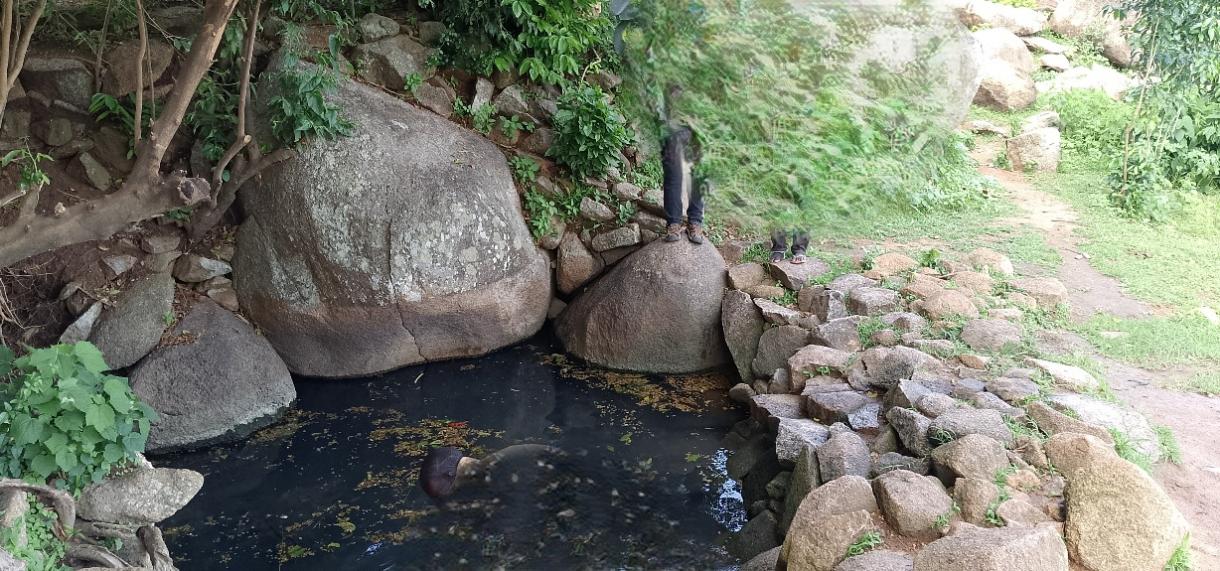
A photo of the Mwikokwe catchment area shows it is perpetually saturated with drainage. The vegetation and wildlife surrounding Mwikokwe are resilient. It cannot be destroyed because of numerous taboos that protect the area.
Taboos surrounding water demonstrate how the Wakara religiosious belief systems create enforceable, community‑driven environmental rules. African scholarship identifies taboos as “guardians of the environment,” protecting sites through fear of spiritual punishment rather than external enforcement. The Wakara narrative of Mwikokwe parallels similar myth‑ritual complexes across Kenya and Nigeria, where sacred water bodies regulate extraction and ensure ecological resilience. The intersection of healing, moral fear, and ecological care reveals water as both a spiritual and environmental resource, consistent with pan‑African Indigenous water governance approaches.
4.4 Ritual Life, Cleansing, Death Practices and Sacred Woodlots
Ritual practice is the domain where Wakara religiosity becomes most visibly enacted, linking communal identity, moral order, and ecological stewardship in a unified system of social life. Cleansing ceremonies, death rituals, and sacred woodlot practices demonstrate the depth of communal participation and the spatial organisation of spiritual power. To capture the range of ritual functions from rain‑invoking processions to death purification rites and tabooed woodlots Table 4.4 synthesises the thematic patterns that structure ritual participation, intergenerational roles, moral danger, and ecological consequences. Figures 7 and 8 illustrate how ritual significance fixes certain landscapes in a state of protection, often preserving vegetation and biodiversity through fear, reverence, and communal memory. By presenting the narratives alongside systematic thematic categorisation, this subsection shows how ritual life operates as both a Wakara religiosity enactment and an Indigenous environmental management system.
Table 4.4
Ritual & Cleansing Practices Thematic Matrix
| Theme | Keywords | Verbatim Evidence | % Mentions |
|---|---|---|---|
| Communal ritual obligation | participation; solidarity | “Even outsiders must join rituals… abstaining is seen as hostility.” (FGD, Bukungu) | 25.6 |
| Intergenerational roles | elders; youth; omuchwara | “Youth prepare goat‑skin cloth; elders oversee ritual order.” (FGD, Nyang’ombe) | 22.1 |
| Death purification rites | jamalalufu; kukwera | “Cleansing after death uses herbs and is done discreetly in woodlots.” (Interview, R4) | 19.4 |
| Sites of ritual danger | lichumu; suicide trees | “Sites of irregular death are feared; belongings cannot be touched.” (FGD, Bukiko) | 16.3 |
| Sacred woodlots | ebhisaka; ritual abandonment | “Woodlots preserved due to ritual abandonment of twins and disabled children.” (FGD, Bwisya) | 16.6 |
Figure 4.3 (Mwikokwe faulted rock): The untouched vegetation supports the claim that ritual danger produces protective ecological zones.
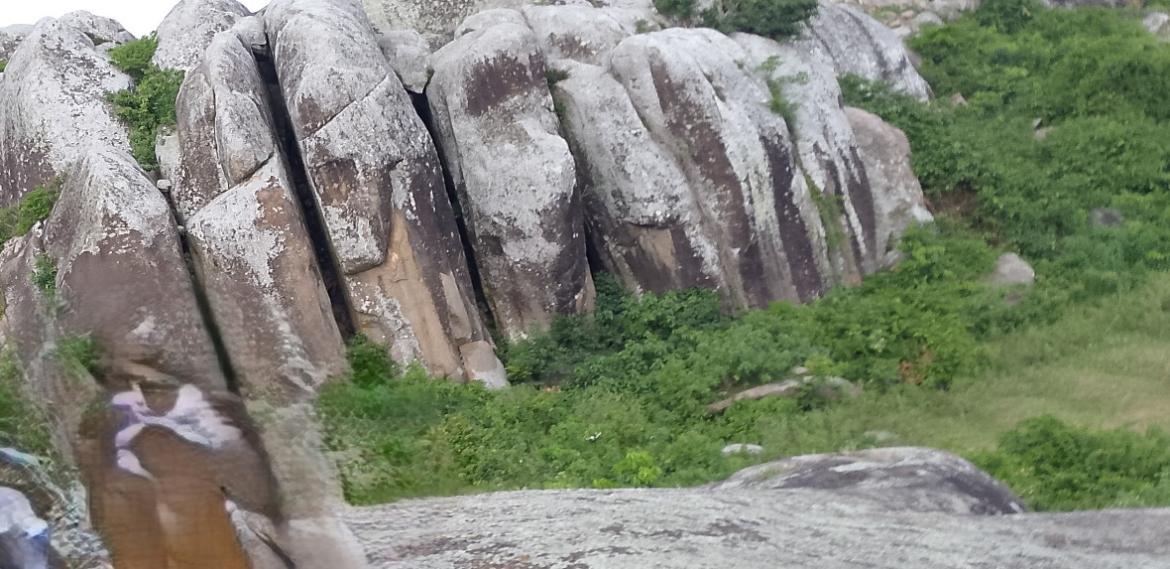
A photograph of the faulted rock in the Mwikokwe area of Nyang’ombe village, surrounded by natural vegetation, indicates that encroachment is prohibited due to the site’s significance as a taboo for the local community, although it sometimes attracts ritualists. Participants explained that the presence of rituals associated with the rock contributes to the preservation of natural features, safeguarding them from destruction such as quarrying or fire.
Figure 4.4 (sacred woodlot): Shows a preserved forest linked to taboo abandonment practices; though ethically controversial, such sites reflect global sacred‑grove conservation where cultural-religious significance safeguards biodiversity.
Figure 4.4
Traditional woodlot at Nyamanga village
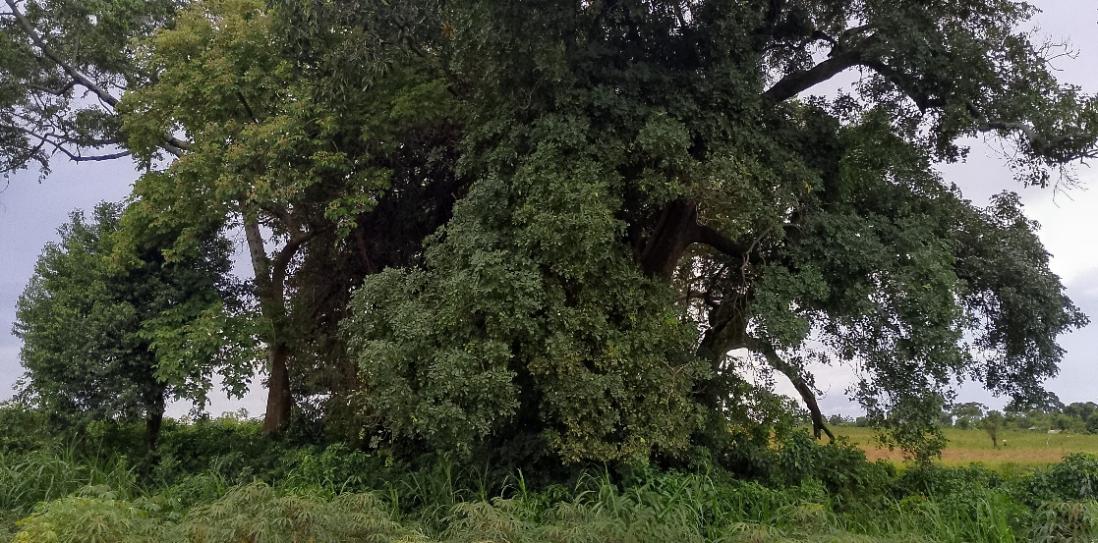
A photograph of one of the traditional woodlots in Nyamanga village, Ukara, depicts a site historically associated with the ritual abandonment of twins and children with disabilities. Participants indicated that the continued preservation of this woodlot is largely motivated by the belief in its ritual significance.
Wakara rituals intertwine metaphysics with ecological practice. Communal cleansing, death rites, and ritual prohibitions demonstrate a moral ecology where purity, danger, and spiritual balance structure environmental use. This aligns with continental analyses of ritual purification among Balobedu, Zulu, and Xhosa communities, where ritual cleansing includes plant‑based medicines and spatial restrictions that maintain ecological and social order. Sacred woodlots echo pre‑colonial conservation systems such as Sengwer groves and Ethiopian church forests, preserved due to spiritual meaning rather than formal law. Overall, rituals operate as both religious obligations and ecological governance systems.
Discussion
The objective of this article was to reconstruct the religious foundations of Wakara religiosity, analyse how these beliefs generate shared moral valuations of species, sacred places, purity, danger and ecological balance, and demonstrate how such values translate into practical environmental obligations through taboos, rituals, sacred-site governance and everyday ecological conduct. The findings presented in Tables 4.1–4.4 show that Wakara environmental ethics are not incidental outcomes of culture but are embedded in a coherent moral ecology. Across totemism, animism, sacred-water taboos and ritual life, Wakara religiosity operates through a metaphysics–axiology–deontology chain: religious beliefs define what is spiritually alive or dangerous; these beliefs produce values of reverence, restraint, purity and fear; and these values are translated into obligations that regulate conduct toward species, landscapes, water bodies and ritual sites.
This discussion therefore reflects on the findings in relation to the study objectives and existing literature. It shows that the Wakara case converges strongly with African eco-philosophical scholarship that views Indigenous religions as ecological knowledge systems, while also extending that scholarship by documenting distinctive features of Wakara moral ecology. These include the vital-force interpretation of python encounters, interactive sacred stones, strict hydro-spiritual taboos, ethically ambivalent sacred woodlots, and the continuing role of ritual governance in environmental protection. These aspects support the central claim of the article that Wakara religiosity constitutes a coherent environmental ethic enacted through spiritualised ecological practice .
5.1 Totemic Beliefs and Sacred Species
The first objective of the article was to reconstruct the religious foundations of Wakara religiosity. Table 4.1 demonstrates that the python, locally known as isatu, is not regarded merely as an animal but as a sacred species endowed with spiritual force. The most frequently mentioned theme was the sacred status of isatu at 32.4%, followed by its role as a conservation mechanism at 26.7%. These findings indicate that totemism is one of the strongest religious foundations of Wakara environmental thought. The python is valued not only because it is associated with clan identity, but because it is believed to possess spiritual agency capable of affecting human wellbeing.
This finding converges with Mandillah and Ekosse’s (2018) argument that African totems serve as cultural and ecological institutions that protect species through taboo, reverence and collective identity. It also agrees with Pearce’s (2023) view that sacred species can operate as “shadow conservation networks,” where biodiversity is protected outside formal state conservation structures. In the Wakara case, isatu habitats such as forests, hills and woodlots become protected zones because people fear the spiritual consequences of harming the python or disturbing its environment. The finding therefore supports wider African evidence that totemism can function as an Indigenous conservation mechanism.
However, the Wakara case also differs from much of the existing literature by showing a more intense vitalistic dimension of totemic belief. Table 4.1 shows that 18.3% of mentions related to vital-force contamination, including the belief that contact with isatu can reduce a person’s vital force and require ritual isolation or burning of clothes. While Mandillah and Ekosse (2018) emphasise totems as heritage and conservation symbols, the Wakara evidence goes further by showing that the totem is experienced as a spiritually dangerous being whose presence affects the human body, moral status and social reintegration. This brings the article closer to Kanu’s (2022) view of African Indigenous ecological knowledge as rooted in life force, relationality and spiritual interdependence.
The finding also raises an important emerging concern. Table 4.1 records knowledge erosion among youth at 12.8%, with respondents noting that some young people misidentify isatu and may kill it out of fear. This partially contrasts with Bhurekeni’s (2022) argument that totemic education can strengthen children’s ecological reasoning. The Wakara case therefore shows that totemic ethics are not automatically transmitted across generations. Their conservation value depends on continued cultural education, ritual memory and intergenerational interpretation. The novelty here lies in showing both the ecological strength and the fragility of totemic conservation. Wakara totemism protects biodiversity, but this protection is vulnerable where youth no longer understand the religious meaning of sacred species.
The implication for this findings is that Wakara totemism confirms the article’s claim that religious metaphysics produces ecological obligations. The python is sacred; because it is sacred, it is valued; because it is valued and feared, its habitat is protected. This is the metaphysics–axiology–deontology chain at work.
5.2 Animistic Beliefs and Sacred Objects
The second objective of the article was to analyse how Wakara religious beliefs produce shared moral valuations of species, places, purity and danger. Table 4.2 shows that animistic beliefs are central to Wakara moral valuation of landscape. The strongest theme was sacred rocks as living presence at 34.5%, followed by healing power and ritual efficacy at 27.1%. These findings demonstrate that stones such as Bulebeka and Mkwaya are not viewed as ordinary physical objects. They are treated as spiritually responsive presences capable of shaking, rising, healing, blessing and mediating human need.
This finding converges with Kanu’s (2022) and Nche and Michael’s (2024) arguments that African Indigenous Religions often understand nature as alive, relational and morally responsive. It also supports Ogolla and Karanja’s (2026) view that African eco-spirituality emerges from cosmologies in which stones, rivers, forests and hills are treated as dwelling places or embodiments of sacred presence. The Wakara case provides concrete ethnographic evidence for these theoretical claims. Bulebeka and Mkwaya are not only symbolic markers of tradition; they structure behaviour, restrict exploitation and preserve the surrounding environment.
The conservation role of sacred stones also aligns with Rai and Mishra’s (2024) argument that sacred landscapes preserve ecological and cultural memory. Table 4.2 shows that conservation through sacralisation accounted for 16.8% of mentions. Because Bulebeka and Mkwaya are spiritually valued, people avoid vandalising, quarrying or casually disturbing them. The visual evidence presented in the findings, especially the preserved condition of Bulebeka, supports the argument that animistic valuation produces ecological restraint.
At the same time, the Wakara case makes an important contribution beyond existing literature. Much scholarship on animism describes sacred objects as symbols of ancestral presence or cultural identity. The Wakara case adds the idea of interactive sacred responsiveness. Respondents do not merely say that the stones are sacred; they describe them as capable of responding to prayer, rising, shaking or granting healing. This suggests that Wakara animism is not passive reverence but an active system of religious communication between humans and spiritually endowed landscapes.
Another important difference concerns the Wakara distinction between a sacred object and a deity. Table 4.2 records the theme “spiritual, not divine entity” at 12.4%. This is significant because it prevents the misinterpretation of Wakara animism as simple stone worship. Mkwaya and Bulebeka are not necessarily regarded as gods; rather, they are understood as objects endowed with spirit, agency or healing force. This distinction contributes to African philosophy by showing the layered nature of Indigenous metaphysics. Sacred objects may be powerful without being divine. They may mediate spiritual force without replacing God, ancestors or other spiritual beings.
The implication for the article is that Wakara animism supports the study’s claim that moral ecology begins with a religious ontology of place. A stone becomes morally significant because it is spiritually alive; because it is spiritually alive, it must be approached with reverence; because it requires reverence, the landscape around it is preserved. This confirms that Wakara environmental ethics are grounded in the perception of a living landscape.
5.3 Taboos, Sacred Waters and Spiritual Sanctions
The third objective of the article was to demonstrate how Wakara moral valuations translate into concrete ecological obligations. Table 4.3 provides one of the clearest examples of this process. The most frequently mentioned theme was sacredness of water sources at 28.9%, followed closely by behavioural prohibitions at 26.3%. These results show that sacred water bodies, known as lijibha, are governed through a combination of spiritual belief, taboo, fear and ritual discipline.
This finding strongly converges with Kanu and Ndubisi’s (2022) argument that African taboos function as guardians of the environment. It also supports Kanu’s (2023) claim that Indigenous taboos regulate human behaviour through religious authority rather than written law. In the Wakara case, people avoid washing, bathing, cutting vegetation, killing animals or behaving carelessly around sacred water sources because these actions are believed to provoke spiritual sanctions. Thus, Wakara water governance is not enforced primarily by police, courts or environmental officers. It is enforced through belief, communal memory and fear of spiritual consequences.
The Wakara findings also align with Masika et al. (2022), who show that Luo and Banyala communities in Kenya use Indigenous norms to protect sacred wells and water catchments. Similarly, UNESCO/IPACC (2025) emphasises that many African communities understand water as a living cultural and spiritual entity. The Wakara case confirms this view by showing that water is not simply a physical resource. It is a sacred medium connected to healing, purity, danger and communal wellbeing.
However, the Wakara case also adds a distinctive hydro-spiritual intensity. Table 4.3 shows that healing water accounted for 17.4% of mentions, while spiritual sanctions accounted for 15.8%. Respondents described rules requiring silence, secrecy and not looking back when collecting healing water. These practices resonate with Ayeni et al.’s (2026) idea of water as cultural memory and spiritual imagination, but the Wakara evidence provides a more detailed illustration of how such beliefs become practical rules of conduct. The sacredness of water is not abstract; it determines who may access water, how they must behave, what they must avoid, and what consequences may follow violation.
The theme of mythic enforcement, recorded at 11.6%, is also significant. Stories such as the overflowing Mwikokwe water and the woman who lost her sanity after violating a taboo show how oral narratives function as ecological law. These stories teach fear, discipline and restraint. They also make taboo enforcement memorable across generations. This supports Mureri et al.’s (2026) findings that sacred wetlands and water bodies may be protected through Indigenous knowledge, spiritual restrictions and mythic narratives.
The implication for the current article is that sacred-water taboos provide strong evidence for the deontological dimension of Wakara religiosity. Once a water source is understood as spiritually inhabited, it becomes morally protected. This moral protection produces specific duties: do not pollute, do not cut vegetation, do not speak carelessly, do not fish, do not bathe, and do not violate ritual procedure. In this sense, lijibha demonstrates how Wakara religiosity converts sacred value into ecological law.
The novelty of the study lies in showing the intensity and detail of this taboo system. Many studies discuss sacred water generally, but the Wakara case documents a highly structured moral ecology in which sacred water governance includes silence, non-retrospection, healing procedures, mythic punishment, ecological protection and communal fear. This makes Wakara sacred-water ethics an important contribution to African Indigenous water governance scholarship.
5.4 Ritual Life, Cleansing, Death Practices and Sacred Woodlots
Table 4.4 shows that ritual life is the most embodied expression of Wakara environmental ethics. The strongest theme was communal ritual obligation at 25.6%, followed by intergenerational roles at 22.1%, death purification rites at 19.4%, sacred woodlots at 16.6%, and sites of ritual danger at 16.3%. These findings demonstrate that Wakara ritual practice is not merely symbolic. It organises communal participation, regulates dangerous spaces, preserves certain landscapes and transmits ecological knowledge across generations.
This finding converges with Mphephu et al. (2025), who describe African death-cleansing rituals as practices that restore spiritual equilibrium and regulate relations between the living, the dead and polluted spaces. Wakara cleansing practices such as jamala lufu and kukwera similarly manage danger, pollution and reintegration. They also regulate movement through specific places such as lake shores, woodlots and ritual paths. Ritual therefore becomes a spatial practice that shapes how people use and avoid particular environments.
The Wakara evidence also aligns with Imarhiagbe and Ogwu’s (2022) argument that sacred groves function as biodiversity reservoirs because they are protected by ritual prohibitions and spiritual fear. The sacred woodlots described in Table 4.4 are preserved because people associate them with ritual danger, ancestral memory and taboo. As with other sacred groves, conservation occurs not because of formal biodiversity planning but because religious meaning prevents ordinary exploitation.
However, the Wakara case also introduces an ethically ambivalent dimension that is important for the novelty of the article. Some woodlots are reportedly associated with the historical abandonment of twins, children with disabilities or persons linked to ritually dangerous births. This differs from much sacred-grove literature, which often presents sacred landscapes mainly as positive conservation traditions. The Wakara case shows that sacred ecologies may produce environmental protection while also carrying difficult histories of exclusion, fear and marginalisation. This is an important emerging aspect because it prevents romanticising Indigenous conservation. The article therefore contributes a more balanced African eco-philosophical argument: Indigenous religious systems may protect nature, but they must also be examined ethically in relation to human dignity and vulnerable persons.
The findings on intergenerational ritual roles also complicate the literature. Mgaya (2026) shows that sacred-grove management among the Bena of Tanzania is threatened by generational shifts and youth disengagement. The Wakara case partly converges with this concern because Table 4.1 shows knowledge erosion among youth. Yet Table 4.4 also shows that youth remain involved in ritual labour, including preparing materials, assisting elders and participating in communal obligations. This suggests that generational change is uneven. Some forms of knowledge are declining, but some ritual responsibilities continue. The Wakara case therefore contributes a more nuanced view of intergenerational transmission: erosion and continuity can coexist within the same Indigenous moral ecology.
The implication for the article is that ritual life provides the strongest evidence that Wakara environmental ethics are enacted rather than merely believed. Rituals convert cosmology into practice. They determine who participates, where people go, what materials are used, which sites are avoided, and which landscapes remain protected. In this sense, ritual is the practical mechanism through which Wakara metaphysics becomes environmental governance.
5.5 Synthesis: Contribution to the Article’s Central Claim
Taken together, Tables 4.1–4.4 confirm the article’s central claim that Wakara religiosity constitutes a coherent moral ecology. Each table represents a different expression of the same underlying ethical structure. Table 4.1 shows sacred species ethics through isatu. Table 4.2 shows sacred-place ethics through Bulebeka and Mkwaya. Table 4.3 shows taboo-based water ethics through lijibha. Table 4.4 shows ritual-landscape ethics through cleansing rites, death practices and sacred woodlots.
The convergence across the tables is important. All four domains show that Wakara religiosity is structured by a repeated pattern: sacredness produces value, value produces restraint, and restraint produces ecological protection. This pattern supports African eco-philosophical arguments by Amanze (2024), Kanu (2022), Kanu and Ndubisi (2022), and Nche and Michael (2024), who maintain that African Indigenous Religions embed ecological responsibility within religious worldviews. The Wakara case gives this theory detailed ethnographic grounding.
At the same time, the study does not simply repeat existing arguments. Its novelty lies in five emerging contributions. First, it documents a vital-force model of totemic conservation, where the python is not only revered but feared as a being capable of affecting human vitality. Second, it presents sacred stones as interactive spiritual agents, not merely symbolic cultural sites. Third, it shows an unusually strict system of sacred-water governance involving silence, secrecy, non-retrospection, healing and mythic punishment. Fourth, it identifies ethically ambivalent conservation, where some preserved woodlots are linked to troubling historical practices involving vulnerable persons. Fifth, it shows that intergenerational ritual governance is neither fully declining nor fully intact, but marked by simultaneous erosion and continuity.
These contributions imply that Wakara religiosity should be understood as a living, negotiated and morally complex ecological system. It is not simply “traditional belief,” nor is it merely informal conservation. It is a philosophical, religious and practical system through which the Wakara define life, danger, purity, sacredness and responsibility. The article therefore advances African eco-philosophy by showing how Indigenous religious categories operate as environmental ethics in practice.
5.6 Implications for environment ecology
The findings have three broader implications. First, they show that African Indigenous Religions should be taken seriously as sources of environmental philosophy. Wakara religiosity provides a clear example of how indigenious religious beliefs about sacred species, animated stones, spiritual waters and ritual danger generate moral duties toward the environment. This supports the argument that African eco-philosophy is not only theoretical but is embedded in lived community practice.
Second, the findings show that biocultural conservation must pay attention to spiritual meanings. The preserved python habitats, sacred stones, water catchments and woodlots described in the findings are protected because they are culturally and religiously meaningful. Conservation approaches that ignore these meanings may fail to understand why some landscapes remain intact. The Wakara case therefore supports the view that biodiversity protection and cultural-spiritual heritage are deeply connected.
Third, the findings caution against romanticising Indigenous ecological systems. While Wakara religiosity produces real conservation outcomes, some practices also raise ethical questions, especially those associated with ritual exclusion, fear and historical treatment of vulnerable persons. The article therefore contributes a balanced perspective: Indigenous moral ecologies can be environmentally valuable and ethically complex at the same time.
Overall, the Discussion confirms that the Wakara case contributes to scholarship by demonstrating how Indigenous religious knowledge can function as environmental ethics, ecological governance, cultural memory and moral philosophy. The study’s originality lies in showing the internal logic of this system through empirical evidence, thematic matrices and African philosophical interpretation.
6. Conclusion
This article has demonstrated that Wakara religiosity constitutes a coherent and dynamic moral ecology in which the African Religious beliefs, ritual authority, sacred geographies, and taboo systems collectively structure environmental ethics and social life. Reconstructing the four core dimensions totemic reverence for isatu, animistic engagements with sacred stones, taboo governance around water bodies, and ritual systems that encode purity, danger, and ancestral order revealed that Wakara cosmology is not an abstract philosophical construct but a lived framework that organises ecological stewardship, moral behaviour, and community identity.
The findings affirm the article’s central claim that metaphysics generates values, and values generate obligations: clan totems protect species and landscapes; sacred objects preserve ecological features through reverence and fear; taboos constitute effective Indigenous water‑management systems; and rituals translate cosmological principles into embodied environmental practice. In synthesising these dimensions, the article contributes novel insights into the relational ontology of African religiosity, offering one of the most detailed empirical illustrations of the metaphysics–axiology–deontology chain at work within an Indigenous African community. It also advances theoretical debates by highlighting intensified the African religiosity ecology, interactive sacred objects, ethically ambivalent conservation outcomes, and intergenerational ritual governance features rarely captured with such ethnographic depth in existing scholarship.
Despite its contributions, the article is not without limitations. The study focuses on a single island community whose cosmology, while richly textured, cannot be assumed to represent all African or even all Tanzanian Indigenous ecological worldviews. Further, although the research captured diverse voices elders, ritual specialists, women, youth, and religious leaders it relied primarily on qualitative methods, making it difficult to quantify ecological outcomes beyond what is visible through observation. Future research would benefit from interdisciplinary collaborations integrating ecological science, hydrology, or biodiversity assessments to empirically measure the conservation outcomes suggested by ritual and taboo systems. Additionally, the presence of Christian and Islamic influences raises important questions about evolving religious syncretism, moral negotiation, and generational reinterpretation of Indigenous metaphysics areas that require longitudinal research to track how Wakara religiosity adapts under demographic and cultural change. Nonetheless, within these limits, the article provides a compelling demonstration of how Indigenous belief systems constitute sophisticated forms of environmental governance, offering valuable insights for broader discussions on biocultural conservation, Indigenous epistemologies, and African eco‑philosophy.
References
Rights and permissions

Disclaimer
All claims expressed in this article are solely those of the author and do not necessarily represent those of the publisher, editors, reviewers, or affiliated institutions. Any product, service, or claim that may be evaluated in this article is not guaranteed or endorsed by the publisher.
Publisher’s note
The publisher remains neutral with regard to jurisdictional claims.
Additional information
Peer review
Article Timeline
Cite this article
- Received
- March 3, 2026
- Revised
- May 25, 2026
- Accepted
- May 27, 2026
- Published
- May 30, 2026
- Version of record
- May 30, 2026
Share this article
Share the article record with colleagues and readers worldwide.
Explore research across our journalsDiscover more research

Recent Publications

Most Read

Recommended
Save this article as a bookmark
Use your browser’s secure bookmark shortcut. Both desktop options are shown below.
Press Ctrl+D
In Chrome, Edge or Firefox, choose a folder if needed, then select Done.
Press ⌘ Command+D
In Safari, Chrome or Firefox, choose the bookmark location and confirm.
Cite this article
Copy a formatted citation or download a reference file.
Cited by
Crossref citation count for this DOI.