

Impacts of Climate Hazards, Vulnerabilities, and Adaptation Strategies of Banana Producers in Senegal: A Scoping Review
Abstract
Banana production in Senegal is vital for food security and rural income, yet it faces severe hydro-climatic disruptions across Tambacounda, Kolda, Sédhiou, and Saint-Louis. Utilizing an iterative literature search and thematic narrative synthesis, this study examines how scientific research characterizes climate influences on these agrosystems. Findings indicate that structural water deficits, river-surge flooding, and high winds diminish both productivity and commercial quality. Smallholder vulnerability is multidimensional, driven by low self-financing capacities and lowland exposure. Although producers employ adaptation techniques such as propping, mulching, and canal construction backed by state and NGO initiatives, stakeholder surveys frequently reveal these measures are inadequate against extreme weather intensity. To address these gaps, future research and public policy must prioritize local dynamic microclimatology to transcend macro-climatic scales and advance the statistical prediction of short-duration extreme events.
Introduction
In tropical and subtropical zones, banana production holds a central position in food security and the rural economy. In Africa and Asia, they represent both a staple food and a cash crop, generating income for numerous agricultural households (Kwa et al., 2019; Djailo et al., 2011). On a global scale, bananas rank among the most produced fruits, underlining the importance of better understanding the biophysical and environmental factors threatening the production stability. However, banana farming is particularly exposed to climate variability and extreme events, which affect the production cycle (growth, flowering, fruiting), bunch quality, and the capacity of producers to maintain consistent output. This situation is highly concerning in West Africa, where reliance on rainfall conditions and weak adaptation options reinforces the vulnerability of cropping systems. The domestication process of banana trees reportedly began with a primary stage of hybridization between wild bananas of the subspecies Musa acuminata, facilitated by human migrations in Southeast Asia during the Holocene over ten thousand years ago (Biabiany, 2021). Globally, banana cultivation is strictly limited to equatorial and tropical zones. The banana plant grows between 30 degrees North latitude and 30 degrees South latitude, with optimal growth occurring between 15 degrees North and 15 degrees South (Quittelier, 2009).
In Senegal, banana production has been a sustained activity since the second half of the 20th century, with the first official plantations registered in 1967 in Saliot (Badji, 2017). The main production zones are in the southern part of the country, specifically in the Kolda and Sédhiou regions, as well as in the Southeast (Tambacounda). However, some production exists along the Senegal Riverbanks. This article analyzes the manifestations and assesses the impacts of climate hazards on banana plantations in the regions of Tambacounda, Kolda, Sédhiou, and Saint-Louis over the 1967–2026 period, emphasizing the link between climate hazards, impacts, vulnerabilities, and adaptation strategies.
Based on this logic, the guiding research questions are as follows: which climate hazards are most documented in the literature, and how do they manifest in banana plantations? What vulnerabilities characterize the producers and their systems? What adaptation strategies are identified, and what constraints limit their implementation?
Methodology
This study is conducted using a scoping review approach, which is appropriate for a broad and heterogeneous research objective. The goal is to analyze the state of available knowledge regarding the links between climate hazards affecting banana plantations, reported impacts on banana production, the vulnerabilities of producers and cropping systems, and the adaptation strategies implemented or recommended.
Description of the study area
Senegal is located at the westernmost tip of the African continent, situated between latitudes 12° and 17’ N and longitudes 11° and 17° W (Figure 1). Specifically, the study area covers all banana-producing villages within the regions of Tambacounda, Kolda, Sédhiou, and Saint-Louis. These villages are located along the banks of the Gambia, Casamance, and Senegal rivers.
The geographic position of the study space across the South, Southeast, and North integrates it into different climatic zones (Sahelian, semi-arid, and sub-humid) (FAO, 1985). The Tambacounda and Kolda regions possess substantial and highly varied water resources and experience higher rainfall compared to the Sahelian zone. This study area also exhibits substantial agricultural potential. Conversely, the Saint-Louis region, belonging to the Sahel, displays highly specific characteristics (Diop, 2025). A climatic gradient along a North-South axis illustrates the spatial variability of precipitation abundance across the country. Northern Senegal is under a Sahelian climate (less than 300–400 mm of rain per year); the center of the country is characterized by the Sahelo-Sudanian (400–700 mm/year) and Sudanian (700–1000 mm/year) climatic zones, while the south falls under a Sudano-Guinean and sub-Guinean climate with precipitation ranging from approximately 1000 mm to 1250 mm per year (FAO, 2018).
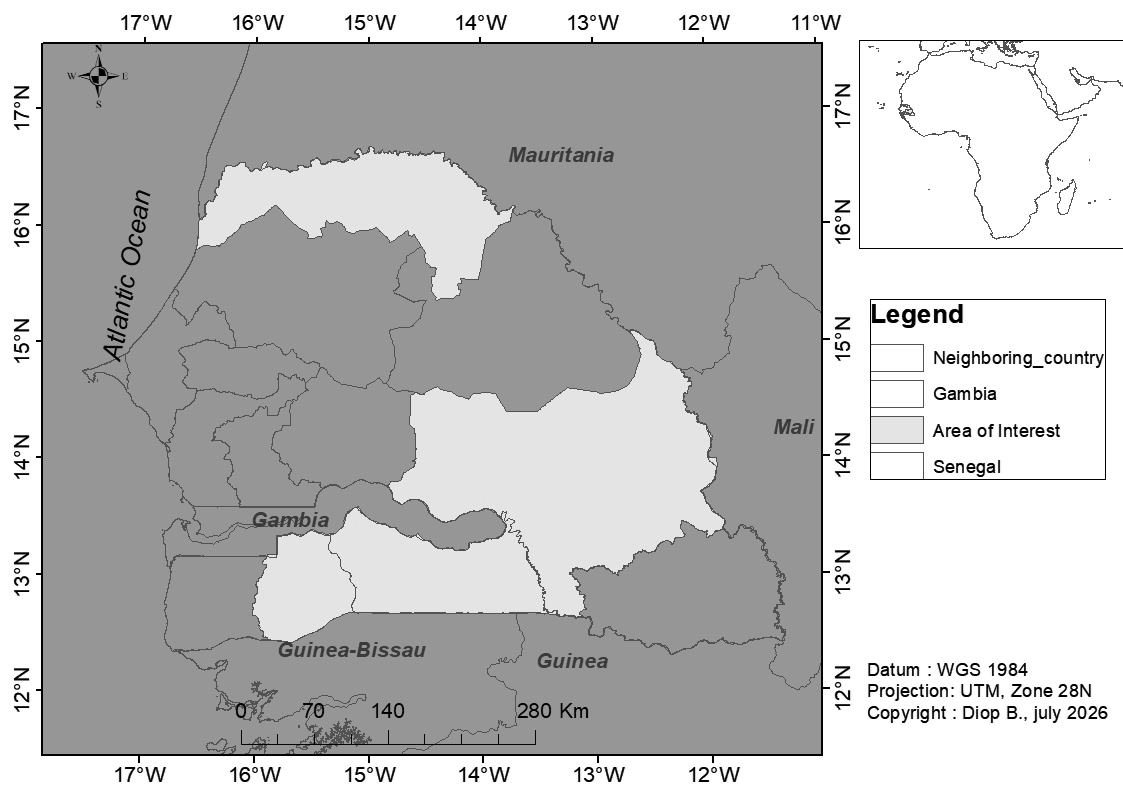
The selected geographical space encompasses virtually the entire dynamics of Senegalese banana production, a sector that mobilizes approximately 9,000 producers and projects a national yield of 115,000 tons for 2026. The relevance of this zone rests on the contrast between three major agro-climatic basins with distinct characteristics. The Tambacounda region represents the country’s primary production hub, accounting for nearly 80% of the national volume under a strictly irrigated regime. The Southern bloc (Sedhiou and Kolda) is characterized by high human activity (Association of Producers exploiting plots of 19 to 29.9 ha with an average yield of 12.22 t/ha); this zone stands out for its strong dependence on rainfed climate conditions (70% of farms in Sedhiou and 34% in Kolda). The Saint-Louis region, located in the northern Sahelian zone, is distinguished by highly productive industrial plantations (yields of 30 to 40 t/ha) relying on total water control and advanced thermal technologies (Sika Finance, 2026).
Agronomically, this space is characterized by the predominance of the Cavendish group, mainly represented by the Poyo, Robusta, Grande-Naine, and Valery varieties. By linking these territories, the study allows for a comparison of cultivation logics (irrigated, rainfed, and mixed) and varied vulnerabilities, thereby offering a comprehensive and representative assessment of Senegalese banana production, spanning from the Sahelian zone to the sub-humid zone (Diop, 2025).
Conceptual framework
The synthesis relies on a chained analytical framework: climate hazards, impacts, vulnerabilities, and adaptations. For each identified hazard, information is structured around impact mechanisms. It also covers vulnerabilities, adaptation strategies, and risk management, including recourse to technical support and climate information.
Inclusion and exclusion criteria
Inclusion: Works focusing on banana production, describing at least one climate hazard, and providing usable information on impacts, vulnerabilities, and/or adaptation strategies of banana growers were retained. Studies from West Africa were prioritized; failing that, comparable tropical/subtropical contexts were mobilized based on their relevance for transferability.
Exclusion: Materials unrelated to banana production and texts failing to provide usable information for at least one of the core axes (hazards, impacts, vulnerabilities, adaptation) were excluded.
Literature search strategy
The literature search was conducted iteratively to ensure a balance between comprehensiveness and feasibility. Queries combined terms related to banana production and climate hazards, as well as the vulnerability and adaptation of farmers. Gray literature was also considered when available, given the potential under-documentation of certain hazards, particularly strong winds, in academic sources.
Results
Climate hazards and their impacts on banana plantations
Results from the collected sources indicate that banana cultivation in Senegal suffers negative effects linked to climate variability. In the study area, reported climatic constraints mainly include water scarcity, flooding, and strong winds, supplemented by hazards with a mechanical component (wind gusts and hail), as well as indirect consequences on plantation operations (Champion, 1960; Aubert, 1971; Diop, 2025). In the Tambacounda region, as elsewhere across the country, climate variation has caused a southward shift of isohyets. The rainfall decline initiated since the late 1960s has significantly affected the precipitation volumes recorded in this area (Faye et al., 2019).
Water scarcity (drought and water stress)
We noticed that the most significant rainfall deficits had occurred between the mid-1970s and the early 1980s. This period is considered the most catastrophic due to the intensity of the deficits and the severity of the resulting consequences (Descroix et al., 2015). The banana plant exhibits a marked sensitivity to water deficits. Studies on water requirements (Champion, 1960) and on the action of climate on banana plant behavior in tropical and subtropical zones indicate that disruptions in the hydrological regime can affect growth and production dynamics. In agronomic logic, these disruptions are likely to reduce productivity and destabilize fertilization practices, particularly when leaching losses become significant (Godefroy et al., 1970, p. 413).
Plant mortality during the cycle is driven more by drought (46.2%) than by wind (19.7%), and less by pest attacks and diseases (12.6%). Most losses in plantain bananas occurred during the fruiting (40.8%) and vegetative (37.7%) stages, and minimally during the flowering stage (10.8%) (Koffi, 2021). If a failure in water supply occurs during the internal growth period of the floral stem, spectacular accidents affect the inflorescence, whose emergence is impeded. A prolonged period of water deficiency results—through faster wilting and slower emergence of new leaves—in the total withholding of leaf blades, and ultimately in the complete wilting of the plant or the breaking of the pseudostem (Champion, 1960).
Flooding
Floods asphyxiate banana roots, delay bunch formation, as well as the overall development process of the banana plant, and halt its entire metabolism. They waterlog the base of the banana plants, alter bunch morphology, and break the pseudostems (Angoua et al., 2018). On young plantations, when water stagnates for about 24 hours, silt remains on the immersed leaves upon recession; while no immediate asphyxia effect is noted, and immediate damage is minimal, vegetative growth is slowed down (Beugnon, 1971). In 2003, following exceptional rainfall in Tambacounda (426 mm of monthly cumulative rainfall in August compared to 180 mm in 2002), the most severe crisis occurred: 57 fields belonging to 13 villages on the right bank of the river were affected by a flood that submerged 737.5 ha out of 1,109.25 ha under cultivation (Badji, 2017).
Flooding acts as a disruptive factor for growing conditions via excess water and altered edaphic states. Angoua et al. (2018) demonstrate that flooding negatively affects dessert banana production in plantations. Furthermore, integrating hydrological dynamics and river surges (Sambou & Lamagat, 1995) sheds light on how flood risks spatially shape the exposure of banana plantations. Regarding flood frequency, Tambacounda experienced 11 years of significant flooding between 2003 and 2024, equating to an average annual frequency of roughly one flood every two years. Intervals between successive floods ranged from 1 to 4 years, with a mean interval of 2.1 years and a standard deviation of 0.83, indicating a relatively regular recurrence of floods over this period (Badji et al., 2026).
Strong winds
The results indicate that strong winds, gusts, and hail can cause mechanical damage and affect fruit development and quality. Field observations reveal severe degradation of leaf surfaces linked to the mechanical actions of wind. These findings align with international literature; Raju et al. (2024) recall in this regard that wind speeds between just 18 and 30 km/h are sufficient to cause laceration of the banana leaf blade, leading to a drop in photosynthetic activity and a consequent reduction in yield. Violent winds can cause the collapse of numerous plants through pseudostem cracking and uprooting of the corm. It is also responsible for tearing and ripping away whole sections of the leaf lamina (Parra et al., 1989). Information reported by Diop (2025) confirms, based on field observations, that strong winds constitute one of the major climatic constraints. Being fragile, banana plants often fail to withstand (falling and breaking) the strong winds accompanying natural squall line phenomena (Badji, 2017).
Beyond these locally identified climate hazards, global temperatures also play a critical role. Global climate forecasts highlight increased vulnerability among major producing nations, whose crops will endure heatwaves exceeding the optimal conditions required for the genus Musa (Bebber, 2023).
Vulnerability of producers and banana plantations
Territorial vulnerability and exposure
The work of Sambou and Lamagat (1995) emphasizes that flooding and river dynamics structure the exposure of agricultural areas. Consequently, locating banana plantations in flood-prone places or areas subject to overflow increases the probability of damage. Similarly, the spatial configuration of plantations and their exposure to prevailing winds condition their susceptibility to mechanical damage (Parra et al., 1989).
Socio-economic and organizational vulnerability
The capacities to absorb losses and implement adaptation measures depend heavily on available resources, access to innovation, and stakeholder organization. Territorial dynamics related to banana innovation in southern Senegal (Badji, 2017) provide a useful explanatory framework: vulnerability depends not solely on hazards, but also on the conditions under which banana production integrates into local strategies and the availability of external support. The absence of development support partners for the sector and a lack of training for executive board members of Producer Organizations undermine the proper functioning of banana producer organizations (Ndiaye et al., 2021).
Institutional vulnerabilities
Diop (2025) indicates that despite initiatives by the State and NGOs, producers frequently deem certain adaptation methods ineffective. This perception signals institutional and organizational vulnerability, linked notably to the alignment of solutions with local realities and the quality of implementation.
Adaptation strategies
Research results show that strong winds, high temperatures, and floods impact the foliar system of banana plants within the study area. To alleviate these constraints, the adoption of technical protection measures against thermal and mechanical stress should be considered. In this regard, Saboki and Jafari (2025) demonstrate that a 50% shade net covering effectively protects banana plants against winds and solar scorching, while reducing water consumption by 25% and increasing bunch weight by more than 27%. Such an alternative could secure yields in the Senegal River Valley.
At the local level, results show that adaptation strategies are organized around three axes: (i) improving water control, (ii) reducing exposure to mechanical damage, and (iii) protecting productive organs to limit losses. Adaptation strategies aimed at reducing the impact of water deficits rely on water control and the optimization of inputs, whose technical modalities vary specifically according to the geographic and cultural realities of each region in the study space. Thus, in Saint-Louis, adaptation centers on state-of-the-art industrial hydraulic management along the Senegal River valley, characterized by high flow pumping and the use of modern thermal regulation technologies.
In Tambacounda, where a purely irrigated system dominates, growers depend on the use of motor pumps along the banks of the Gambia River and resort extensively to traditional organic mulching using straw or Combretum leaves to limit soil evaporation and water drying. Conversely, in Sédhiou, within a basin highly dependent on rainfall (70% rainfed farms), resilience focuses on the construction of diversion canals and the utilization of runoff water in lowlands. Finally, in Kolda, the response to water stress relies on developing mixed systems combining the use of Casamance surface waters and strengthening the collective management by local farmers’ associations to optimize irrigation schedules.
Adaptation strategies for floods emphasize the planning and anticipation of hydrological risks. Remote sensing and flood forecasting in the case of the Gambia River (Sambou & Lamagat, 1995) provide a foundation for understanding how anticipation can reduce exposure. The results of Angoua et al. (2018) confirm that flooding has a negative effect on production, reinforcing the importance of adapting management practices and plantation organization within high-risk zones (Diallo, 2021).
Strategies aimed at limiting wind damage include setting up protection mechanisms (windbreaks) and plant stabilization practices. Harmand (1998) highlighted the value of irrigated windbreaks and structural forestry plantations to protect crops in the valley and delta of the Senegal River. Strategies reported by Diop (2025) also include guying and propping. Regarding hail and wind, Parra (1989) shows that these hazards fall under growth and quality determinants, which justifies a crop protection approach. Wind force can be considerably reduced by placing hedges made of trees or shrubs all around the plantation and in exposed places. These hedges act as windbreaks, limiting blowdowns within the plantation (Meunier et al., 2011). To limit losses, Diop (2025) reports that producers resort to bunch bagging (using bags), which represents a direct protection strategy for productive organs.
Discussion
This review article highlights a complex trajectory for banana farming in Senegal from its official beginnings in 1967 at Saliot up to 2026. A cross-analysis of the literature shows that the sustainability of this sector depends not solely on the intensity of climate hazards, but on a systemic interaction between the intrinsic biological vulnerability of the genus Musa, the geographic exposure of agricultural lands, and socio-economic barriers that limit the efficiency of local adaptation strategies.
The analysis of the 1967–2026 period reveals a profound mutation of the Senegalese agro-climatic landscape, characterized by a southward shift of isohyets and a rainfall decline initiated in the late 1960s. The banana sector, historically established to counter the droughts of the 1970s–1980s in Casamance and eastern Senegal, now faces constraints driven by climate hazards. Although the banana plant is morphologically a giant herbaceous monocotyledon requiring a humid tropical climate, its cultivation in Senegal operates within a highly contrasted North-South climatic gradient, spanning from the Sahelian climate zone to the semi-humid region.
Water stress stands as the main abiotic factor limiting productivity. A cumulative annual rainfall below the critical threshold of 1100 mm induces yield drops ranging between 20% and 60%, severely disrupting floral initiation and causing the phenomenon known as “bunch choking” (Abdoussalami et al., 2023). Water stress remains a major cause for concern, accounting for 46.2% of plant mortality during the production cycle, according to the work of Koffi (2022). These data validate the theories of Champion (1960, p. 388), showing that water scarcity halts the internal growth of the floral stem and induces total leaf blade wilting or pseudostem collapse. However, the scope of Koffi’s (2022) study remains geographically constrained and struggles to reflect the specificities of Senegalese irrigated systems, as it fails to quantify the share of mortality attributable to irrigation system failures versus strict meteorological drought.
Conversely, hydrological analysis highlights a critical vulnerability to water excess, as the banana plant does not tolerate stagnant water, which causes root rot and soil asphyxiation. The memorable floods of 2003 in Tambacounda, characterized by 64 days of intermittent rain and an exceptional August rainfall of 426 mm, illustrate the catastrophic cost of these events. This crisis submerged over 66% of exploited surfaces and required state investments of 532 million CFA francs to relocate infrastructure and ban farming activities within the riverbed (Badji et al., 2026). The work of Badji et al. (2026) provides valuable statistical rigor by establishing an average recurrence of one flood every two years between 2003 and 2024. Nonetheless, this source suffers from a major limitation: it aggregates damages at a territorial scale without providing precise details on the differential sensitivity of plots based on fine topography or the specific banana variety grown.
In addition to hydrological dynamics, the literature characterizes major impacts linked to high winds associated with squall lines. Although wind is ranked second by Koffi (2022) among the causes of physical plant mortality, accounting for 19.7% of losses, its effects on commercial quality are deleterious. By tearing leaf lamina, wind alters the photosynthetic apparatus and increases foliar respiration at the expense of carbohydrate transfer to the maturing bunch, as demonstrated by Parra et al. (1989). This fundamental physical source, while technically rigorous, is dated and presents significant methodological limitations for the current Senegalese context, as it was carried out in Latin American ecosystems under cyclonic weather regimes, rendering its transferability partial when facing Sahelian winds and West African squall lines. The thermal dimension, for its part, also imposes strict limits since the sector suffers from the effects of extreme temperatures outside the optimal range of 28°C. On this point, the data from Ganry (1973) and classical literature on cold remain highly theoretical and derived from controlled experimental stations; they omit the actual impact of extreme Sahelian heatwaves (exceeding 40–45°C), which are increasingly frequent in eastern Senegal, on flower abortion or direct thermal stress among agricultural laborers.
The vulnerability of Senegalese producers to these hazards operates across several interconnected scales. At the plot scale, biophysical vulnerability is accentuated by the genetic homogeneity of banana varieties present in Senegal. This clonal sensitivity is aggravated at the territorial scale by the mandatory establishment of banana plantations along the major beds of the Gambia, Casamance, and Senegal rivers for water access reasons, which creates maximum geographic exposure to floods. At the farm scale, socio-economic vulnerability has materialized due to low self-financing capacity, rudimentary harvesting tools, and transport systems using unadopted bicycles or carts, increasing post-harvest losses during inclement weather. Biophysical vulnerability stems from the banana’s sensitivity to water conditions (Champion, 1960) and mechanical factors. Added to this are the effects of the hydrological regime on nutrient availability, particularly through leaching processes (Godefroy et al., 1970). Within this framework, vulnerability expands when plantations are in zones prone to water excess or deficit. Runoff varies sharply depending on vegetative cover: it is inversely proportional to the density of the vegetative canopy. Crops that leave the soil bare or sparsely covered for a large part of the year reduce evapotranspiration, whereas natural vegetative covers more broadly exploit the soil’s water retention potential; runoff is thus significantly higher in cultivated spaces (Laurent et al., 2010).
To contend with these threats, producers deploy various adaptation strategies, but their actual effectiveness prompts reservations within local communities. To mitigate water deficits, operators turn to irrigation and organic mulching. However, the study by Badji (2017) underlines the technical limitations of these setups: sprinkler irrigation in eastern Senegal imposes an unsustainable workload, requiring approximately 4 hours per day for the manual displacement of irrigation pipes. Furthermore, mulching, if applied too close to the corm (less than 30–60 cm), promotes stagnant moisture and pest proliferation.
To counter strong winds, the implementation of propping is recommended, while covering bunches with bags directly protects the fruits. However, recent work by Diop (2025, p. 271) indicates that despite State and NGO initiatives, producers frequently judge these adaptation methods ineffective. The fundamental limitation of Diop’s (2025) study is that it relies exclusively on stakeholder perceptions and subjective statements without field verification to determine whether this perceived “inefficiency” stems from poor technical execution or an actual flaw in the promoted technologies. On the technical side, the requirements and behavior of the banana tree regarding water are well documented (Champion, 1960). The structural design and management of agroforestry banana plantations can also help improve cultivation conditions depending on the environment (Meunier et al., 2011).
Ultimately, this study highlights major blind spots in current climate research in Senegal, which suffers from a significant deficit in dynamic microclimatology. A conceptual vacuum exists regarding fine climate modeling at the local scale, as the literature remains confined to using regional macro-climatic data that mask local variations. Local climate science has also failed to study the coupling between banana plantation evapotranspiration feedback and the modification of the surrounding microclimate in Sahelian and Sudanian zones. Finally, the statistical and predictive characterization of short-duration extreme climate phenomena, such as the exact frequency of micro-gusts or changes in the distribution of hourly precipitation intensity over the 1967–2026 period, remains completely absent from current climate models. To secure the sector over the coming decades, research must imperatively address these gaps by shifting from a simple descriptive account of general water balances to a physical and quantitative analysis of surface micro-climatic dynamics. It is nonetheless necessary to moderate future yield projections, as models based on climate averages do not account for the expected multiplication of extreme weather phenomena, nor the alteration of production cycles triggered by the emergence and spread of plant pathologies (Varma & Bebber, 2019).
This review approach has several limitations: the heterogeneity of work types (articles, theses, and reports), a risk of missing certain works, particularly within gray literature, the partial transferability of results originating from other regions, and the absence of an objective for aggregated quantitative estimation.
Conclusion
This review study has provided a precise diagnosis of the systemic interactions between climate hazards, structural vulnerabilities, and the adaptation strategies of banana producers in Senegal from 1967 to 2026. The agro-meteorological and biophysical impact mechanisms disrupting banana plantations have been characterized and placed in historical perspective. The analysis highlights that the sector’s vulnerability is primarily territorial and edaphic: Senegalese banana plantations are preferentially established on hydromorphic soils within lowlands, a geographic configuration required for water access but one that intrinsically overexposes crops to major flooding during river surges. Testimony from field actors confirms the catastrophic scale of these submersions, to which are added the mechanical pressures of strong winds that regularly devastate plantations by snapping pseudostems. Although banana growers deploy diverse adaptation strategies (such as guying, propping, or constructing irrigation canals), the evaluation of their actual efficacy prompts sharp reservations among local communities, who frequently deem them insufficient against the increasing intensity of contemporary climate extremes.
At the conclusion of this work, two major research perspectives emerge to enrich the scientific community and guide public agricultural development policies. On one hand, it is necessary to develop local-scale dynamic microclimatology to move beyond the use of regional macro-climatic data. This will allow for the fine modeling of variations at the plot scale and enable the analysis of the coupling between banana plantation evapotranspiration feedback and the modification of the surrounding microclimate in Sahelian and Sudanian zones. On the other hand, future research must shift toward the statistical and predictive characterization of short-duration extreme climate phenomena. This implies integrating the evolution of hourly precipitation distribution and the exact frequency of micro-gusts associated with squall lines into local models, thereby correcting the limitations of current projections based on simple climate averages that omit the anticipated rise of these meteorological extremes.
References
Rights and permissions

Disclaimer
All claims expressed in this article are solely those of the author and do not necessarily represent those of the publisher, editors, reviewers, or affiliated institutions. Any product, service, or claim that may be evaluated in this article is not guaranteed or endorsed by the publisher.
Publisher’s note
The publisher remains neutral with regard to jurisdictional claims.
Additional information
Data availability
Data availability is not applicable to this article because no new data were created or analysed.
Funding
This research received no specific grant from any funding agency in the public, commercial, or not-for-profit sectors.
Ethics declarations
Ethics approval was not required for this study.
Article Timeline
Cite this article
- Received
- August 15, 2026
- Revised
- September 17, 2026
- Accepted
- September 28, 2026
- Published
- October 7, 2026
- Version of record
- October 7, 2026
Share this article
Share the article record with colleagues and readers worldwide.
Explore research across our journalsDiscover more research

Recent Publications
- Climate Information Sources, Adaptation Practices and Barriers among Smallholder Crop Farmers in Kakamega East Sub-County, Kenya
- Assessing the Impacts of Flooding on Environmental Sustainability and Livelihoods in Tonj Payam, Warrap State, South Sudan
- Strengthening Carbon Fund Frameworks to Enhance Climate Sustainability Practice in Rural African Communities

Most Read

Recommended
- Climate Information Sources, Adaptation Practices and Barriers among Smallholder Crop Farmers in Kakamega East Sub-County, Kenya
- Assessing the Impacts of Flooding on Environmental Sustainability and Livelihoods in Tonj Payam, Warrap State, South Sudan
- Strengthening Carbon Fund Frameworks to Enhance Climate Sustainability Practice in Rural African Communities
Save this article as a bookmark
Use your browser’s secure bookmark shortcut. Both desktop options are shown below.
Press Ctrl+D
In Chrome, Edge or Firefox, choose a folder if needed, then select Done.
Press ⌘ Command+D
In Safari, Chrome or Firefox, choose the bookmark location and confirm.
Cite this article
Copy a formatted citation or download a reference file.
Cited by
Crossref citation count for this DOI.