

Applying the Discourse of Renewal Theory to Post-Crisis Recovery in Kenyan Higher Education
The Case of Daystar University


Abstract
The COVID-19 pandemic forced universities to rethink how they communicated with and supported stakeholders beyond the acute phase of crisis. This study examines Daystar University’s post-crisis recovery following the first three waves of COVID-19 in Kenya through the Discourse of Renewal Theory (DRT). Using a convergent parallel mixed-methods design, data were obtained from 271 students and eight university senate members. Findings indicate that Daystar University inadvertently enacted all four DRT dimensions: organizational learning, ethical communication, prospective rather than retrospective vision, and effective organizational rhetoric. These practices supported a rapid transition to virtual learning, accreditation of an online campus by Kenya’s Commission for University Education, strengthened ICT infrastructure, and new academic and administrative innovations. Visionary leadership and preservation of institutional values were central to renewal, although communication consistency and reach remained uneven. The study extends DRT beyond its predominantly Western, private-sector applications into an African higher-education context and demonstrates how crisis can catalyse institutional learning, technological adaptation, stakeholder care, and organizational renewal after disruption, including in resource-constrained university settings across Africa.
Highlights
- ObjectiveThis study examines Daystar University’s post-crisis recovery following the first three waves of COVID-19 in Kenya through the Discourse of Renewal Theory (DRT). Read source
- MethodsUsing a convergent parallel mixed-methods design, data were obtained from 271 students and eight university senate members. Read source
- FindingsFindings indicate that Daystar University inadvertently enacted all four DRT dimensions: organizational learning, ethical communication, prospective rather than retrospective vision, and effective organizational rhetoric. Read source
- ConclusionThe study makes two principal contributions to the literature. Read source
About this reading aid
These are complete passages selected automatically from the abstract and full text using section labels and study-specific wording. Selection runs locally on the journal server, without an external AI service. It may miss nuance or select an imperfect passage; it is not an independent assessment or an editor-reviewed summary. Missing points are identified explicitly.
Introduction
The coronavirus (COVID-19) pandemic disrupted the operations of organizations across every sector, but institutions of higher learning were among the hardest hit. Extended campus closures interrupted in-person instruction, examinations, and the communal life that underpins the university experience, forcing academic leaders worldwide to shift teaching and learning online at a scale and speed previously untested (Sun et al., 2020). In Kenya, as elsewhere in Africa, universities that had little prior investment in digital infrastructure faced a particularly steep transition (Mwebi, 2021; Osabwa, 2022; Wekullo et al., 2022).
Much of the scholarly attention devoted to organizational crises, including COVID-19, has focused on the acute phase of the crisis itself, that is, how organizations should communicate as the threat unfolds. Dominant frameworks in this tradition, such as Situational Crisis Communication Theory and image restoration theory, are chiefly concerned with protecting an organization’s reputation and legitimacy in the face of blame (Nwogwugwu, 2018; Zamoum & Gorpe, 2018). Considerably less attention has been paid to the period that follows: the post-crisis phase, in which an organization must decide not merely how to survive a crisis but how to be transformed by it. The Discourse of Renewal Theory (DRT), developed by Ulmer and Sellnow (2002), was proposed as a corrective to this imbalance. Rather than treating crisis solely as a threat to be contained, DRT reframes it as a focusing event that can yield organizational learning, renewed ethical commitment, and a stronger sense of institutional purpose (Ulmer et al., 2011).
DRT, however, has an important limitation. Its empirical base has developed almost entirely within Western, privately owned organizations, and its proponents acknowledge that evidence of its application in publicly regulated or non-Western settings remains sparse (Ulmer et al., 2011). Few studies have tested the theory’s four dimensions (organizational learning, ethical communication, a prospective rather than retrospective vision, and effective organizational rhetoric) in an African higher-education context. Fewer still have done so for a crisis as prolonged and systemic as a global pandemic, as opposed to a bounded, organization-specific event such as a product recall or a leadership scandal.
This article addresses that gap. It argues that DRT can be extended beyond its original boundaries to explain how an African university recovered from a prolonged, systemic crisis. It further argues that renewal can occur even when an institution does not consciously adopt a renewal framework, although it may be uneven across the theory’s four dimensions. To test this claim, the study pursued three objectives: (1) to establish the post-crisis strategies that Daystar University employed to mitigate the effects of the COVID-19 pandemic; (2) to analyze how the university’s post-crisis management compared with DRT in supporting recovery, learning, and renewal; and (3) to examine the outcomes of those strategies for the institution’s renewal.
Beyond its theoretical contribution, the paper to a practical need. As Kenyan and other African universities continue to absorb the operational lessons of COVID-19hybrid delivery, digital infrastructure investment, and revised assessment policy institutional leaders have had comparatively little locally grounded evidence to draw on in deciding which of these adaptations to retain, formalize, or abandon now that the acute phase of the pandemic has passed. A case study that traces one institution’s response through to its measurable outcomes offers exactly this kind of evidence, and does so through a theoretical lens, DRT, that is explicitly oriented toward identifying what should be sustained rather than merely what was survived.
Literature Review
Crisis and the Post-Crisis Phase
Crisis research has traditionally approached organizational crisis from two vantage points: an internal perspective, concerned with the coordination of an organization’s own relational and technical systems to minimize damage and prevent recurrence, and an external perspective, concerned with managing stakeholders’ perceptions of the organization (Bundy et al., 2017). Bundy et al. (2017) argue thata comprehensive view of crisis requires integrating both perspectives, since an organization’s internal response and its external reputation are ultimately interdependent. Crisis management itself is typically framed as a strategic management function that unfolds across identifiable stages, moving from signal detection and preparation, through the acute crisis event, to a recovery phase centred on organizational learning and safeguards against recurrence (Coombs, 2015). Aljuhmani and Emeagwali (2017) similarly characterize the recovery phase as the point at which crisis managers audit their organization’s crisis response and translate lessons learned into strategic planning.
The post-crisis phase deserves scholarly attention because it is here that an organization’s long-term trajectory is set. As Bundy et al. (2017) note, organizations that willingly share the lessons they have drawn from a crisis are generally viewed favourably by stakeholders, who read such transparency as an act of goodwill. Conversely, organizations that treat the post-crisis period merely as a return to business-as-usual forfeit the opportunity for renewal that the crisis presented.
The Discourse of Renewal Theory
DRT was developed as an alternative to apologia and image-restoration approaches to crisis communication, both of which are principally defensive and retrospective, aimed at explaining or excusing an organization’s conduct (Ulmer & Sellnow, 2002). DRT instead directs attention to the opportunities a crisis creates, defining renewal as the fresh sense of direction an organization adopts once it emerges from a crisis (Ulmer et al., 2011). The theory identifies four interrelated dimensions through which renewal is achieved.
The first, organizational learning, holds that crises should not be wasted; organizations that draw and communicate lessons from a crisis strengthen stakeholders’ confidence that the crisis is being resolved (Ulmer et al., 2011). Scholars distinguish between behavioural learning, which is externally imposed and represents the weakest form of learning, paradigmatic learning, which combines external pressure with internal initiative and requires sustained training and leadership support, and systemic learning, which is proactive and may even prevent a future crisis altogether (Ulmer et al., 2011). The second dimension, ethical communication, rests on strong pre-crisis stakeholder relationships, provisional rather than strategically defensive messaging, and communication that allows stakeholders to make a genuinely informed, significant choice (Ulmer et al., 2011). The third dimension, a prospective rather than retrospective vision, requires organizations to shift their emphasis from assigning blame toward articulating a future built around their core values (Ulmer et al., 2011); DRT is considered an optimistic theory precisely because it treats crisis as a source of opportunity, the emergence of new leaders, the resolution of long-standing shortfalls, accelerated change, and the development of new competitive advantages (Ulmer et al., 2011). The fourth dimension, effective organizational rhetoric, concerns a leader’s capacity to construct an alternative, hopeful reality for stakeholders, mobilizing their commitment to rebuilding rather than merely resolving the crisis (Ulmer et al., 2011).
Scholars have credited DRT with encouraging organizations to look inward, producing a deeper level of post-crisis reflection than threat-focused theories typically elicit (Anderson & Guo, 2020), and with helping organizations visualize a future beyond the crisis by centering stakeholders and employees in the recovery process (Smith, 2018). At the same time, the theory’s proponents have identified conditions that constrain renewal, including organizational mindlessness, a routinized response that fixates on threat rather than opportunity, and the type of organizational ownership, given that privately owned organizations typically enjoy greater autonomy and willingness to invest in recovery than their publicly regulated counterparts (Ulmer et al., 2011). More recent scholarship has sought to extend DRT’s reach beyond these original parameters, applying it to public institutions, prolonged crises, and social-mediated crises (Fuller et al., 2019; Xu, 2018), a trajectory this study continues by testing the theory in a Kenyan higher-education setting.
Crisis Communication, Leadership, and Stakeholders
Crisis communication scholarship converges on the centrality of stakeholders to an organization’s recovery. Nwogwugwu (2018) observes that organizational reputations, built over years, can be damaged within hours of a crisis, which explains organizations’ urgency in protecting their standing; understanding stakeholders’ perceptions is therefore essential to crafting an appropriate response. Zhao et al. (2020) similarly argue that organizations seeking to build a positive future beyond a crisis must engage stakeholders in ethical, positive, and future-oriented dialogue precisely the disposition that DRT recommends. Marsen (2020) adds that timely, well-coordinated communication, delivered by an appropriately positioned spokesperson, is central to effective crisis management, while Jeong (2015) notes that stakeholders’ attitudes and perceived organizational responsibility directly affect an organization’s sustainability.
Leadership occupies a similarly prominent place in this literature. Teo et al. (2017) argue that organizational resilience during crisis is substantially a function of its members’ fortitude, and that leaders who communicate a clear vision and demonstrate commitment inspire that resilience in others. Because DRT positions optimistic, values-driven rhetoric as a precondition for renewal, the character and visibility of an organization’s leadership during the post-crisis phase is, in effect, a proxy for whether DRT’s fourth dimension effective organizational rhetoric is being enacted.
Crisis in Higher Education and the COVID-19 Context
Crisis management scholarship in higher education predates COVID-19, having developed substantially in response to school shootings and campus emergencies in the United States. Gainey (2009) found that many institutions lacked a designated crisis communication function altogether, and recommended that institutions maintain a formal crisis plan, informed leadership, and strong stakeholder relationships. Wang and Hutchins (2010) similarly argue that higher-education crises, whatever their cause, disrupt an institution’s core teaching mission and test its leadership’s capacity to make rapid, defensible decisions. Thompson et al. (2017), applying DRT specifically to school shootings, found the theory practical in a post-crisis education setting because of its emphasis on stakeholder commitment and prospective crisis management, while cautioning that DRT is most effective where positive stakeholder relationships already existed before the crisis.
COVID-19 introduced a distinct kind of higher-education crisis: not localized or organization-specific, but global, prolonged, and externally imposed. Sun et al. (2020) describe the pandemic as having pushed education online at a scale the sector had never tested, while Fernandez and Shaw (2020) argue that the crisis presented a rare opportunity for strategic, technologically minded academic leaders to challenge institutional inertia. Onyema et al. (2020) recommend that academic leaders respond by adopting digital infrastructure, decentralizing decision-making, and communicating honestly and frequently with stakeholders. Within Africa, Osabwa (2022) and Wekullo et al. (2022) document the strain the pandemic placed on institutions with limited pre-existing digital capacity, while Mwebi (2021) documents Kenyan universities’ own scramble to transition online. None of this literature, however, applies the DRT framework to assess whether the resulting institutional responses amounted to genuine renewal, as opposed to reactive survival the gap this study addresses.
Conceptual Framework
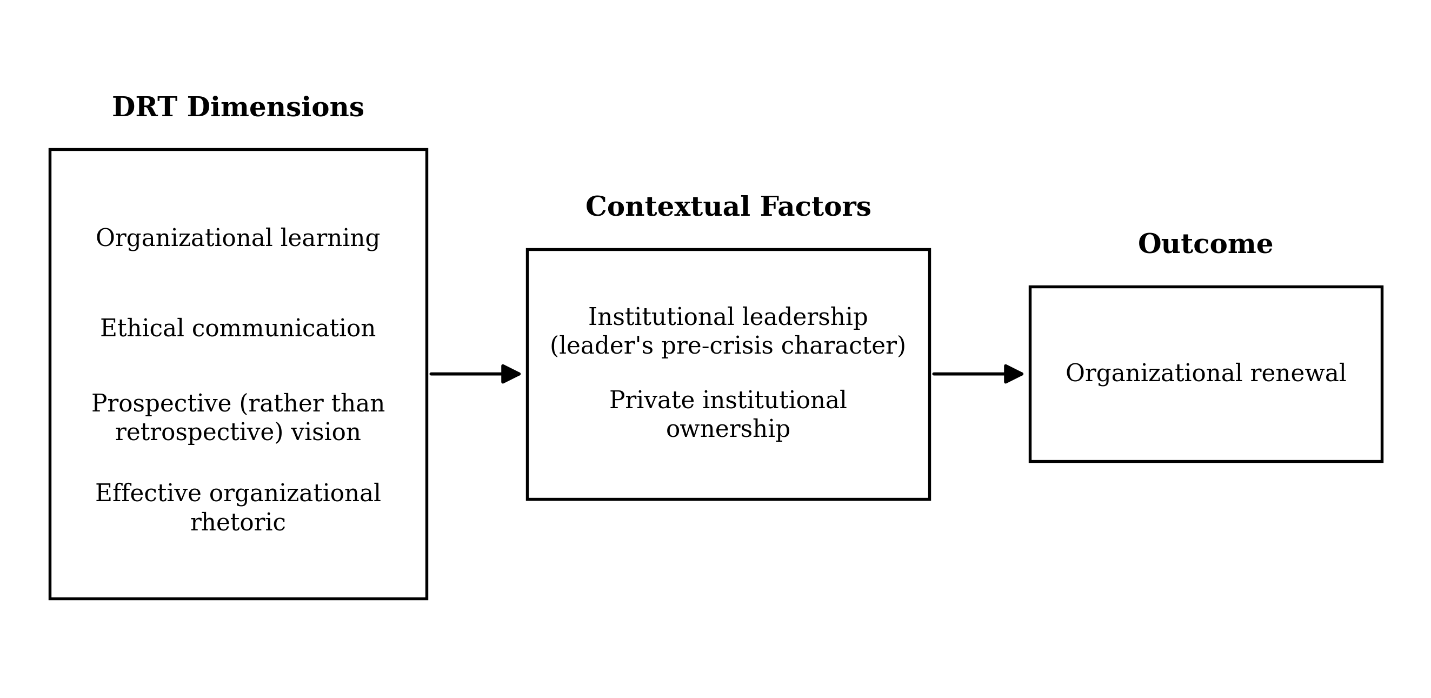
Building on Ulmer et al.’s (2011) four theoretical dimensions, this study conceptualizes organizational learning, ethical communication, prospective versus retrospective vision, and effective organizational rhetoric as the constructs through which post-crisis renewal may be observed, and organizational renewal as the outcome the study sought to describe. Institutional leadership and the university’s status as a privately owned institution are treated as contextual factors. This follows the premise, drawn from Ulmer et al. (2011) and corroborated by Teo et al. (2017) that a leader’s pre-crisis character and an institution’s autonomy from bureaucratic constraint shape how readily the four DRT dimensions translate into renewal. Consistent with the study’s descriptive design, the framework serves as an analytical lens for organizing data collection and interpretation rather than as a causal model to be statistically tested. It directs attention to whether, and to what extent, each dimension was evident in Daystar University’s post-crisis management, and how these were reflected in the institution’s renewal. On this reading, renewal is not an automatic by-product of surviving a crisis. A university that transitions to virtual learning without also communicating ethically, articulating a prospective vision, or benefiting from visible leadership might survive the crisis without achieving renewal in the sense DRT intends.
Methodology
Research Design
This study adopted a descriptive research design, appropriate where the aim is to provide an accurate account of a current organizational phenomenonrather than to test causal relationships (Rahi, 2017). Within this design, a convergent parallel mixed-methods approach was used, in which quantitative and qualitative data were collected independently and interpreted together to achieve triangulation and complementarity (Schoonenboom & Johnson, 2017).
Population
The quantitative population comprised Daystar University’s 3,399 undergraduate and postgraduate students across six schools (Daystar University Registrar, 2021).
Sample
A 10% sample (n = 340) was drawn, stratified by school with proportionate allocation, so each school contributed 10% of its enrolment: Communication, 81; Arts and Social Sciences, 64; Business and Economics, 56; Applied Human Sciences, 35; Science, Engineering and Health, 95; and Law, 9.
Within each stratum, selection was non-random. Eligibility was restricted to students who had experienced the university before the pandemic, identified by registration-number prefix. These were fourth-year undergraduates, second-year master’s students, and third-year students who had completed a Daystar diploma. Students admitted from 2020 onward, and PhD and diploma students, were excluded.
In the Schools of Communication and of Arts and Social Sciences, questionnaires were administered in classrooms after examinations, with every tenth eligible student approached. In the remaining schools, trained research assistants approached eligible students at the cafeteria, halls of residence and campus bus stop during the May-August 2022 examination period until each school’s quota was met.
The procedure is thus stratified quota sampling with purposive eligibility screening. Of the 340 questionnaires distributed, 271 were returned, a response rate of 79.7%.
The qualitative population comprised the university’s 51-member senate. Twelve members holding offices directly responsible for steering the institution through the pandemic (March 2020-March 2022) were identified purposively, and snowball referrals were used to identify further office-holders. Eight interviews were conducted: five via Zoom, two in person, and one by telephone after an internet failure. Interviews averaged 45 minutes and were all recorded and transcribed with consent.
Saturation was defined as the point at which few or no new codes emerge (Weller et al., 2018). It was assessed by coding each transcript before conducting the next and recording new codes per interview; interviews seven and eight generated no new codes. Data collection therefore ended at eight of the twelve targeted interviews.
Instruments
Data were collected using a self-administered questionnaire and a semi-structured interview guide, both piloted before fieldwork. The questionnaire was piloted with ten second-year students and the interview guide with two academic staff members, none of whom were included in the final sample.
The questionnaire had two sections. Section A captured respondents’ background: gender, year of study and school. Section B captured the study constructs using three response formats. The first was five-point Likert agreement items (5 = strongly agree to 1 = strongly disagree), used for the post-crisis strategies and their perceived outcomes. The second was a five-point rating scale (very poor to excellent), used to assess how the university’s seven institutional values were reflected in its post-crisis communication. The third was categorical items (yes / no / not sure), used for perceived institutional changes and for statements on prospective focus, communication quality, and culture and values.
The interview guide contained ten open-ended questions covering the strategies employed, their outcomes, lessons learned, policy changes, stakeholder management, the role of leadership, and the reflection of institutional values. Table 2 shows how each construct was operationalized across the two instruments. Effective organizational rhetoric, which concerns leaders’ communication of an optimistic, forward-looking vision, was captured mainly through the interviews, since it relates to senior leaders’ discourse, which students were less positioned to assess.
| Construct | Indicators | Questionnaire items (students) | Interview questions (senate) |
|---|---|---|---|
| Post-crisis strategies | Awareness of strategies; safety and health measures; crisis communication; continuity of learning; psychosocial support | Q4 (yes/no/not sure); Q5 A-P (16 Likert items) | Q1 (strategies employed) |
| Organizational learning | Treating the crisis as an opportunity to learn; willingness to learn lessons; reflection on improvement; adaptation of teaching | Q10a items 3-5 (yes/no/not sure); Q5 K (Likert) | Q3 (lessons learned); Q6 (policy changes) |
| Ethical communication | Accurate and factual information; responsiveness to concerns; sensitivity and genuineness; consistency with institutional values | Q5 C, G, M, N (Likert); Q9 (seven values, rating scale); Q10b (4 items); Q10c (3 items) | Q5 (stakeholder handling); Q9 (values) |
| Prospective vision | Commitment to corrective action; rebuilding trust; communicating next steps and continuity | Q10a items 1-2; Q5 H, I, J, P (Likert) | Q7 (whether DU is in a better place) |
| Effective organizational rhetoric | Visible leadership communication; leaders articulating renewal | Q5 D (designated spokesperson) | Q8 (role of leadership) |
| Institutional leadership (contextual factor) | Leadership’s role in the return to normalcy | - | Q8 |
| Organizational renewal (outcome) | Return to normalcy; continuity of learning; stakeholder loyalty; transparency; reputation; institutional change (e.g., virtual learning as the norm, regular stakeholder communication) | Q6 A-F (Likert); Q7 (yes/no/not sure); Q8 A-F (yes/no/not sure) |
Diagnostic Tests
Content validity was established through expert review: The questionnaire and interview guide were examined against the research questions to confirm that each item was relevant and that the questions were adequately covered. Face validity was assessed during piloting with ten second-year students and two academic staff members, which checked that items were clear and interpreted as intended. For the qualitative strand, credibility was supported by recording and transcribing all interviews verbatim and by the convergent design itself, which allowed interview themes to be compared against the survey results.
The study did not compute a formal reliability coefficient. The multi-item Likert and rating-scale items were analyzed descriptively at item level rather than combined into composite scores, and the categorical items (yes / no / not sure) were likewise reported item by item. Because internal consistency was not statistically established, the quantitative findings should be read as item-level descriptions of student perceptions rather than as measurements of the underlying constructs. This is noted as a limitation.
Findings
Respondents were approximately evenly split by gender (49.8% male, 50.2% female)and were drawn from across Daystar University’s seven schools, with the largest shares from the School of Science, Engineering and Health (24.4%) and the Schools of Arts and Humanities and Communication (20.7% each). The findings are organized around the study’s three objectives, beginning with the strategies Daystar University employed, followed by the outcomes of those strategies, and concluding with an assessment of how the institution’s response compares with DRT’s four theoretical dimensions.
| Quantitative sample students | |||
|---|---|---|---|
| Questionnaires | Distributed | 340 | |
| Returned (analyzed) | 271 | 79.1 | |
| Gender | Male | 135 | 49.8 |
| Female | 136 | 50.2 | |
| School of study | Science, Engineering & Health | 66 | 24.4 |
| Arts & Humanities | 56 | 20.7 | |
| Communication | 56 | 20.7 | |
| Nursing | 26 | 9.6 | |
| Human & Social Sciences | 24 | 8.9 | |
| Business & Economics | 38 | 14.0 | |
| Law | 5 | 1.8 | |
| Qualitative sample senate members | |||
| Interviews | Targeted | 12 | |
| Conducted (saturation reached) | 8 | 66.7 | |
| Interview length | Average | 45 min |
Post-Crisis Strategies Employed
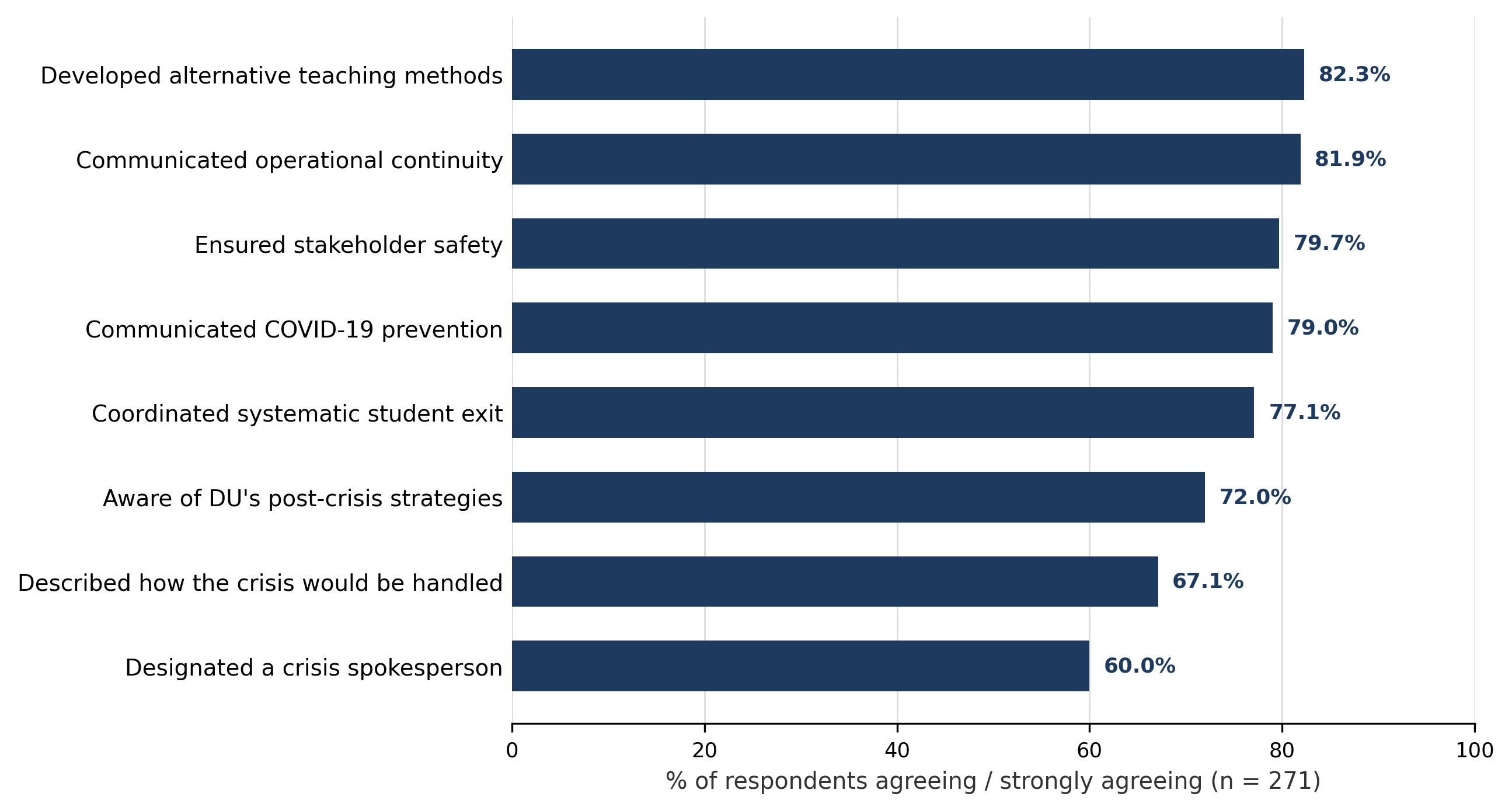
A majority of respondents (72%) reported being aware of the strategies Daystar University employed after the onset of COVID-19, though a notable minority (28%) were unaware or unsure, suggesting room for wider dissemination of the institution’s crisis response. Among specific strategies, respondents most strongly endorsed the university’s efforts to ensure stakeholder safety (79.7% agreeing or strongly agreeing), its development of alternative teaching methods (82.3%), and its communication of operational continuity (81.9%). A designated crisis spokesperson attracted comparatively weaker and more ambivalent endorsement (60% agreeing or strongly agreeing, but 23% neutral), a gap discussed further below.
The qualitative data converged with, and enriched, these findings. All eight interviewees identified the university’s shift from physical to virtual learning asits central post-crisis strategy, with most crediting the pre-existing Moodle learning-management platformfor enabling a comparatively fast transition once government directives closed campuses. The university’s management, according to Respondent Five, “put together a committee that was able to monitor the progress of the pandemic, internally and externally,” which led to the creation of an Online, Distance and eLearning (ODeL) board tasked with building the policies and infrastructure needed to sustain remote learning. Respondent Two described the strategy in similarly integrated terms: “The agreed strategy was to move teaching online … on the administrative side, was to look for ways to assist students access data, since teaching and learning was happening online.” Additional platforms, including Zoom, Google Meet, and Microsoft Teams, supplemented Moodle, and the institution negotiated subsidized internet rates with the Kenya Education Network to support students who lacked reliable connectivity.
These findings corroborate Zamoum and Gorpe’s (2018) observation that effective post-crisis management requires integrating internal operational adjustments with external stakeholder communication: Daystar University’s response combined technical infrastructure decisions (the ODeL board, subsidized internet) with communicative ones (continuity messaging, staff and student training). They also support Fernandez and Shaw’s (2020) argument that the pandemic rewarded institutions with strategic, technologically minded leadership willing to challenge institutional inertia; Daystar University’s rapid pivot to virtual learning, several respondents noted, drew directly on infrastructure the institution had underused before the pandemic, consistent with Sun et al.’s (2020) observation that institutions with pre-existing digital capacity adapted fastest.
Outcomes of the Strategies Employed
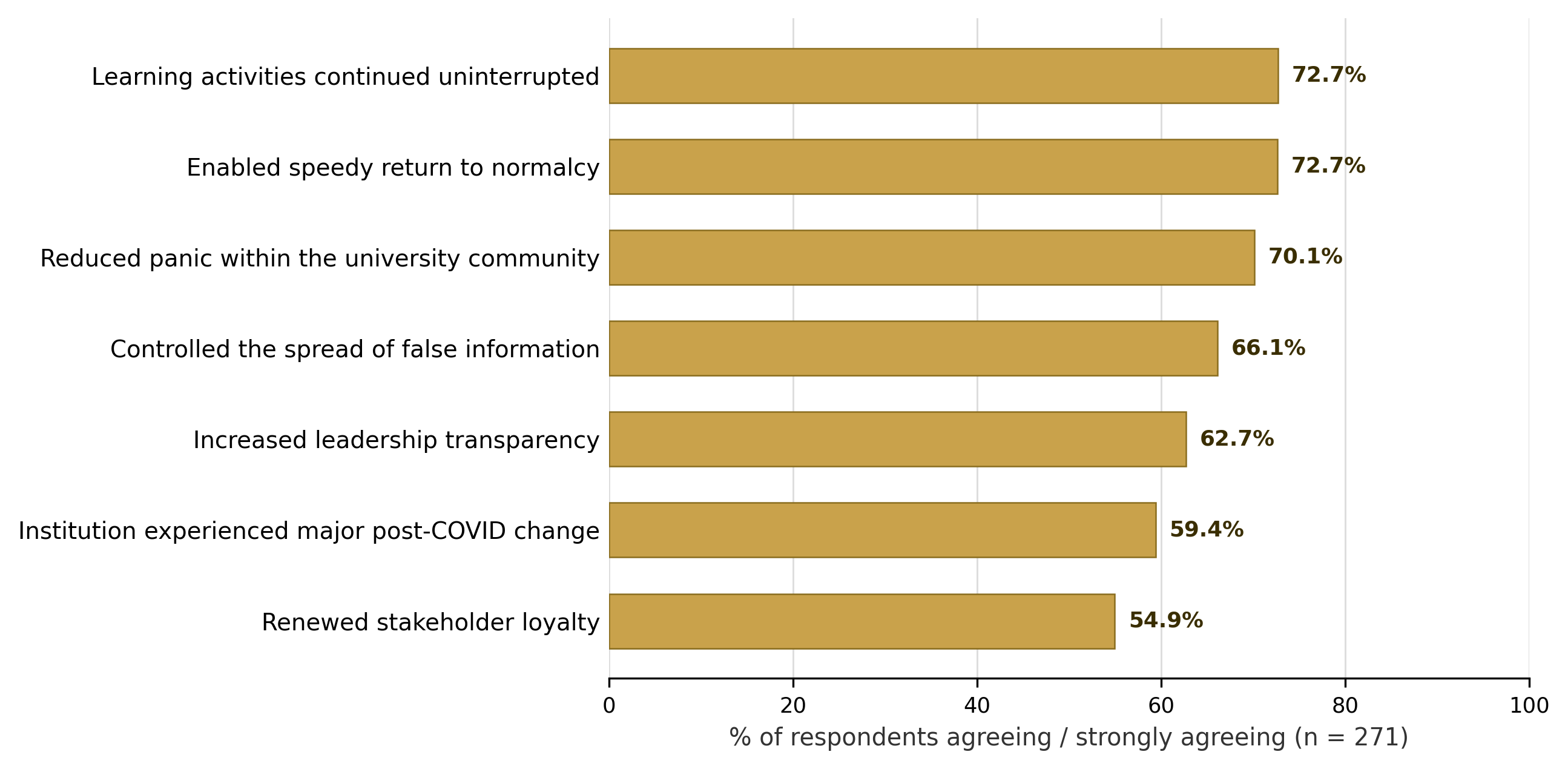
Respondents broadly credited the university’s strategies with positive outcomes. A majority agreed the strategies controlled the spread of false information (66.1% agreeing or strongly agreeing), supported a speedy return to normalcy (72.65%), reduced panic within the university community (70.1%), and allowed learning activities to continue largely without interference (72.7%). Perceptions of renewed stakeholder loyalty were more equivocal (54.94% agreement, but 30.63% neutral), as were perceptions of increased leadership transparency (62.7% agreement, with a quarter of respondents unsure). Nearly six in ten respondents (59.4%) believed the institution had undergone major change as a result of the pandemic.
The qualitative data identified several concrete institutional outcomes beyond the survey’s pre-set items. All eight interviewees pointed to uninterrupted learning as a primary outcome; as Respondent Two put it, “the university never closed … that was a great outcome.”
Six of the eight credited the institution’s smooth transition to virtual delivery with securing accreditation from Kenya’s Commission for University Education (CUE) to operate an online campus, accreditation that Daystar’s Open, Distance and eLearning (ODeL) Centre received in 2022 (CUE, 2026). These respondents described Daystar as one of the few Kenyan universities to have received such accreditation at the time. Respondent Four placed it “among the first three or four universities to be approved as a new e-campus,” a perception this study did not independently verify against CUE records. Respondents also linked the accreditation to a strengthened ICT infrastructure, an upgraded university management system, and refurbished student and staff portals. Respondent Four summarized this cluster of gains as "the greatest of all the outcomes," while Respondent One described a broader technological upgrade that extended to procurement systems.
New academic and administrative developments followed. These included the introduction of Problem-Based Learning, a shift in the weighting between continuous assessment and final examinations (from 60/40 to 40/60), and the creation of a Thesis Management System to support graduate research remotely. Virtual remedial classes also led to the launch of a new online Master of Science in Research Methodology programme. Two respondents noted a growing international profile, including a new partnership with Beulah Heights University, and reported enrolment gains rather than losses. Set against these gains, two respondents identified the increased cost of operating a virtual campus and the erosion of the university community’s social life as the strategies’ principal costs.
These outcomes affirm Zhao et al.’s (2020) contention that organizations engaging in ethical, future-oriented dialogue with stakeholders achieve organizational posterity, and Smith’s (2018) broader claim that positive post-crisis strategies tend to beget positive outcomes. They also extend Teo et al.’s (2017) argument about organizational resilience into an institutional-scale, pandemic-driven crisis: Daystar University’s continuity was less a function of any single decision than of the institution’s members’ collective, sustained adaptation across nearly two years.
Comparison with the Discourse of Renewal Theory
The strongest evidence for DRT’s applicability to Daystar University’s response lies in the alignment between the institution’s actions and the theory’s four dimensions.
Organizational learning: A substantial majority of respondents (69.4%) agreed that the university treated COVID-19 as an opportunity to learn and grow, and the introduction of Problem-Based Learning developed, according to Respondent Two, based on “a lot of surveys among students” illustrates learning translated directly into curricular change. Consistent with Ulmer et al.’s (2011) typology, this pattern most closely resembles paradigmatic learning: it combined external pressure (government-mandated closures) with sustained internal initiative, staff training, and leadership involvement, rather than the minimal, externally enforced compliance associated with behavioural learning.
Ethical communication: Respondents rated the reflection of the university’s seven core values Christ-centeredness, trustworthiness, caring, responsibility, citizenship, fairness, and respect as “good” or “excellent” by comfortable majorities in every case, ranging from 66.5% (fairness) to 74.5% (Christ-centeredness). Communication sensitivity (63.1%), coordination (68.6%), and genuineness (67.2%) were similarly affirmed, as was the extent to which the university’s communication reflected its core values (68.3%) and organizational culture (70.8%). Qualitative accounts reinforced this picture: Respondent Four described how the institution ensured “not one of either the staff members, or the students were left behind” by subsidizing internet access, and Respondent Eight recounted how international students unable to travel home were housed on campus until it was safe to fly. Nonetheless, in every values item, between roughly one-fifth and one-third of respondents remained neutral or unsure, and 23% of respondents were neutral on whether the institution had a designated crisis spokesperson. Taken together, this suggests that while the institution’s core-value commitments were genuinely enacted, their communication was not uniformly reaching, or persuading, every stakeholder a gap consistent with Marsen’s (2020) observation that an under-defined spokesperson role can leave stakeholders uncertain about where authoritative crisis information originates.
Prospective versus retrospective vision: A majority of respondents (60.5%) agreed that virtual learning had become the institutional norm, and majorities likewise agreed that the university was committed to corrective action (68.3%) and to rebuilding stakeholder trust (62.4%). Of the seven opportunity types that Ulmer et al. (2011) associate with a prospective orientation to crisis, the data most clearly evidence two: accelerated change, in the university’s compressed digital transition, and the emergence of new competitive advantages, in its online accreditation and expanded international reach.
Effective organizational rhetoric: Interviewees consistently credited the university’s Vice Chancellor with providing the vision around which the institutional response coalesced. Respondent Five’s account “if a leader is going nowhere, the followers will go nowhere … the fact that we were able to transition 100%, almost immediately, is because of our Vice Chancellor” exemplifies DRT’s claim that a leader’s optimism and commitment mobilize stakeholder support for rebuilding, rather than mere crisis containment. This is consistent with 62.4% of survey respondents agreeing that the institution’s leadership inspired stakeholders to embrace the changes required by the pandemic.
| DRT Dimension | Representative Survey Item | % Agree / Strongly Agree | % Neutral / Not Sure |
|---|---|---|---|
| Organizational learning | “The institution treated COVID-19 as an opportunity to learn and grow” | 69.4 | 20.7 |
| Ethical communication | “The institution’s communication reflected its core values” | 68.3 | 25.8 |
| Prospective vs. retrospective vision | “The institution was committed to corrective action to improve” | 68.3 | 24.3 |
| Effective organizational rhetoric | “The institution was devoted to rebuilding trust with its stakeholders” | 62.4 | 27.7 |
Across all four dimensions, the quantitative and qualitative data converged rather than diverged, lending confidence to the study’s central finding: Daystar University enacted the theoretical dimensions of DRT, albeit inadvertently, without explicit reference to the theory itself. This finding both corroborates and extends prior applications of DRT in education settings, such as Thompson et al.’s (2017) study of school shootings, while demonstrating the theory’s relevance to a prolonged, externally imposed, sector-wide crisis rather than a bounded, organization-specific one.
The Centrality of Leadership
A theme that recurred across nearly every interview, but sits outside DRT’s four formally named dimensions, was the personal centrality of the institution’s leadership to its renewal. Respondents repeatedly attributed the speed and coherence of the university’s response not to any single policy but to the Vice Chancellor’s visibility, decisiveness, and willingness to delegate authority to the ODeL board and other crisis structures. This finding aligns with Teo et al.’s (2017) argument that organizational resilience is substantially leader-dependent, and suggests that DRT’s fourth dimension, effective organizational rhetoric, may in practice function less as a discrete communicative act and more as an extension of a leader’s broader, sustained visibility throughout the recovery period.
Conclusion
This study set out to analyse the post-crisis strategies Daystar University applied following the first three waves of the COVID-19 pandemic and to assess how those strategies aligned with the Discourse of Renewal Theory. The evidence indicates that the university, without deliberately invoking DRT, nonetheless enacted its four defining dimensions: it drew and acted on lessons from the crisis, communicated with and cared for its stakeholders in ways that largely reflected its stated values, oriented its response toward future opportunity rather than retrospective blame, and benefited from visible, optimistic leadership that mobilized stakeholder commitment to rebuilding. The tangible outcomes of this response uninterrupted learning, accreditation as an online campus, a strengthened ICT infrastructure, new academic programmes, and new international partnerships support DRT’s central claim that crisis, properly engaged, is a focusing event rather than merely a threat.
The study makes two principal contributions to the literature. Theoretically, it extends DRT’s empirical base beyond the Western, private-sector organizations on which the theory was originally built, demonstrating its applicability to a private university operating in a resource-constrained, developing-country context, and to a systemic, externally imposed crisis rather than an organization-specific one. It further suggests that DRT’s fourth dimension, effective organizational rhetoric, may be usefully understood as inseparable from the sustained, personal visibility of institutional leadership, rather than as a series of discrete rhetorical acts. Practically, the study offers university leaders and communication practitionersan empirically grounded example of how organizational learning, values-driven communication, and prospective leadership combine to produce measurable institutional renewal, while also flagging a specific and remediable weakness: the absence of a clearly designated crisis spokesperson left a meaningful share of stakeholders uncertain about the source and consistency of institutional communication.
On this basis, the study recommends that institutions of higher learning embed organizational learning explicitly within their strategic plans, so that lessons from one crisis are systematically available to guide preparation for the next; that they formally designate and publicize a crisis spokesperson role, to reduce the ambiguity this study identified; that university leaders undertake dedicated training in crisis communication, with an emphasis on framing crises as focusing events rather than threats; and that institutions continue to invest in the digital infrastructure that, in Daystar University’s case, proved decisive in enabling a rapid and credible response.
Limitation
The study is limited by its single-case design, which restricts the generalizability of its findings to other institutions, and by its reliance on self-reportedsurvey and interview data, which are subject to social-desirability bias, particularly plausible given the university’s explicitly Christian institutional identity. The qualitative sample, though it reached thematic saturation, comprised eight of an intended twelve senate members, and may not capture perspectives held by senate members outside the study’s purposive sample. Future research might usefully apply DRT comparatively across public and private Kenyan universities, examine how organizational ownership structure moderates the theory’s four dimensions in practice, and investigate the relationship between leadership style and the specific renewal outcomes this study identifies.
References
Rights and permissions

Disclaimer
All claims expressed in this article are solely those of the author and do not necessarily represent those of the publisher, editors, reviewers, or affiliated institutions. Any product, service, or claim that may be evaluated in this article is not guaranteed or endorsed by the publisher.
Publisher’s note
The publisher remains neutral with regard to jurisdictional claims.
Declarations & editorial transparency
Data availability
The data supporting the findings of this study are available from the corresponding author upon reasonable request.
Funding
This research received no specific grant from any funding agency in the public, commercial, or not-for-profit sectors.
Peer review statement HRL Journal Service Policy
HRL Journal Service uses the following process for manuscripts sent for external peer review. An associate editor screens scope and eligibility; an academic editor assesses subject relevance and scholarly quality. The Editor-in-Chief and academic editor appoint suitable reviewers and manage conflicts of interest. Review is double blind: author and reviewer identities are concealed from one another during review. Authors respond to the feedback, with further review where needed. Once satisfied with the revisions, the academic editor recommends approval and forwards the manuscript for copyediting, reference checks and correction of typographical errors. The Editor-in-Chief makes the final publication decision. Article-specific review records and any exceptions are reported separately below.
Article-specific review status not recorded
Academic editor names are published according to the journal’s disclosure policy and the editor’s consent. An editor may request non-display; authors may raise a reasoned concern, which the journal assesses for privacy, safety and conflicts of interest. A missing name alone does not establish the reason for non-display or imply an ethics concern. Reviewer anonymity during double-blind review is a separate matter.
AI use & language assistance HRL Journal Service Policy
Authors and copyeditors may use language-assistance tools, including Grammarly, to improve spelling, grammar and readability under human supervision. Edits must preserve scientific meaning, uncertainty and the authors’ interpretation. Authors remain responsible for the accuracy, originality, references and integrity of their work; AI tools cannot qualify as authors or replace editorial judgement. Authors must disclose AI assistance at submission. Generative rewriting, content creation or use in research methods, analysis or figures requires an article-specific statement identifying the tool and its purpose; no use may fabricate data, sources or findings. Confidential manuscripts and personal data must not be shared with external tools without appropriate permission and confidentiality safeguards. This shared policy does not establish whether a tool was used in this article; any supplied article-specific disclosure appears below.
No separate AI-use disclosure has been supplied in this record. This does not establish that AI was or was not used.
Publication timeline
Recorded milestones for this article. Only supplied dates are shown.
- Received
- Revised
- Accepted
- Published
How the HRL review process works
The standard route for manuscripts sent for external peer review; this illustration does not certify individual stages or supply missing dates.
- 01Scope & eligibilityAssociate editor
- 02Subject assessmentAcademic editor
- 03Double-blind peer reviewReviewers appointed by the editorial team
- 04Revisions & academic approvalAuthors respond; academic editor evaluates
- 05Copyediting & reference checksCopyeditor
- 06Final publication decisionEditor-in-Chief
 Publication record
Cite this article
Share this article
Share the article record with colleagues and readers worldwide.
Explore research across our journalsDiscover more research

Recent Publications

Most Read

Recommended
Save this article as a bookmark
Use your browser’s secure bookmark shortcut. Both desktop options are shown below.
Press Ctrl+D
In Chrome, Edge or Firefox, choose a folder if needed, then select Done.
Press ⌘ Command+D
In Safari, Chrome or Firefox, choose the bookmark location and confirm.
Add to Mendeley
Save this article’s reference using either option below.
Import a reference file
Download the RIS file, then import it in Mendeley Reference Manager using Add new → Import library, or drag the file into your library.
Download RIS for MendeleyUse Mendeley Web Importer
With the extension installed, return to this article and select the Mendeley icon in your browser toolbar. Review the detected reference before saving.
Get the official Web ImporterYou choose what to import. Opening this dialog does not sign you in or send article content to Mendeley.
Cite this article
Copy a formatted citation or download a reference file.
Cited by
Crossref citation count for this DOI.