

Raila Amolo Odinga – the Alternative Social Actor in Kenya

Abstract
Raila Amolo Odinga’s life and political career were marked by a persistent tension between centrality and marginality, an inherited peripheral position reproduced through decades of detention, exclusion, and periodic recall to power during national crises. His death in India in October 2025 and the return of his body to Kenya crystallized this spatial symbolism. This study examines how Kenyan political cartoons, themselves a peripheral genre within news media, framed Odinga’s death and whether they granted him posthumous entry into the political centre or reaffirmed his location at the periphery. Using a qualitative design, four cartoons published in major Kenyan print and digital media were purposively sampled and analysed through Barthes’ two-order semiology, Entman’s framing theory, and Galtung’s and Wallerstein’s centre-periphery theory. The cartoons repeatedly seek to restore Odinga to national centrality, dignity, and belonging, yet each also exposes structures that sustained his marginality. The study conceptualizes this unresolved pattern as mythological suspension, whereby collective grief produces emotional resolution while leaving structural accountability incomplete and political reckoning remains unfinished after death.
Highlights
- ObjectiveThis study examines how Kenyan political cartoons, themselves a peripheral genre within news media, framed Odinga’s death and whether they granted him posthumous entry into the political centre or reaffirmed his location at the periphery. Read source
- MethodsThis study used a qualitative research design, with framing analysis serving as its main methodological strategy. Read source
- FindingsNo reliable short passage identified. Please consult the full article. Read full text
- ConclusionAcross all four cartoons, political cartooning reveals itself as a potent site of mythological production and ideological negotiation. Read source
About this reading aid
These are complete passages selected automatically from the abstract and full text using section labels and study-specific wording. Selection runs locally on the journal server, without an external AI service. It may miss nuance or select an imperfect passage; it is not an independent assessment or an editor-reviewed summary. Missing points are identified explicitly.
Background
Raila Amolo Odinga CGH, Kenya’s most persistent opposition figure, died in India on 15th October 2025 after five unsuccessful presidential campaigns, multiple detentions, and a career spent at the margins of power despite serving as Prime Minister and negotiating critical peace agreements. His body returned to Kenya in the cargo hold of a plane, a spatial positioning that mirrored the political peripherality that had defined his public life. This study examines how political cartoons framed Odinga in death, employing framing theory (Entman, 1993) as its analytical lens and Centre-Periphery theory (Galtung, 1971; Wallerstein, 1974) to illuminate the structural conditions that produced his marginality.
Odinga’s peripheral positioning was an inherited and institutionalized condition originating with his father, Jaramogi Oginga Odinga, Kenya’s first Vice President, who was expelled from KANU following ideological differences with President Jomo Kenyatta (Ogot, 1995). Jaramogi’s exclusion from mainstream politics established a template of structural marginalization that the Kenyan state deployed with remarkable consistency against his son. As Wallerstein (1974) theorized, Centre-Periphery dynamics are not accidental but actively reproduced by dominant structures to maintain existing distributions of power. Raila’s own biography (his education in East Germany, detention without trial following the 1982 coup attempt, and recurring cycles of incarceration) substantiated and deepened this inherited marginality, rendering him one of the most symbolically saturated political figures in Kenyan public life (Badejo, 2006).
Odinga’s public identity was constituted by profound contradictions: the socialist ideologue who was simultaneously a capitalist entrepreneur; the Luo cultural figurehead who championed cosmopolitan transformation over ethnic preservation; and the structurally excluded outsider repeatedly called upon to legitimize the very centre that marginalized him through strategic “handshakes” that stabilized governments in crisis (Nkumbo, 2019; Nyagaka, 2025). These irreconcilable tensions, far from undermining his political significance, amplified it, providing cartoonists with extraordinarily dense communicative material. As Goffman (1974) argued, when a subject’s identity is constituted by competing frames, the communicative agent must choose which frame to foreground, a challenge Kenyan cartoonist navigated across Odinga’s entire career.
Four convergent justifications undergird the study of Odinga through political cartoons. First, his active career (1980s–2025) mirrored Kenya’s post-independence evolution, encompassing the return to multipartism, the 2007–2008 crisis, and the 2010 Constitution. Second, his semiotic density (the raised fist, the prison cell, the “nusu mkate” metaphor) furnished cartoonists with immediately legible symbolic material through which to comment on the entire architecture of Kenyan power (Barthes, 1957/1972). Third, political cartoons remain understudied in African media scholarship despite their significance as instruments of political commentary (Louwagie et al., 2022). Fourth, in Kenya’s context, where visual communication carries particular weight, the political cartoon functions as a primary rather than supplementary form of political discourse (Nkumbo, 2019).
Odinga’s death presents a unique analytical opportunity. As Halbwachs (1992) established, death represents a moment when societies must negotiate and narrate the meaning of a life within their broader collective story. The central question guiding this inquiry is whether cartoonists framed Odinga’s death as granting him entry into the centre that eluded him in life, or as confirming his permanent residence at the periphery, and what those representations reveal about the nature of political power and resistance in post-colonial Kenya.
The inspection of political communication within postcolonial African contexts remains a critical yet inadequately theorized domain in media and political science scholarship. Among the diverse instruments of political communication, the political cartoon occupies a paradoxical epistemic position: simultaneously crucial in its capacity to distil complex political narratives into accessible visual imagery, and marginal in its placement within print media hierarchies. This literature review examines the scholarly landscape pertinent to understanding how political cartoons framed Raila Amolo Odinga as an alternative social actor within Kenya’s centre-periphery political structure, engaging thematically with existing scholarship on political cartoons, visual semiology, African political communication, and the socio-political dynamics surrounding the Odinga dynasty.
The study employs a tripartite theoretical framework. First, Roland Barthes’ two-order semiological system (1957/1972; 1967) provides the tools for decoding both denotative and connotative meanings embedded in visual signs. In Barthesian semiotics, the first order of signification operates at the level of denotation (the literal, descriptive content of a sign), while the second order operates at the level of connotation, encompassing culturally and historically situated meanings that accumulate around the sign. It is at this second order that myth is produced: the sign is emptied of its historical specificity and reinvested with naturalised ideological content (Barthes, 1957/1972). In political cartooning, this mythologizing process carries particular potency, as caricature inherently compresses complex political realities into emotionally resonant symbols. Second, Entman’s (1993) framing theory examines how cartoonists diagnose problems, assign causal attributions, render moral evaluations, and imply remedies through selective visual emphasis. Third, centre-periphery theory (Galtung, 1971; Wallerstein, 1974) illuminates the structural conditions governing Odinga’s positioning relative to dominant power formations. Together, these frameworks provide the conceptual apparatus required to interrogate what political work the cartoons perform, whose interests they serve, which narratives they reinforce or contest, and how Odinga is constituted as an alternative social actor within Kenya’s postcolonial political architecture.
Methodology
This study used a qualitative research design, with framing analysis serving as its main methodological strategy. All political cartoons of Raila Amolo Odinga that were published in Kenyan print and digital media after his passing on October 15, 2025, made up the target population. Four cartoons were chosen for in-depth research from this population using purposive sampling. The cartoons were retrieved from the print editions, official websites and official social media accounts (Instagram, X and Facebook) of the Daily Nation, The Standard and The Star, together with the Standard Group’s KTN digital platform. Where the print version of a cartoon could not be accessed directly, it was retrieved from televised newspaper reviews archived on YouTube.
Retrieval was conducted between February and March of 2026 by manually browsing each outlet’s editorial-cartoon section and online archive and by searching the platforms using the terms “Raila”, “Raila Odinga”, “Baba” and “cartoon.” The date window was fixed from 15 October 2025, the day of Odinga’s death, to 31st October 2025, in order to capture the period of national mourning and public discussion. This search yielded an initial corpus of five cartoons. Cartoons were included if they (a) were published by a Kenyan media outlet within the date window, (b) depicted or directly referred to Odinga, and (c) addressed his death, mourning or legacy. Cartoons were excluded if they were duplicates or reposts of the same drawing across platforms, reader-generated or unattributed memes, or cartoons in which Odinga appeared only incidentally in commentary on another subject. From the five cartoons that met these criteria, four were purposively selected on the basis of thematic diversity, symbolic richness, and representativeness of the broader discursive patterns found in the corpus. Barthes’ (1957/1972;1967) semiological framework for denotative and connotative decoding, Entman’s (1993) framing typology to investigate problem definition, causal attribution, moral evaluation, and treatment recommendation, and Galtung’s (1971) center-periphery theory as a comprehensive interpretive lens were all integrated into a three-stage analytical process for each cartoon. Long-term involvement, detailed descriptions, an audit trail, and theoretical triangulation were used to guarantee analytical rigor. There was no need for institutional ethical clearance because the study examined publicly accessible media artifacts.
Analysis and Discussion
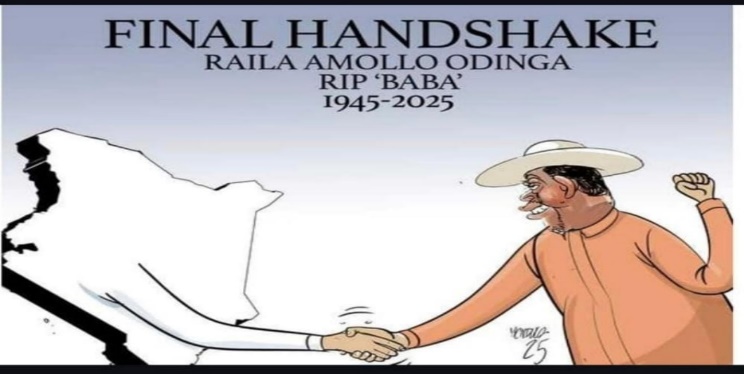
Cartoon 1: The Final Handshake
The Final Handshake cartoon under examination was published by the Daily Nation on October 16, 2025, and distributed via the publication’s official Instagram account, positioning it within the realm of digital visual journalism. It emerged in the immediate aftermath of the demise of Rt. Hon. Raila Amolo Odinga, a situation that influenced both its symbolic significance and its anticipated public reception.
Scene Description
This cartoon depicts the late Raila Amolo Odinga rendered through his most recognisable visual markers: a wide-brimmed hat, earth-toned orange attire, and a raised left fist. He is shown engaged in a handshake with a humanoid silhouette formed in the shape of the Kenyan map. The extended arm of the map-figure traces geographically toward the western region of the country, corresponding to Luo Nyanza, Odinga’s ethnic and political heartland. The overall visual grammar of the composition is nostalgic and reconciliatory, suggesting a final act of mutual recognition between a nation and its most enduring political dissenter.
First-Order Semiotic Analysis: Denotation
At the denotative level, the cartoon shows a recognisable Kenyan political figure who is identified through iconic costume elements. The political icon: Raila Amolo Odinga is engaging in a handshake with a personified representation of the Kenyan nation. The handshake is the image’s central compositional act: a reciprocal gesture of greeting, acknowledgement, or farewell. The Kenyan map-silhouette stands in for the nation as an abstracted collective entity. Odinga’s raised fist is the other primary denotative sign, identifying him as a figure in a posture of assertion or salutation.
Second-Order Semiotic Analysis: Connotation and Myth
At the second order of signification, each of the cartoon’s major sign clusters carries connotative weight that, taken together, produces a complex and at times contradictory mythological statement about Odinga’s identity, his relationship with the Kenyan nation-state, and the political meaning of his death.
The Raised Fist: The Myth of Perpetual Resistance
The raised left fist is among the most semantically loaded signs in the global vocabulary of political iconography. In the tradition of Pan-Africanist resistance, socialist solidarity movements, and anti-colonial struggle, the raised fist denotes defiance, popular power, and organised opposition to systemic oppression. In the specific context of Kenyan political culture, and in relation to Odinga’s career in particular, the gesture condenses five decades of opposition politics into a single frozen pose. It does not denote a specific electoral campaign or legislative contest but the entire accumulated repertoire of Odinga’s adversarial relationship with state power.
The Barthean myth produced by this sign in the context of a posthumous tribute cartoon is one of irreducible vocation. The fist raised in greeting and in a handshake simultaneously, in a moment of apparent reconciliation, denotes not the suspension of struggle but its continuation into and through death. Odinga does not lower the fist even as he shakes the nation’s hand. This is the cartoon’s first mythological claim: that resistance and recognition are not opposites but can coexist in the same gesture, which the dissenter and the nation can reach toward each other without either party fully surrendering their constitutive identity.
The Personified Map: Naturalizing the Nation as a Moral Actor
The decision to depict Kenya as a sentient, humanoid figure capable of extending a hand toward Odinga is one of the cartoon’s most significant semiotic moves. At the denotative level, it is simply a visual convention for ‘the nation.’ At the connotative level, however, the personification transforms the Kenyan state from an institutional arrangement constituted by specific actors, power interests, historical decisions, and documented violations into a natural, unitary, feeling entity. As Barthes (1957/1972) contends, myth operates precisely by this kind of naturalization: it converts the historical into the essential, the contingent into the inevitable.
The moral significance of this conversion cannot be overstated. By depicting Kenya-as-nation extending its hand to Odinga in posthumous recognition, the cartoon confers retroactive magnanimity on the political establishment that the historical record does not clearly support. The state that detained Odinga, allegedly defrauded him of electoral victory across multiple cycles, and deployed force against his supporters dissolves into the figure of a bereaved nation reaching toward its lost son. Myth, as Barthes insists, does not lie; it simplifies. The nation-as-mourner is not false, but it is incomplete.
Orange Attire: Political Identity as Chromatic Code
Odinga’s orange attire functions as a dense chromatic political signifier. Orange is the colour of the Orange Democratic Movement (ODM), the party Odinga founded and led for nearly two decades. This is the colour under which he contested the 2007 and subsequent elections. In Kenyan political semiotics, orange is inseparable from Odinga’s political identity, much as his hat functions as a personal index. At the connotative level, the orange attire in a memorial cartoon insists that Odinga’s party identity does not dissolve into generic nationalist sentiment now of death; he arrives at the national handshake as himself, an ODM man, an opposition figure, not a neutral citizen.
The myth this sign produces is one of political integrity: the man who shakes Kenya’s hand does so without having first changed his colours, literally or figuratively. He remains, in death, what he was in life. This is a fact the cartoonist embeds in the most immediately legible visual vocabulary available.
The Geography of the Handshake: Spatial Myth and the Centre-Periphery Reproduced
The cartoon’s most analytically generative dimension is also its most easily overlooked: the spatial directionality of the handshake. The extended arm of the Kenya map-figure points geographically toward Luo Nyanza, Odinga’s ethnic heartland in western Kenya. This is not a neutral compositional choice. As Hall (1997) argues, spatial hierarchies in representational systems reinscribe the very structures they appear to transcend. The map does not extend from a geographically central or neutral position; it reaches from the center toward the periphery. More precisely, the periphery reaches toward the center, while the center extends back just far enough to complete the handshake.
The directivity is telling: Nyanza reaches toward Nairobi, the margin toward the centre, yet Kenya as a whole does not visually reorient toward the west. As Ngũgĩ wa Thiong’o (1986) reminds us, geography is never innocent but rather a colonial text upon which belonging and legitimacy are inscribed. The cartographic detail of the handshake subtly re-ethnicizes Odinga even as the image’s mythological surface claims to universalise him. He is Baba to the nation, and yet the geometry of the image locates him, undeniably, on the margin.
The Handshake as Mythological Settlement
Viewed as a whole, the handshake motif performs what might be called a mythological settlement. By depicting the nation and its most enduring political adversary in a final mutual gesture of recognition, the cartoon normalizes what was historically a profoundly fractured relationship. Electoral disputes, state persecution, post-election violence, and unresolved institutional injustices are evacuated from the composition’s field of meaning. Essence displaces history: Odinga’s struggle is recast not as a reasoned political response to structural injustice but as an innate, timeless dimension of his identity that the nation now retrospectively embraces.
This is Barthes’ central mythological mechanism: myth does not deny history; it purifies it, stripping away contingency and conflict and presenting the image as inevitable and whole. The handshake says: this was always going to happen. This was always the destination. In doing so, it quietly absolves the political order that made Odinga’s lifelong opposition both necessary and ultimately incomplete of accountability.
Application of Framing Analysis Dimensions
The cartoon portrays the primary concern as unresolved national reconciliation, or the enduring divide between Odinga’s enormous popularity and his persistent institutional exclusion. Although the image’s geometry suggests the closure is only partial, his death ultimately, if posthumously, ends this gap. It remains unclear who is responsible for the estrangement that makes the last handshake necessary. The comic’s visual language achieves reconciliation rather than assigning guilt. However, by placing the gesture in Nyanza rather than in a nationally neutral center, the spatial coding discreetly links the alienation to a structural imbalance between the center and the periphery rather than to a particular political player.
Both Odinga and Kenya are morally elevated by the handshake: Odinga is presented as a figure deserving of national honour, while Kenya is seen as a country capable of granting it. However, a subtle qualification is introduced by the raised fist: the figure who upheld his oppositional integrity to the end is credited. Notably, the cartoon does not urge Odinga to have become someone he wasn’t in order to win the country’s hand. The cartoon subtly urges a national reckoning with Kenya’s past treatment of political dissidents at the level of treatment recommendations. By portraying Odinga’s passing as the reason for a farewell handshake, it suggests that death should not have been necessary for this kind of acknowledgement. In the end, the suggestion is retroactive: the country ought to have embraced Odinga when he was still able to do so.
Centre-Periphery Dynamics
The Final Handshake cartoon occupies a paradoxical place within the study’s overall Center-Periphery theoretical framework. On its mythological surface, it seems to collapse the center-periphery dichotomy: in death, the periphery figure is finally accepted by the center he had spent his entire life trying to reach. However, the image’s spatial coding (the arm stretched from Nyanza, the directionality from margin to center) shows that the binary is replicated even as it appears to be resolved. The country does not go west to meet Odinga on his own territory; instead, as it always does, the periphery reaches toward the center.
This is the aspect of the cartoon’s mythological economy that reveals ideology. The handshake resolves the aesthetic issue while preserving the structural integrity of the center-periphery framework. The country offers its condolences, but it does so from its own cartographic center and within its own geographic parameters. Even after being granted national status, Odinga remains geographically on the periphery. The distance that requires a handshake is not closed, yet the handshake itself is real.
| Level | Signifier | Signified (Connotation) | Myth Produced |
|---|---|---|---|
| Denotation | Wide-brimmed hat, orange attire | Odinga’s personal appearance | - |
| Connotation | Orange attire (ODM colour) | Party and political identity retained | The dissenter arrives unchanged; integrity is non-negotiable |
| Denotation | Raised left fist | Salutation / assertion | - |
| Myth | Fist raised during handshake | Resistance co-exists with recognition | Vocation and reconciliation are not opposites |
| Denotation | Humanoid Kenya map | Nation personified | - |
| Myth | Nation as sentient mourner | State laundered into bereaved community | Institutional coercion is aesthetically dissolved |
| Connotation | Arm extends from Nyanza | Geographic directionality | Periphery reaches toward centre; structure reproduced |
| Framing | Final posthumous handshake | Reconciliation deferred until death | The nation could have embraced its dissident sooner |
Cartoon 2: Kenya Mourns
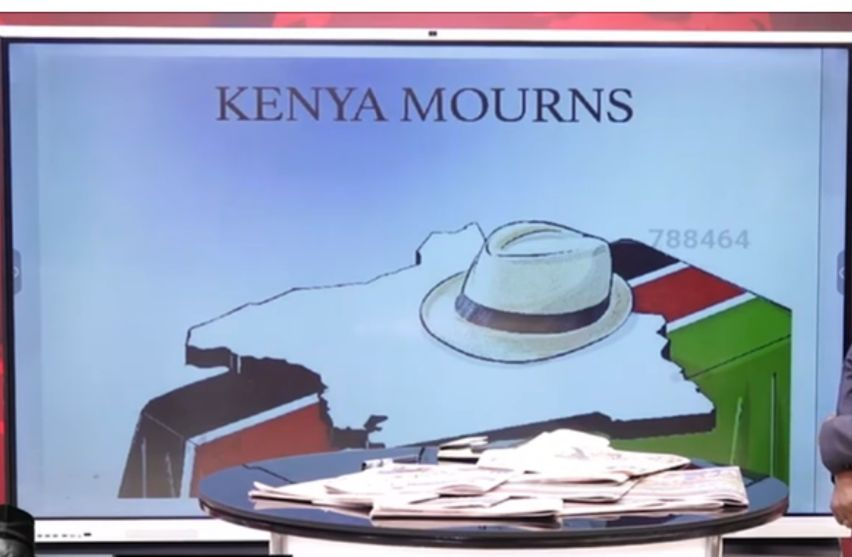
The cartoon under analysis was published in the print edition of the Daily Nation on October 16, 2025, one of Kenya’s most widely circulated and editorially influential broadsheets. Its publication situates it within the domain of traditional print journalism, a medium that carries institutional authority in the context of national mourning and public commemoration. The cartoon appeared in direct response to the death of Rt. Hon. Raila Amolo Odinga, a context that invested its visual content with heightened symbolic significance and framed its reception within an atmosphere of collective national grief.
Scene Description
The cartoon’s composition is relatively simple. The overall image consists of three components: a map of Kenya rendered in the colours of the national flag, Odinga’s recognizable wide-brimmed hat placed on or over the map, and the flag’s colour scheme applied to the cartographic surface. Apart from the two-word caption “Kenya Mourns,” there are no narrative actions, verbal acts, or human figures. The empty hat resting on a nation in grief gives the composition a motionless, elegiac quality. The main semiological statement of the cartoon is that there is no body beneath the hat.
First-Order Semiotic Analysis: Denotation
At the denotative level, the cartoon shows a political figure’s most iconic item of clothing: the hat placed upon a map of the country in which that figure was a major public actor, with the map coloured in the national flag’s palette. The composition is a visual announcement of death and national mourning: the hat without the body signals absence, the flag colours signal the national register of the loss, and the map grounds the event geographically. These are the elementary, descriptive facts of the image. The analytical labour begins when we move to the second order of signification.
Second-Order Semiotic Analysis: Connotation and Myth
The Hat as Myth-Sign: Absence, Identity, and the Conversion of Person into Symbol
The hat is the cartoon’s principal and most semantically rich element. In Kenyan political culture, Odinga’s wide-brimmed hat has transcended its role as a simple garment, attaining the status of a myth-sign as defined by Barthes (1957/1972): a sign stripped of its material specificity and imbued with the concentrated significance of a complete political identity. The hat signifies not merely headwear, but rather Odinga himself, his career, his aesthetic identity, and the substantial gravity of his public importance.
This cartoon depicts the headgear sans the accompanying man. This is a significant semiological operation: the body is absent, yet the sign persists, freed from the contingencies of the living individual and lifted to the realm of pure symbol. This is myth generated through absence, as characterized by Barthes (1957/1972). The hat is no longer owned by a politician who engaged in five elections, suffered incarceration, spearheaded large protests, facilitated negotiations, and executed smart compromises crucial to five decades of pragmatic politics. It has now entered the realm of legend. History is subtly supplanted; legacy occupies its position.
This represents the cartoon’s most consequential mythological function. By depicting solely the hat, the most portable, transferable, and reproducible emblem of Odinga’s identity, the cartoon exemplifies the condensation that Barthes articulates: the intricate, contradictory, historically particular individual is reduced to a naturalized pattern. The hat is perfect. It lacks any of the tactical complexities inherent in the man’s actual political career. In the ultimate Barthean sense, it represents the myth of Odinga: reduced, emotionally comprehensible, and ideologically advantageous.
The Flag-Coloured Map: Sanctification of Territory and the Spatial Myth of Inclusion
The map of Kenya depicted in the colours of the national flag operates with comparable ideological significance. At the denotative level, it is a geographic depiction of the nation in a recognizable colour palette. The use of flag colours on the map signifies the sanctification of national territory, transforming a geographic outline into a venerated national entity, infused with the sovereignty, constitutional authority, and collective identity represented by the flag’s colours. The map transcends its role as a physical reference, evolving into a moral and political assertion regarding belonging and nationhood.
The positioning of Odinga’s hat on this revered cartographic surface is not merely a compositional decision but a profound mythological assertion: it posits that Odinga’s identity is fundamentally integral to the nation: not in its ethnic margins, not in Luo Nyanza, not at the outskirts, but at the very heart of Kenya. As Barthes (1957/1972) would observe, this becomes a myth of spatial integration that retrospectively addresses the unresolved aspects of political life: Odinga is central in death in ways he was consistently marginalized in life.
This centering, however, must be undertaken with critical caution. Ngũgĩ wa Thiong’o (1986) cautions that geographical representation is fundamentally political, and positioning the periphery at the center of the national map may indicate not authentic inclusion but rather absorption: the nation-state assimilating its dissidents on its own terms, at the point when they can no longer dissent. The hat on the map serves not merely as an homage; it may also represent a posthumous absorption. The perimeter is ultimately allowed to occupy the center because it no longer poses a threat to it.
Minimalism as Mythological Strategy
Where the preceding sections read the hat and the map as individual signs, this section considers what the cartoon leaves out. Kenya Mourns contains no speech balloon, no dialogue and no human figure; its only verbal element is the two-word caption that gives the cartoon its title. In Barthes’ (1977) terms, a linguistic message of this kind anchors an image, steering the reader towards one of the many meanings it could carry. What is striking is where this caption places its emphasis: it names the nation and the act of mourning, but not the man. Odinga’s identity is left entirely to the hat, which the reader must decode from shared cultural knowledge. That the image remains instantly legible without his name is itself evidence of how thoroughly the hat had been naturalised as a sign for Odinga by October 2025. The caption’s choice of subject also quietly repeats the cartoon’s larger move of converting a political life into a national emotion.
The composition’s visual economy also governs salience. With only two elements on the page, nothing competes with the hat for the reader’s attention. Kress and van Leeuwen (2006) note that salience is produced through size, placement, tonal and colour contrast, and that an element placed at the centre of a composition is read as the nucleus of its information, with surrounding elements subordinate to it. Placing the hat at the centre of the national map therefore makes it both the most salient element and the informational nucleus of the image. Entman (1993) describes framing as selecting some aspects of a perceived reality and making them more salient, and he stresses that frames are defined as much by what they omit as by what they include. The cartoon’s reduction is therefore not a neutral simplicity but a framing decision: by making the hat the only thing to look at, it makes Odinga’s symbolic presence the only thing to think about.
Finally, omission frames the mourning itself. The absence of a body, of mourners, of a crowd and of any political actor leaves an image with no narrative and no conflict. Grief is shown as a state rather than an event: nothing happens, no one acts, and no one is held responsible. This is the sense in which minimalism works as a mythological strategy. Barthes (1957/1972) argues that myth presents what is historical as though it were simply self-evident. An image this spare seems too simple to carry ideology at all, and that apparent innocence is what allows it to naturalize Odinga’s death as a purely national, depoliticized loss. What is left out, including the detention cells, the disputed elections and the state that stood between Odinga and the centre, is precisely what the image cannot be questioned about, because nothing in it points there.
Application of Framing Analysis
The cartoon presents the issue as a matter of national loss: the permanent disappearance of an individual whose identity had grown intertwined with Kenya’s political landscape. The vacant hat delineates the issue both geographically and symbolically: the emblem persists, yet the individual has vanished. The initial dimension of analysis pertains to problem definition, whereas the cartoon’s visual economy conveys meaning through its omissions. The void within the hat is not merely incidental to its significance but integral to it; absence itself is the argumentative essence.
The cartoon does not make any causal attribution. Its minimalism intentionally eliminates agency: there is no person, no gesture, no inciting incident – only the consequences of death. The evacuation of causality holds ideological significance. By eliminating any causal framework from the image, the cartoon depicts Odinga’s demise as a natural event, detached from political or structural context. Characterizing death solely as finitude, rather than as a historical occurrence, constitutes a specific interpretive act that stifles inquiry rather than encourages it.
The ethical assessment inherent in the image functions at the utmost level of sophistication. The flag-coloured map symbolizes constitutional nationhood and sovereign identity, serving as the interpretive framework for evaluating Odinga’s life. By positioning the hat at the topographical center of this revered land, the image asserts that Odinga’s contribution holds national moral significance: that it resides not on the periphery of Kenyan political memory but at its core. The nation serves as both the framework and the standard for the individual.
This graphic, in contrast to the initial cartoon, suggests no specific political solution and proposes no programmatic trajectory. The subliminal suggestion is one of reflection: the nation that currently adorns itself with the symbolic colours of this individual is implicitly urged to scrutinize the disparity between its posthumous veneration and its past treatment of him. The hat on the map serves as an homage; nevertheless, the cartoonist intentionally leaves ambiguous whether it also acts as an indictment: a tacit acknowledgment of the discrepancies in how nations commemorate the deceased and how they regard the living.
Centre-Periphery Dynamics in Cartoon 2
Cartoon 2 attempts, more overtly than Cartoon 1, to spatially rectify the center-periphery hierarchy. The hat is not situated in Luo Nyanza; it is located at the center of the national map. This serves as a purposeful geographical modification; a visual assertion that Odinga’s identity is situated not at the ethnic periphery where he was consistently positioned during his political career, but at the national center from which he was continually excluded. However, as the earlier examination illustrates, this spatial adaptation is inherently contradictory in its mythical function. Hall (1997) observes that posthumous national affiliation is the most ideologically beneficial kind of attachment, as it involves no structural reciprocity. The center can assimilate the peripheral figure once the figure is incapable of imposing demands on the center. Odinga is seen in the cartoon at the precise moment of his complete political incapacitation, his demise. The centre-periphery structure is not eradicated; it is temporarily suspended, aesthetically, for the period of the image, while the structural conditions that generated it remain unexplored.
The cartoon’s main ideological contradiction lies in the fact that as it effectively positions Odinga within the national context, it also highlights the circumstances of his marginalization in life. A hat at the heart of Kenya is a strong symbol. This indirectly acknowledges that the individual who donned that hat dedicated his life to attaining the center that the cartoon now readily bestows upon him.
| Level | Signifier | Signified (Connotation) | Myth Produced |
|---|---|---|---|
| Denotation | Wide-brimmed hat (without body) | Personal accessory signalling absence | - |
| Myth | Hat as independent sign | Man converted to symbol | History displaced; legacy naturalised |
| Denotation | Kenya map in flag colours | National territory marked | - |
| Connotation | Flag colours as sacred coding | Territory converted into moral entity | Nation sanctified; mourning elevated to constitutional register |
| Myth | Hat placed at map’s centre | Peripheral figure spatially integrated | Centre absorbs dissident; inclusion deferred to death |
| Connotation | Minimalist composition | Simplicity as rhetorical strategy | Myth of innocence; ideology hidden in apparent obviousness |
| Framing | Empty hat; no human figure | Absence as central statement | National loss naturalised; structural context evacuated |
The Barthean Myth of the Alternative Social Actor
Both cartoons contribute to the creation of what Barthes would identify as a myth of Odinga: a second-order semiological system wherein the historical, contingent, and contradictory figure of Raila Amolo Odinga is reconstituted as a naturalised archetype: the Alternative Social Actor. This myth operates by stripping the sign ‘Odinga’ of its historical specificity, namely, the tactical decisions, alliances, handshakes, compromises, and failures of a five-decade political career, and replacing it with the archetype of the noble outsider, the perpetual reformer, the individual who was perpetually at the threshold but never within.
The Final Handshake myth legitimizes this identity through the portrayal of a man who preserved his chromatic and gestural authenticity till the end: dressed in orange, fist raised, confronting the nation on his own terms even in death. The Kenya Mourns myth naturalises it through the figure of a sign (a hat) so thoroughly emptied of biographical complexity that it can be placed anywhere, on any surface, and carry only the weight of legend. Collectively, they create an Odinga whose potency is directly proportional to his simplification; the intricacies of his political journey are the cost of the myth’s emotional impact.
This mythologization accomplishes critical ideological roles in the posthumous public sphere. It maintains the recollection of Odinga as a symbol of unadulterated opposition, unencumbered by the handshakes, coalitions, and tactical compromises that characterized his genuine political trajectory. It safeguards the fiction of unwavering advocacy from the uncertainties of actual political practice. It generates, for the readers of the cartoons, a simplified, emotionally impactful, politically comprehensible character: the peripheral figure whose importance lies in his enduring connection to a center that will never fully accept him. The most probing question these myths evoke, and cannot resolve, is whether the Alternative Social Actor delineates Odinga’s political stance or serves as a requisite prescription dictated by the story economy of Kenyan politics. If the myth requires its peripheral figure, it also necessitates the center to remain intact. By portraying Odinga as the perpetual outsider, these cartoons may unintentionally mythologize and therefore legitimize the political framework that facilitated his banishment.
Cartoon 3: Raila at the Gates of Heaven
Publication Details
| Publication | The Standard Digital/KTN Platform |
|---|---|
| Date | 20th October 2025 |
| Medium | Digital (online editorial cartoon) |
| Context | Death of Rt. Hon. Raila Amolo Odinga, October 2025 |

Scene Description
The scene is set in heaven, signified by clouds. There is a closed gate with a switch on its side. Two characters are present. The first is an angel dressed in purple regalia with white wings, standing behind a purple podium. The second is the late Raila Amolo Odinga, rendered through his iconic visual markers: a blue fedora hat, blue trousers, an orange belt, orange socks, black shoes, a white shirt with an orange tie, and folded sleeves. Odinga carries a white banner reading ‘ELECTORAL REFORMS.’ The angel addresses him: ‘...WHILE YOU WERE ON YOUR WAY, THE PRESIDENT SIGNED THE CYBERCRIME LAW!’
First-Order Semiotic Analysis: Denotation
At the denotative level, the cartoon depicts Raila, a recently deceased Kenyan politician, arriving at the gates of heaven, still carrying a protest banner, and being informed by an angelic gatekeeper of a law passed in his absence. The visual grammar is relatively conventional: clouds and a gate connote heaven; wings and purple garments identify the angelic figure; the fedora, which Odinga wore consistently in his public life, functions as an immediate index of identity.
Second-Order Semiotic Analysis: Connotation and Myth
At the second order of signification, the image is considerably richer. Each major sign cluster carries connotative weight that, taken together, produces a powerful mythological statement about Odinga’s identity, political mission, and relationship with the Kenyan state.
The Heavenly Gate as Liminal Threshold
The gate, shown closed at Odinga’s arrival, functions as more than an architectural detail. Connotatively, a closed gate at the threshold of heaven, the final destination, reproduces the central theme of Odinga’s entire political life: exclusion from centres of power. At the denotative level, it is simply the entrance to the afterlife. At the connotative level, it evokes every electoral defeat, every post-election exclusion from government, every locked door of the State House. The Barthean myth produced here is that exclusion is Odinga’s natural condition, that even death cannot alter the constitutive tension of his identity as the outsider who perpetually arrives at a threshold he is not yet permitted to cross.
The switch on the gate’s side introduces an additional semiotic layer. Unlike an organic barrier, a switch implies a human-controlled system; power is exercised by those who control the mechanism. In the Kenyan political imaginary, this resonates with the recurring narrative that Odinga’s exclusions were not inevitable outcomes but deliberate acts of institutional gatekeeping.
The Angel in Purple: Sacred Authority and Its Irony
The angel’s purple vestments function on multiple semiotic registers. Denotatively, purple identifies an ecclesiastical and royal figure. Connotatively, the colour carries a specific art-historical and liturgical weight: historically associated with Roman imperial authority and subsequently adopted by the Catholic Church for Advent, Lent, confession, and mourning, purple in its funerary usage contextualizes Odinga’s arrival as a rite of passage, a crossing between life and death that is being solemnized. However, the angel functions here not as a solemn celebrant but as a news-bearer delivering political intelligence. The irony of this role, a celestial gatekeeper reduced to a political commentator, is a classically Barthean mythic operation. The sacred is converted into an instrument to carry the irreverent: heaven itself is made to witness and implicitly pass judgment on the political machinations of the Kenyan state. By placing political commentary in the mouth of an angel, the cartoonist naturalizes the idea that Odinga’s political struggles possess a moral-spiritual, not merely civic, significance. This is myth-making at its most pointed.
Odinga’s Dress Code: The Semiotics of Political Identity
Odinga’s chromatic coding is highly deliberate. The blue fedora hat and blue trousers reference the Azimio la Umoja coalition of the 2022 general election, the most recent major political formation of which Odinga was the standard-bearer. The orange tie, belt, and socks reference the Orange Democratic Movement (ODM), the party Odinga led for two decades.
This dual colour-coding is semiologically significant. Rather than dressing Odinga in a single, uniform political colour, the cartoonist presents him as inhabiting multiple simultaneous political identities, the electoral alliance (blue) layered over the party foundation (orange). This is a sign of Odinga’s political identity, which was not monolithic but historically layered, each colour marking a different chapter of his public life. The fedora itself functions as what Barthes would call a ‘myth-sign’; it has long become a near-universal visual shorthand for Odinga himself, emptied of its material origin and reinvested with the condensed meaning of an entire political career.
Folded Sleeves: The Myth of Perpetual Labour
The folded shirt sleeves are a particularly rich sign. In the iconography of labour and activism, rolled sleeves denote readiness, industriousness, and an orientation towards practical work rather than ceremonial posturing. Connotatively, the sign positions Odinga not as a statesman arriving at his final rest but as a worker who has not yet completed his task, perhaps who never can. The Barthean myth this sign naturalizes is one of irreducible vocation: Odinga does not arrive in heaven as a retiree but as an activist whose identity is so thoroughly constituted by struggle that even death cannot produce a posture of completion or repose.
The Electoral Reforms Banner: Perpetual Opposition as Myth
The white banner reading ‘ELECTORAL REFORMS’ is the cartoon’s most explicitly political sign. As a denotative element, it identifies the cause Odinga carried throughout his political life, his repeated contestations of electoral processes that he and his supporters regarded as rigged, his advocacy for institutional reform, and his role as the principal opposition voice on this issue over three decades. Connotatively, the banner’s whiteness echoes the purity connotations of martyrdom, the white of innocence, of moral clarity, of causes unsullied by the compromises of power.
The myth produced by the banner in this context is a powerful one: that the cause of electoral justice in Kenya is inseparable from Odinga himself, so fully that it travels with him beyond death. This is a mythologisation of the man into the movement. This Barthean naturalization risks blocking the institutional and structural dimensions of the electoral reform project by anchoring it entirely in a single charismatic figure.
The Angel’s Message: The Cybercrime Law and Political Irony
The angel’s statement that the President signed the Cybercrime Law while Odinga was ‘on his way’ is the cartoon’s central punchline and it’s most pointed political intervention. The underlying fact is a matter of record: President William Ruto assented to the Computer Misuse and Cybercrimes (Amendment) Bill, 2024, on 15 October 2025, the same day Odinga died (Human Rights Watch, 2025; Walter, 2025). The causal relationship, however, belongs to the cartoon rather than to the historical record. The cartoon implies that Odinga’s presence in Kenya functioned as a political restraint, and that his absence, even in the liminal period of dying, created an opening the state was quick to use. This reading echoed contemporaneous criticism of the law. Human Rights Watch (2025) argued that its overbroad provisions risked criminalizing legitimate online speech, and the Kenya Human Rights Commission challenged it in court as a threat to privacy and freedom of expression (Walter, 2025). The government, for its part, defended the amendments as targeting terrorist recruitment, radicalization, pornography and cyberbullying (Capital FM News, 2025). This study does not adjudicate between these positions; its concern is how the cartoon uses the coincidence of timing to construct Odinga as a restraint on state power.
This is a classic Barthean mythic operation in reverse: rather than naturalizing the existing power structure, the cartoonist denaturalizes it by exposing its contingency. In the cartoon’s logic, the Cybercrime Law is not presented as natural, inevitable, or just; it is presented as having passed because the political actor most likely to contest it was no longer present to do so. Odinga’s death is thus reframed not as a private loss but as a structural political event with immediate institutional consequences. The state, in this framing, required Odinga’s presence, even as an adversary, to be held in check.
Framing Analysis Dimensions
From the framing-analysis perspective, responsibility is assigned not to any single actor but to the political system itself. The cartoon implicates a governance architecture that has grown dependent on singular opposition figures rather than on institutionalized checks and balances. In this framing, Odinga is simultaneously constructed as critical and irreplaceable, a characterization that functions as both a tribute to his legacy and a pointed indictment of Kenya’s failure to cultivate durable, institution-based democratic accountability. The moral evaluation embedded in the cartoon is rendered through the figure of the angel, whose sacred authority elevates Odinga’s mission beyond the political into the transcendent. The implied message is that the cause of electoral reform and civic liberty carries divine sanction, and that by contrast, the Cybercrime Law represents not merely a legislative act but a moral transgression: a deliberate assault on freedoms that the cartoon frames as both constitutionally and spiritually inviolable. Finally, in terms of treatment recommendation, the cartoon stops short of explicit prescription but communicates a clear implicit directive: the cause Odinga carried must be taken up and continued by others. The banner of electoral reform cannot be permitted to ascend to heaven in the hands of the one man who bore it. The visual grammar of the cartoon, in this sense, functions as a civic call to action: an appeal to collective responsibility in the face of a political vacuum that, in the cartoon’s telling, the state is already positioned to fill.
Centre-Periphery Dynamics in Cartoon 3
Within the study’s overarching Centre-Periphery theoretical framework, Cartoon 3 maps Odinga’s death onto his constitutive structural position. Even at the moment of departing the earthly plane, he remains identified with opposition and reform, with the periphery rather than the centre. Heaven, in this frame, is merely another threshold at which Odinga arrives without being able to cross, another State House gate. The cartoon mythologizes his outsider identity as absolute and transcendent: it is not a contingent feature of his political career but an ontological condition.
This framing carries a melancholic ideological charge. On one hand, it celebrates Odinga’s unwavering commitment. On the other hand, it inadvertently naturalizes the very power structure it critiques: by presenting Odinga’s exclusion as so total that even death reproduces it, the cartoon risks suggesting that reform and the centre’s resistance to it are equally eternal, that nothing can fundamentally change.
| Level | Signifier | Signified (Connotation) | Myth Produced |
|---|---|---|---|
| Denotation | Blue fedora, orange tie/belt/socks | Odinga’s clothing | - |
| Connotation | Blue (Azimio) + Orange (ODM) | Layered political identity | The political man is inseparable from his campaigns |
| Denotation | Closed gate in clouds | Heaven’s entrance | - |
| Connotation | Controlled gate mechanism | Systemic exclusion | Gatekeeping is natural to Odinga’s existence |
| Denotation | Angel in purple | Ecclesiastical authority | - |
| Myth | Angel as a political informant | Sacred bearing witness to profane politics | Odinga’s struggle has moral-cosmic significance |
| Denotation | Folded sleeves | Readiness to work | - |
| Myth | Sleeves folded even in death | Vocation survives death | Odinga’s activist identity is ontological, not contingent |
| Denotation | ‘Electoral Reforms’ banner | Protest sign | - |
| Myth | Banner carried to heaven | Cause is co-extensive with the man | Democratic reform is martyred alongside Odinga |
| Framing | Cybercrime Law signed in transit | State portrayed as exploiting his absence | Opposition is a structural necessity, not a luxury |
Cartoon 4: Reunion in Heaven
Publication Details
| Publication | The Star Newspaper |
|---|---|
| Date | 16th October 2025 |
| Medium | Print (editorial cartoon) |
| Context | Death of Rt. Hon. Raila Amolo Odinga, October 2025 |
Scene Description
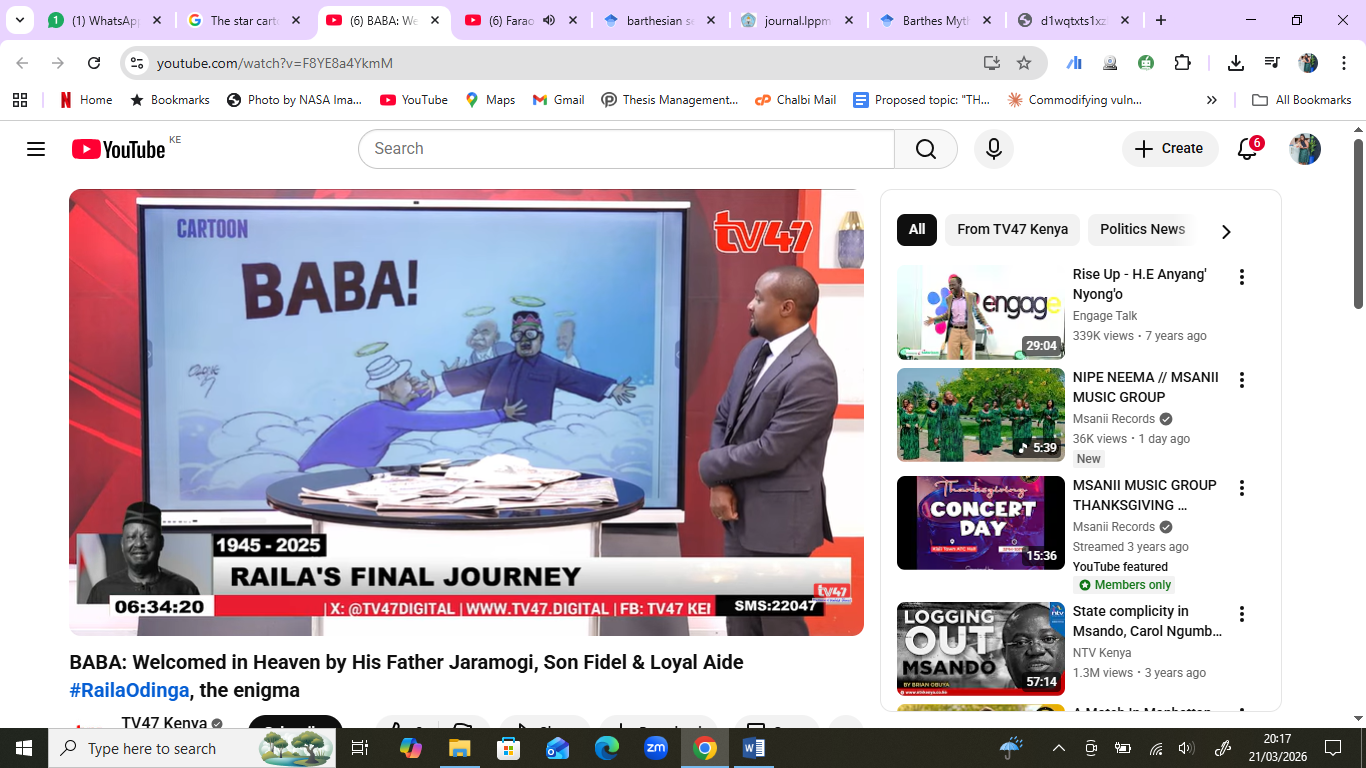
Set in heaven, signified by clouds and halos above each character, the cartoon depicts four figures. Raila Odinga, rendered by his iconic fedora hat and dressed in blue, arrives with arms outstretched in a gesture of embrace. He is received by: (1) his late father, Jaramogi Oginga Odinga, dressed in a Kaunda suit and ligisa hat; (2) his former aide, George Oduor, who died in April 2025; and (3) his son, Fidel Odinga, who died in 2015. The scene is a family reunion in the afterlife.
First-Order Semiotic Analysis: Denotation
At the denotative level, the cartoon shows a deceased political leader arriving in heaven and being greeted by previously deceased family members and a close personal associate. The composition is warm and embracing in its visual grammar, seen in the open arms, proximate bodies, the horizontally unified group of four, all conventional visual signs of reunion and welcome.
Second-Order Semiotic Analysis: Connotation and Myth
Heaven as the Site of Familial Belonging
The choice to set the reunion exclusively within the family unit, and the conspicuous absence of political colleagues, allies, rivals, or the millions of ordinary Kenyans who supported Odinga, is the cartoon’s most significant semiotic decision. Heaven, which in the dominant Christian imaginary is a community of the righteous, is here rendered as a private family compound. This is a radical compression of Odinga’s social identity: the public man is dissolved into the private figure, the national leader is reduced to son, father, and employer.
Connotatively, this framing reproduces a Luo cultural understanding of belonging in which the family homestead, known as ‘dala’, is the primary unit of social identity, and where the dead return to the ancestral home. The ligisa hat of Jaramogi and the Kaunda suit are tailored markers of a specific generational and cultural moment: the post-independence African leader, pragmatically dressed in the nationalist aesthetic of the 1960s and 1970s. Jaramogi’s attire places him immediately in the register of the founding generation of Kenyan nationalism, and his presence as the figure of welcome establishes a dynastic continuity.
The Halos: Universalizing Sainthood
All four figures bear halos, which in Christian iconography denote divine favor and moral perfection. The bestowal of halos upon all four characters, including figures like George Oduor, whose public profile was minimal, is a democratizing and universalizing gesture within the sacred register. The myth produced is that proximity to Odinga (familial or associational) confers sanctity. This is a significant ideological operation: it positions the entire Odinga relational network within a hagiographic frame.
More broadly, the halo functions as a ‘myth of totality’: by sanctifying all those present, the cartoon naturalizes the idea that Odinga’s cause was righteous, that those who supported or were close to him were morally elevated by that association, and that his death constitutes a kind of martyrdom (Barthes, 1957/1972).
The Absent Multitude: Framing by Exclusion
Perhaps the most analytically productive aspect of Cartoon 4 is not what it includes but what it excludes. Odinga’s political life was constituted by mass mobilization: millions of Kenyans rallied to his cause across five presidential campaigns. His funeral, vigil, and public functions, including campaigns and public protests, drew enormous crowds. Yet in heaven, he is met only by four individuals, all of them members of his private relational sphere.
This exclusion is not incidental; it is the cartoon’s central ideological statement, and it maps precisely onto the study’s Centre-Periphery framework. Odinga, despite having functioned as the most visible symbol of popular political aspiration in Kenya for four decades, is consigned, even in the afterlife, to the margins of the national community. The crowd that defined his public identity is absent. In their place is the small, intimate circle of family and aides.
This is a deeply ambivalent semiotic operation. On one reading, it is a humanizing gesture: it insists that beneath the public persona, there was a private man of family and loyalty. On another reading, it reproduces the very marginality that defined his political life, the suggestion that, however large his following in the streets, he remained ultimately alone at the decisive threshold, without the institutional allies and power-centre embrace that his public stature might have warranted.
The Fedora and the Ligisa: Dynastic Symbolism
The juxtaposition of Raila’s white fedora and Jaramogi’s ligisa hat is semiologically rich. Both items of headwear function as dynasty-markers, each indexing its wearer’s era, aesthetic, and political orientation. The ligisa is associated with western Kenya’s cultural heritage and the socialist-nationalist politics of the first generation of independence leaders. The fedora is cosmopolitan, pan-African, and associated with Odinga’s later urban, rights-based political identity.
Together, the two hats represent a political dynasty in transition: from Jaramogi’s socialism and nationalist foundationalism to Raila’s liberal democratic advocacy. The myth this juxtaposition produces is one of dynastic continuity and historical purpose, the idea that the Odinga political project is not the work of one man but of a lineage, a mission passed from father to son across generations. This mythologization of political heredity naturalizes the idea that the Odinga family has a special, historically ordained role in Kenyan political life, a role that death cannot terminate.
George Oduor and Fidel Odinga: Loyalty and Loss
The inclusion of George Oduor, Odinga’s longtime personal aide who died months before him, and Fidel Odinga, Raila’s son who predeceased him by a decade, introduces registers of personal loyalty and parental grief into the semiotic field. Oduor’s presence connotatively affirms that Odinga’s relational world was constituted by long-term, intimate loyalty rather than transactional political alliance. Fidel’s presence introduces a note of parental completion: the father rejoins the son, inverting the natural order of grief.
The Barthean myth produced by this configuration is one of fidelity: Odinga is a man surrounded by those who loved and served him faithfully, and who arrived in death before him, waiting. This constructs death as homecoming, a narrative that performs important emotional and ideological work in framing the public reception of Odinga’s passing.
Framing Analysis
From Entman’s (1993) framing dimensions, cartoon 4 does not frame a political problem per se; rather, it frames a condition of existence, the structural isolation of the political outsider, reproduced even in death. The problem is the Centre’s permanent refusal to embrace the Periphery figure, even posthumously. This suggests that causal responsibility for Odinga’s solitude in the afterlife is implicitly attributed to the political centre’s historic failure to integrate him. By choosing to show only family, the cartoonist suggests that Odinga’s political allies and the masses who supported him are, in the ultimate reckoning, absent or insufficient companions.
On moral evaluation, the halos on all four figures perform a moral evaluation of the highest order: those who constitute Odinga’s inner circle are sanctified. The political centre, the presidents who excluded him, the electoral commissioners who allegedly defrauded him, are conspicuously absent and, by implication, unworthy of heaven. Unlike Cartoon 3, this cartoon does not imply an explicit political remedy. Its implicit recommendation is one of historical recognition: that Odinga deserved not merely the loyalty of his family and closest aide, but the full embrace of the nation he served, a recognition that the cartoon, by its very composition, withholds on behalf of the nation.
Centre-Periphery Dynamics in Cartoon 4
Cartoon 4 is perhaps the most devastating articulation of the Centre-Periphery tension in the entire study. In depicting Odinga’s heavenly reception as an exclusively familial event, the cartoon systematically strips away every marker of his public, national, and political identity. He is not received by the people he served. He is not greeted by the political movement he built. He is not met by the institutional recognition that was perpetually denied him in life.
In this framing, the periphery is not merely a political position but a permanent ontological condition, one that even the transcendence of death cannot dissolve. The man who for four decades embodied the political aspirations of millions arrives, in the end, at a private family compound in the clouds. The nation he sought to lead is nowhere to be seen. This is the cartoon’s bleakest, most powerful mythological claim: that Kenya, as a national community, was ultimately unable or unwilling to fully claim Odinga as its own.
| Level | Signifier | Signified | Myth Produced |
|---|---|---|---|
| Denotation | Clouds and halos | Heaven | - |
| Connotation | Heaven as family compound | Private belonging over public legacy | The outsider remains outside even in eternity |
| Denotation | White fedora (Raila) | Identity marker | - |
| Connotation | Fedora meets Ligisa hat | Father-son dynastic encounter | The Odinga political mission is dynastic and hereditary |
| Denotation | Open arms | Greeting, reunion | - |
| Myth | Only family present to receive | Political nation absent | Odinga was never truly embraced by the political centre |
| Denotation | Halos on all four figures | Sanctity | - |
| Myth | Universal halo bestowal | Proximity to Odinga confers sanctity | The Odinga circle is hagiographically elevated |
| Framing | Absent masses and political allies | National recognition withheld | Kenya could not fully own its most prominent outsider |
| Connotation | Fidel Odinga present | Father-son reunion | Death as homecoming; natural grief order inverted |
Comparative Analysis: All four Cartoons
When examined collectively, Cartoons 1 and 2 form a complementary diptych regarding Odinga’s demise, conveying the same essential mythic assertion through notably distinct visual approaches, a structural quality they share with Cartoons 3 and 4, which similarly constitute a diptych that offers complementary and at times contradictory mythological framings. Across all four cartoons, the overarching aim is consistent: to facilitate national healing by retrospectively bridging the disparity between Odinga’s public prominence and his enduring institutional marginalization. Yet the methods each pair employs to achieve this resolution and the ideological tensions they generate in doing so vary considerably both within and between the two diptychs.
Cartoons 1 and 2 resolve Odinga’s death on earthly, civic terrain, while Cartoons 3 and 4 relocate that resolution to the celestial. This spatial distinction is not merely aesthetic; it is ideologically significant. Cartoon 1 (The Final Handshake) is a relational cartoon that necessitates two participants and a gesture. The nation and the individual must converge, extend towards one another, and fulfill an act of reciprocal acknowledgment. This relational framework accentuates the action of both parties and, hence, the historical context of the estrangement that the handshake must transcend. A gap exists; a reaching occurs; a closing transpires. The process is evident, and the spatial geometry of the reaching communicates, if subtly, the structural asymmetry that created the gap. Cartoon 3 (The Standard Digital) operates within a similar logic of continuity and unresolved tension, insisting that Odinga’s death changes nothing politically, that his cause travels with him even into heaven, and that, in the cartoon’s telling, the state moved swiftly to use his absence. It is a cartoon about the political costs of personal loss, and its mythology is one of vocation: the activist is the cause.
Cartoons 2 and 4, by contrast, are each their respective pair’s quieter, more inward counterpart. Cartoon 2 (Kenya Mourns) is a symbolic illustration that necessitates merely an object and a surface. There is no gesture, no agency, no extension: merely the fixed positioning of a sign on consecrated terrain. The handshake of Cartoon 1 signifies the necessity of reconciliation, while the hat on the map implies that national identity is simply asserted: positioning the symbol at the center suffices to settle what decades of political conflict could not. The myth of Cartoon 2 is thus more comprehensive, more ingrained, and more ideologically encompassing than that of Cartoon 1, as it eliminates any evident remnants of the history that necessitates the gesture. Cartoon 4 (The Star) performs a parallel operation at the personal rather than civic register. It is a humanist’s cartoon: it insists that beneath the political actor was a private man of family, loyalty, and grief: a cartoon about intimacy and isolation, about the gap between public stature and private belonging. Its mythology is one of solitude: the great man dies alone, received only by those who loved him personally, not those he served publicly.
The Centre-Periphery tension, which defines Odinga’s political biography, is encoded differently across all four cartoons, yet it never fully escaped. Where Cartoon 3 constructs this tension as a political and institutional problem (the state, as the cartoon implies, exploiting the reformer’s absence), Cartoon 4 renders it as an existential and ontological condition: the outsider is constitutively alone at the threshold. Similarly, Cartoons 1 and 2 each encode the tension spatially. In Cartoon 1, the spatial orientation of the handshake situates Odinga in Luo Nyanza, despite the image asserting his role as Baba to the nation. In Cartoon 2, the rectification of positioning the hat at the national center is comprehensible solely in the context of a political existence experienced at the ethnic periphery: the centering holds significance only due to the recollection of marginalization. This is the mythological deficiency that haunts all four cartoons: none can completely evade the re-ethnicization of the figure they aim to nationalize. According to Barthes (1957/1972), myth does not completely eradicate its original meaning; the sign maintains its historical foundation while the legendary form attempts to surpass it.
Taken together, the four cartoons suggest that Kenya’s media narrative in October 2025 was shaped by a profound and unresolved conflict: the aspiration to recognize Odinga as a national figure, juxtaposed with the systemic inability to adequately interrogate the circumstances that rendered such recognition a posthumous act rather than a current political reality. The cartoonists express authentic sorrow. They do not, however, conduct a structural interrogation. The two diptychs jointly suggest that the Kenyan political cartoonist’s understanding of Odinga’s death was profoundly shaped by the same structural tensions that characterized his life: the gap between his immense popular significance and his permanent institutional marginalization; the tension between his public vocation and his private humanity; the distance between the nation he aspired to lead and the family compound to which he ultimately returned.
The Barthean Myth of the Alternative Social Actor
All four cartoons participate in constructing what Barthes would recognize as a myth of Odinga: a second-order semiological system in which the historical, contingent, contradictory figure of Raila Amolo Odinga is transformed into a naturalized type: the Alternative Social Actor. This myth functions by emptying the sign ‘Odinga’ of its historical specificity (the actual tactical decisions, alliances, compromises, and failures of a five-decade political career) and filling it with the universal form of the noble outsider, the eternal reformer, the man who was always at the gate but never inside. Whether that gate is rendered as a civic handshake, a symbolic hat, a heavenly struggle, or a private reunion, the underlying mythic structure remains constant.
This mythologization serves important ideological functions in the post-mortem public sphere. It preserves the memory of Odinga as a figure of pure opposition, uncomplicated by the handshakes, coalitions, and strategic accommodations that marked his actual political career. It protects the narrative of uncompromising advocacy from the complexities of lived political practice. And it produces, for the cartoons’ readers, a simplified, emotionally resonant, and politically legible figure: the periphery player whose significance is precisely his permanent relationship to a centre that will not have him.
Conclusion
Across all four cartoons, political cartooning reveals itself as a potent site of mythological production and ideological negotiation. Through the application of Barthean semiotics, what appears as simple tribute imagery (a handshake, a hat on a map, a man carrying his banner through heaven’s gate, a father greeted by his son in the clouds) unfolds into a complex domain where the competing demands of national mourning, historical accountability, ethnic recognition, and political legitimation are simultaneously advanced and suppressed. The cartoonists have produced, in these four images, some of the most penetrating commentary on Odinga’s life and Kenya’s political culture available anywhere in the record of his passing.
The Centre-Periphery framework finds in these cartoons both its clearest visual expression and its most telling limitation. Each image strains toward the dismantling of the centre-periphery binary by positioning Odinga at the national center, insisting his cause is eternal, returning him to family, restoring him to dignity, yet none can fully achieve that dismantling without exposing, in the very act of attempting it, the structural conditions that sustained the binary throughout his life. The tension is not resolved by these cartoons; it is visually navigated, emotionally processed, and mythologically suspended. More than that, it is mythologized as constitutive and permanent, as something that transcends the political conjuncture and achieves the status of a natural condition. In doing so, they simultaneously celebrate and lament: celebrating the vocation and integrity of the man who never surrendered his banner, lamenting the nation that was never fully able to welcome him home.
This simultaneity (grief that is authentic and reckoning that remains unfinished) constitutes the most truthful semiological claim these cartoons make. Kenya mourns Raila Amolo Odinga. The hat is on the map. The hand is outstretched. The banner is still raised. And the structural conditions that marginalized the man remain, in these images as in the political life they commemorate, unaddressed.
References
Rights and permissions

Disclaimer
All claims expressed in this article are solely those of the author and do not necessarily represent those of the publisher, editors, reviewers, or affiliated institutions. Any product, service, or claim that may be evaluated in this article is not guaranteed or endorsed by the publisher.
Publisher’s note
The publisher remains neutral with regard to jurisdictional claims.
Declarations & editorial transparency
Data availability
All data supporting the findings of this study are included in the article and its supplementary materials.
Funding
This research received no specific grant from any funding agency in the public, commercial, or not-for-profit sectors.
Ethics declarations
Ethics approval was not required for this study.
Conflict of interest
The authors declare that they have no competing interests.
Peer review statement HRL Journal Service Policy
HRL Journal Service uses the following process for manuscripts sent for external peer review. An associate editor screens scope and eligibility; an academic editor assesses subject relevance and scholarly quality. The Editor-in-Chief and academic editor appoint suitable reviewers and manage conflicts of interest. Review is double blind: author and reviewer identities are concealed from one another during review. Authors respond to the feedback, with further review where needed. Once satisfied with the revisions, the academic editor recommends approval and forwards the manuscript for copyediting, reference checks and correction of typographical errors. The Editor-in-Chief makes the final publication decision. Article-specific review records and any exceptions are reported separately below.
Article-specific review status not recorded
Academic editor names are published according to the journal’s disclosure policy and the editor’s consent. An editor may request non-display; authors may raise a reasoned concern, which the journal assesses for privacy, safety and conflicts of interest. A missing name alone does not establish the reason for non-display or imply an ethics concern. Reviewer anonymity during double-blind review is a separate matter.
AI use & language assistance HRL Journal Service Policy
Authors and copyeditors may use language-assistance tools, including Grammarly, to improve spelling, grammar and readability under human supervision. Edits must preserve scientific meaning, uncertainty and the authors’ interpretation. Authors remain responsible for the accuracy, originality, references and integrity of their work; AI tools cannot qualify as authors or replace editorial judgement. Authors must disclose AI assistance at submission. Generative rewriting, content creation or use in research methods, analysis or figures requires an article-specific statement identifying the tool and its purpose; no use may fabricate data, sources or findings. Confidential manuscripts and personal data must not be shared with external tools without appropriate permission and confidentiality safeguards. This shared policy does not establish whether a tool was used in this article; any supplied article-specific disclosure appears below.
No separate AI-use disclosure has been supplied in this record. This does not establish that AI was or was not used.
Publication timeline
Recorded milestones for this article. Only supplied dates are shown.
- Received
- Revised
- Accepted
- Published
How the HRL review process works
The standard route for manuscripts sent for external peer review; this illustration does not certify individual stages or supply missing dates.
- 01Scope & eligibilityAssociate editor
- 02Subject assessmentAcademic editor
- 03Double-blind peer reviewReviewers appointed by the editorial team
- 04Revisions & academic approvalAuthors respond; academic editor evaluates
- 05Copyediting & reference checksCopyeditor
- 06Final publication decisionEditor-in-Chief
 Publication record
Cite this article
Share this article
Share the article record with colleagues and readers worldwide.
Explore research across our journalsDiscover more research

Recent Publications

Most Read

Recommended
Save this article as a bookmark
Use your browser’s secure bookmark shortcut. Both desktop options are shown below.
Press Ctrl+D
In Chrome, Edge or Firefox, choose a folder if needed, then select Done.
Press ⌘ Command+D
In Safari, Chrome or Firefox, choose the bookmark location and confirm.
Add to Mendeley
Save this article’s reference using either option below.
Import a reference file
Download the RIS file, then import it in Mendeley Reference Manager using Add new → Import library, or drag the file into your library.
Download RIS for MendeleyUse Mendeley Web Importer
With the extension installed, return to this article and select the Mendeley icon in your browser toolbar. Review the detected reference before saving.
Get the official Web ImporterYou choose what to import. Opening this dialog does not sign you in or send article content to Mendeley.
Cite this article
Copy a formatted citation or download a reference file.
Cited by
Crossref citation count for this DOI.