

Physical and Mental Health Implications of Female Genital Mutilation
Abstract
Female genital mutilation (FGM) persists in parts of Kenya, including among Maasai communities in Kajiado County, despite decades of legal prohibition and community-based intervention. Its cultural drivers have been extensively documented, but the physical and mental health consequences borne by affected women and girls are less often synthesised for the community social workers who are frequently their first point of professional contact. This review draws together evidence from two large systematic reviews and meta-analyses, together encompassing up to 116 primary studies and more than 480,000 women and girls, alongside Kenya-specific prevalence and intervention literature, to characterise FGM's obstetric, gynaecological, urological, sexual, and mental health sequelae. Pooled estimates show FGM is significantly associated with prolonged labour, perineal tears, episiotomy, postpartum haemorrhage, urinary tract infection, dyspareunia, and sexual dysfunction, while mental health evidence, though consistently indicating elevated post-traumatic stress, depression, and anxiety, remains limited by small and heterogeneous samples. The review discusses implications for community social work practice, including safeguarding, trauma-informed support, and referral pathways linked to Kenya's Alternative Rite of Passage programmes, and identifies Maasai-specific health-outcome research as a priority gap.
Highlights
- ObjectiveAccordingly, the review aims to synthesise peer-reviewed evidence on the physical and mental health implications of FGM and to examine its significance for community social work practice among FGM-affected Kenyan communities such as the Maasai of Kajiado County. Read source
- MethodsThis review adopts a narrative synthesis design informed by the structure of the Preferred Reporting Items for Systematic Reviews and Meta-Analyses (PRISMA), rather than an original programme of primary data collection. Read source
- FindingsThe evidence base synthesised in this review is summarised in Table 1, drawing principally on the descriptive characteristics reported by Pallitto et al. (2025). Read source
- ConclusionFGM carries well-documented, statistically significant physical health consequences across the obstetric, gynaecological, urological and sexual domains, and a smaller but directionally consistent body of evidence linking it to adverse mental health outcomes. Read source
About this reading aid
These are complete passages selected automatically from the abstract and full text using section labels and study-specific wording. Selection runs locally on the journal server, without an external AI service. It may miss nuance or select an imperfect passage; it is not an independent assessment or an editor-reviewed summary. Missing points are identified explicitly.
Introduction
Female genital mutilation (FGM) comprises all procedures involving the partial or total removal of the external female genitalia, or other injury to the female genital organs, for non-medical reasons (Pallitto et al., 2025). The World Health Organization classifies the practice into four types of increasing severity, from partial removal of the clitoral glans (Type I) to the narrowing of the vaginal orifice through infibulation (Type III) and other harmful procedures without tissue excision (Type IV) (Lurie et al., 2020). An estimated 230 million women and girls alive today have undergone some form of FGM, concentrated in a band of countries stretching across sub-Saharan Africa, the Middle East and parts of Asia (Farouki et al., 2022; Pallitto et al., 2025).
Kenya has made measurable progress in reducing FGM prevalence, from an estimated 31.8% of women aged 15–49 in 2003 to 21.6% in 2014 (Muhula et al., 2021) and, most recently, 14.8% in the 2022 Kenya Demographic and Health Survey (Adam and Jebet, 2025). This national decline, however, conceals substantial ethnic and regional variation: communities such as the Maasai and Somali continue to record disproportionately high rates relative to the national average (Muhula et al., 2021). In Kajiado County, home to a large Maasai population, FGM has historically been embedded within rites of passage marking a girl’s transition to womanhood and eligibility for marriage, a cultural logic documented in detail in ethnographic research from Maili 46 location in Kajiado West Sub-County (Obingo, 2023). Community-led alternative rite of passage (ARP) programmes have since been credited with meaningful reductions in FGM prevalence, early marriage and teenage pregnancy in the same county (Kawai et al., 2025; Muhula et al., 2021).
The great majority of Kenyan and East African scholarship on FGM, including the cultural-driver literature exemplified by work such as Obingo’s (2023), has understandably concentrated on why the practice persists and how prevention programming might interrupt its transmission across generations. A separate and largely distinct body of international literature, situated mainly in obstetric, gynaecological and public health journals, has quantified the health consequences of FGM once it has already occurred (Berg et al., 2014; Lurie et al., 2020; Pallitto et al., 2025). These two literatures rarely meet. Community social workers, who in many Kenyan settings sit at the intersection of child protection, family support and community health liaison, are consequently left to draw on cultural and legal knowledge of FGM without an equivalent, practice-oriented synthesis of what the practice does to the bodies and minds of the women and girls they support (Costello, 2015; Villani, 2023).
No published synthesis has yet drawn the physical and mental health evidence on FGM together specifically for a community social work audience working within a high-prevalence Kenyan setting. This matters because health-based evidence offers social workers a distinct entry point for engagement: one that need not depend solely on legal prohibition or an appeal to abandon custom, but can instead be grounded in the concrete, embodied harms that FGM causes across the life course. This review’s central claim is that the health consequences of FGM constitute a substantial and currently underused evidence base for community social work practice, complementing rather than replacing the cultural and legal framings that have dominated the Kenyan literature to date. Accordingly, the review aims to synthesise peer-reviewed evidence on the physical and mental health implications of FGM and to examine its significance for community social work practice among FGM-affected Kenyan communities such as the Maasai of Kajiado County.
Methods
This review adopts a narrative synthesis design informed by the structure of the Preferred Reporting Items for Systematic Reviews and Meta-Analyses (PRISMA), rather than an original programme of primary data collection. Because no single Kenyan study has yet measured FGM-related health outcomes with comparator groups at a scale sufficient for independent statistical analysis, the review instead synthesises previously published, peer-reviewed comparative studies and two large existing systematic reviews and meta-analyses, situating their findings within Kenyan prevalence and intervention literature.
Population and evidence base
The population represented in the synthesised evidence is not a single sample recruited for this review, but the pooled population of women and girls captured across the underlying primary studies. The two anchor sources are Pallitto et al.’s (2025) systematic review and meta-analysis conducted for the World Health Organization, which analysed 78 studies encompassing 486,949 women and girls (67 comparative studies of women with and without FGM, and 11 population-based studies without a comparator group), and Lurie et al.’s (2020) systematic review and meta-analysis of painful and obstetric outcomes, which analysed 116 studies encompassing 141,273 women (77,324 with FGM and 63,949 without). Within these pooled samples, participants were recruited across a range of settings as reported by the original study authors: antenatal, labour-ward and gynaecological clinics in FGM-practising countries; household- and population-based surveys, including Demographic and Health Surveys; and, in a minority of studies, diaspora and refugee-resettlement services in Europe, North America and Australia. Eighty-seven per cent of the studies informing Pallitto et al.’s (2025) review originated in high-FGM-prevalence countries, with the remainder drawn from diaspora populations. Participant age ranged from early adolescence to older adulthood across the combined evidence base, and FGM exposure was assessed by self-report, clinical examination, or both, depending on the study. This review additionally draws on Kenya-specific literature describing the population and setting of the Maasai community of Kajiado County directly: household- and community-based ethnographic fieldwork conducted with adult Maasai residents of Maili 46 location, Kajiado West Sub-County (Obingo, 2023), and a quasi-experimental evaluation of girls and community stakeholders participating in alternative rite of passage programming across Kajiado County (Kawai et al., 2025; Muhula et al., 2021).
Search strategy and eligibility
A structured literature search was conducted in August 2026 across PubMed/PubMed Central, PLOS journals, BMC journals, BMJ journals, Frontiers journals, and grey literature from the Kenya National Bureau of Statistics, UNICEF and the World Health Organization. Search terms combined “female genital mutilation” or “female genital cutting” with terms for specific health domains (obstetric, gynaecological, urological, sexual, psychological, mental health, PTSD, depression, anxiety) and, separately, with “Kenya”, “Maasai” or “Kajiado” to identify country- and community-specific literature. No lower date limit was applied; searches captured literature published up to 2025.
Studies were eligible for inclusion if they reported original comparative data on physical or mental health outcomes among women or girls with and without FGM, were systematic reviews or meta-analyses providing pooled effect estimates, or provided Kenya- or East Africa-specific data on FGM prevalence, cultural context or intervention outcomes. Eligible sources were peer-reviewed and published in English, or, in the case of the underlying primary studies pooled within the two anchor meta-analyses, met the language and translation criteria applied by those reviews’ own authors. Excluded were editorial or opinion pieces without original data, sources lacking a defined comparison group (with the exception of population-based surveys of immediate complications, retained descriptively), duplicate reports of the same dataset, and any material that could be construed as promoting or facilitating the practice.
Data extraction and synthesis
Data were extracted into a structured matrix recording, for each source: authorship and year; country or setting; study design; sample size; comparator group where applicable; health domain and specific outcome; and the effect estimate reported by the original authors, expressed as an odds ratio (OR) with 95% confidence interval (CI), or as a prevalence percentage where pooling had not been undertaken by the source authors. Effect estimates reported in this review are those published by the original study authors and were not independently recalculated. Findings were synthesised narratively and organised by health domain (obstetric and neonatal, gynaecological, urological, sexual and mental health). Descriptive characteristics of the primary evidence base are summarised in Table 1, and selected reported associations between FGM and health outcomes are summarised in Table 2. Because pooled effect sizes are not available across the small number of primary mental health studies, prevalence data extracted from six primary studies identified within Abdalla and Galea’s (2019) systematic review were additionally visualised as a boxplot (Figure 1) to illustrate the range and central tendency of reported post-traumatic stress disorder (PTSD), depression and anxiety prevalence across these studies.
Results
The evidence base synthesised in this review is summarised in Table 1, drawing principally on the descriptive characteristics reported by Pallitto et al. (2025). Of the 78 studies underpinning that review, 38 (48.7%) were cross-sectional comparative studies, 21 (26.9%) were case–control studies, 8 (10.3%) were cohort studies, and 11 (14.1%) were population-based studies of immediate complications without a comparator group. Studies contributed data across five health domains, most commonly obstetric and neonatal outcomes (36 studies, 46.2%) and gynaecological outcomes (27 studies, 34.6%), with fewer studies addressing urological (19, 24.4%), sexual health (14, 17.9%) and, notably, mental health outcomes (7, 9.0%). Methodological quality was mixed: only 12 studies (15.4%) were rated high quality, 31 (39.7%) medium quality, and 35 (44.9%) low quality. The large majority of studies (87.2%) originated in high-FGM-prevalence countries rather than diaspora settings.
| Characteristic | Category | n | % |
|---|---|---|---|
| Study design | Cross-sectional comparative | 38 | 48.7 |
| Case–control | 21 | 26.9 | |
| Cohort | 8 | 10.3 | |
| Population-based (immediate complications, no comparator) | 11 | 14.1 | |
| Total | 78 | 100.0 | |
| Health domain examined* | Obstetric & neonatal | 36 | 46.2 |
| Gynaecological | 27 | 34.6 | |
| Urological | 19 | 24.4 | |
| Sexual health | 14 | 17.9 | |
| Mental health | 7 | 9.0 | |
| Methodological quality | High | 12 | 15.4 |
| Medium | 31 | 39.7 | |
| Low | 35 | 44.9 | |
| Study setting / origin | High FGM-prevalence country | 68 | 87.2 |
| Diaspora / high-income country | 10 | 12.8 |
* Percentages for health domain sum to more than 100% because a single study could report outcomes across more than one domain. Source: descriptive characteristics as reported in Pallitto et al. (2025).
Table 2 summarises selected reported associations between FGM and health outcomes across the two anchor meta-analyses. Across obstetric and neonatal outcomes, FGM of any type was significantly associated with prolonged or obstructed labour (OR 2.61, 95% CI 1.62–4.23), perineal tears or lacerations (OR 2.45, 95% CI 1.83–3.28), episiotomy (OR 1.70, 95% CI 1.21–2.38), postpartum haemorrhage (OR 2.24, 95% CI 1.72–2.92) and caesarean birth (OR 1.36, 95% CI 1.09–1.69) (Pallitto et al., 2025). Lurie et al.’s (2020) independent, earlier meta-analysis reported a closely comparable estimate for prolonged labour (OR 2.04, 95% CI 1.27–3.28). Gynaecological menstrual difficulties were also significantly elevated (OR 1.73, 95% CI 1.11–2.69; Pallitto et al., 2025).
Urological and sexual health outcomes showed the largest effect sizes in the reviewed evidence. Urinary tract infection was significantly associated with FGM of any type in Pallitto et al.’s (2025) analysis (OR 3.59, 95% CI 2.21–5.81), though Lurie et al. (2020) had earlier found a non-significant trend for the same outcome (OR 2.11, 95% CI 0.80–5.54). Dyspareunia (OR 3.88, 95% CI 2.32–6.50) and sexual dysfunction (OR 3.20, 95% CI 1.75–5.84) were similarly elevated (Pallitto et al., 2025).
Mental health evidence was more limited in volume but directionally consistent. Behrendt and Moritz (2005), in a case–control study of Senegalese women and girls, reported PTSD in 30.4% of those who had undergone FGM compared with none of the comparison group, and an affective disorder in 21.7% compared with 4.2% (one of 24 participants) of the comparison group. Köbach, Ruf-Leuschner and Elbert (2018), studying women in Ethiopia’s Somali Region, found PTSD in 18.4% of women with the more severe FGM Types II/III compared with 5.4% of women without FGM.
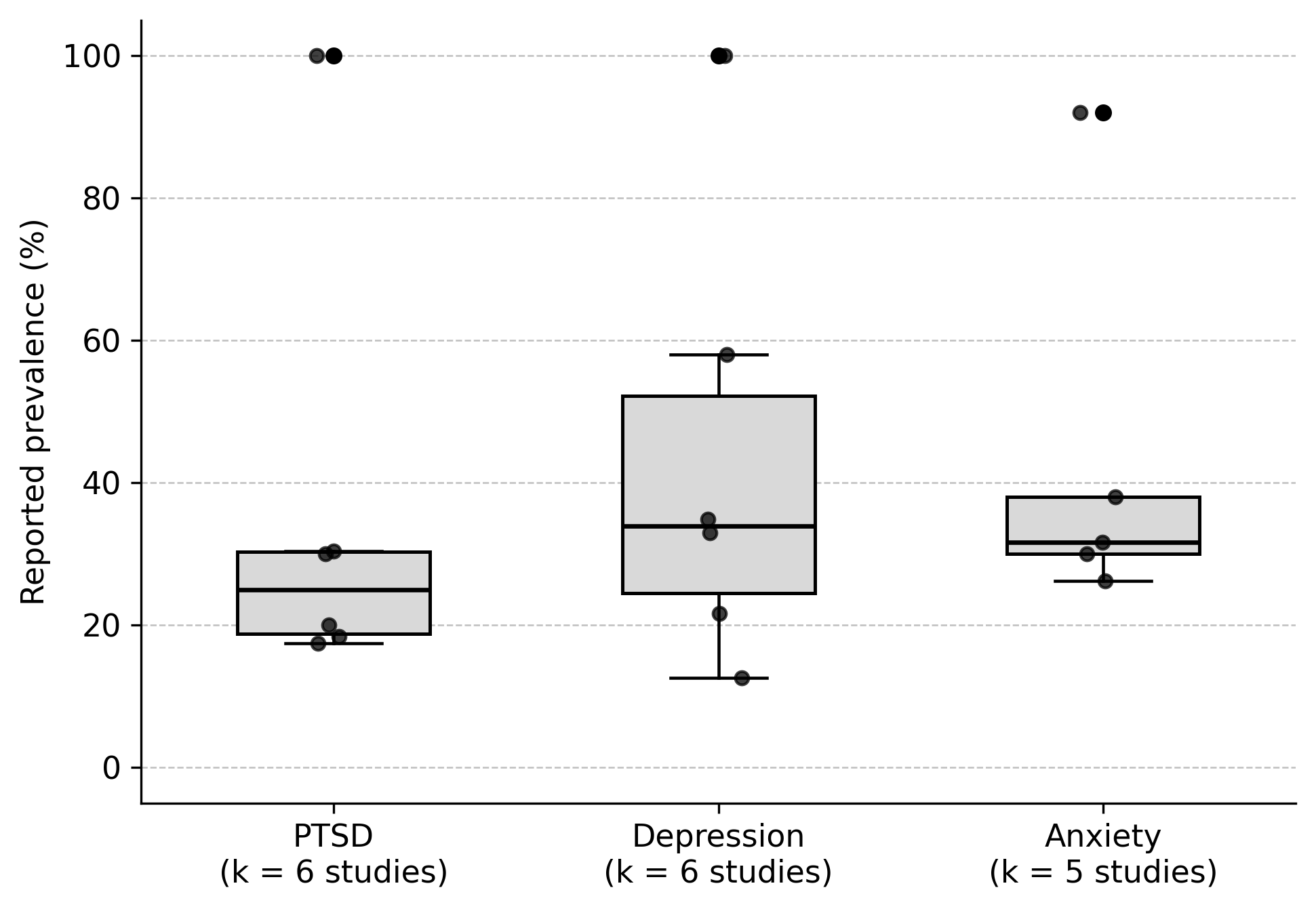
Boxplot of reported PTSD, depression and anxiety prevalence (%) across primary studies identified within Abdalla and Galea’s (2019) systematic review. Boxes show the interquartile range and median; whiskers show the full range; points show individual study estimates. Source: extracted from primary studies reported in Abdalla and Galea (2019).
Figure 1 illustrates the spread of reported PTSD, depression and anxiety prevalence across six primary studies identified within Abdalla and Galea’s (2019) systematic review. Reported PTSD prevalence ranged from 17.5% to 100%, depression from 12.6% to 100%, and anxiety from 26.2% to 92%, with the highest values drawn from a small (n=13) case series of asylum seekers with a documented history of pervasive gender-based violence (Lever et al., 2018) rather than from community-based samples. Median reported prevalence across the six studies was 25.0% for PTSD, 34.0% for depression and 31.7% for anxiety. Across all five domains examined, the direction of association was consistent: women and girls with FGM were more likely than those without to report or be diagnosed with adverse physical and psychological outcomes. The magnitude and statistical precision of associations varied by domain, largely reflecting differences in the number and quality of contributing primary studies, a pattern discussed further below.
| Domain | Outcome | Reported effect estimate | N | Source |
|---|---|---|---|---|
| Obstetric | Prolonged/obstructed labour | OR 2.61 (1.62–4.23) | 14,282 | Pallitto et al. (2025) |
| Prolonged labour | OR 2.04 (1.27–3.28) | 15,576 | Lurie et al. (2020) | |
| Perineal tears/lacerations | OR 2.45 (1.83–3.28) | 36,300 | Pallitto et al. (2025) | |
| Episiotomy | OR 1.70 (1.21–2.38) | 58,395 | Pallitto et al. (2025) | |
| Postpartum haemorrhage | OR 2.24 (1.72–2.92) | 56,122 | Pallitto et al. (2025) | |
| Caesarean birth | OR 1.36 (1.09–1.69) | 77,088 | Pallitto et al. (2025) | |
| Gynaecological | Menstrual difficulties | OR 1.73 (1.11–2.69) | 8,677 | Pallitto et al. (2025) |
| Urological | Urinary tract infection | OR 3.59 (2.21–5.81) | 10,589 | Pallitto et al. (2025) |
| Urinary tract infection | OR 2.11 (0.80–5.54), ns | 8,269 | Lurie et al. (2020) | |
| Sexual health | Dyspareunia | OR 3.88 (2.32–6.50) | 8,534 | Pallitto et al. (2025) |
| Sexual dysfunction | OR 3.20 (1.75–5.84) | 2,118 | Pallitto et al. (2025) | |
| Mental health | PTSD | 30.4% vs 0.0% (comparator) | 47 | Behrendt & Moritz (2005) |
| PTSD (Types II/III) | 18.4% vs 5.4% (comparator) | 167 | Köbach et al. (2018) | |
| Affective disorder / depression | 21.7% vs 4.2% (comparator) | 47 | Behrendt & Moritz (2005) | |
| Depression/PTSD/anxiety | 33.0%/20.0%/30.0% | 66 | Knipscheer et al. (2015) |
OR = odds ratio; 95% CI = 95% confidence interval; ns = not statistically significant (CI crosses 1.0). Unless otherwise stated, comparisons are between women/girls with any type of FGM and women/girls without FGM.
Discussion
The findings synthesised here confirm that FGM carries measurable health consequences across the reproductive, urological, sexual and psychological domains, consistent with two decades of accumulating international evidence (Berg et al., 2014; Muteshi, Miller and Belizán, 2016; Reisel and Creighton, 2015). For community social workers operating in FGM-affected Kenyan settings, this evidence base offers something the cultural-driver literature, however rich, cannot: a concrete account of what the practice does to a woman’s body and mind, at the point of cutting and across her subsequent reproductive life. This distinction matters practically. Cultural and legal framings of FGM, of the kind documented for the Maasai community of Maili 46 by Obingo (2023), help explain why families continue the practice despite prohibition; health-based evidence instead equips social workers with a register of engagement that speaks to bodily harm and wellbeing rather than solely to legality or tradition, which may open different, complementary conversations with families and community gatekeepers.
A notable feature of the evidence synthesised in Table 2 is the pattern of convergence and divergence between the two anchor meta-analyses. For prolonged labour, the independent pooled estimates produced by Lurie et al. (2020) and Pallitto et al. (2025) are closely aligned (OR 2.04 and 2.61 respectively), lending confidence to this association. For urinary tract infection, however, the two reviews diverge: Lurie et al. (2020), pooling fewer and smaller studies, found an elevated but statistically non-significant association; Pallitto et al.’s (2025) larger and more recent analysis, incorporating additional studies published in the intervening five years, found a significant association of greater magnitude. A similar pattern is evident for caesarean birth, where Lurie et al.’s (2020) borderline, non-significant estimate was resolved into statistical significance by Pallitto et al.’s (2025) larger sample. This pattern, of associations sharpening as the evidence base grows, mirrors an observation made within Lurie et al.’s (2020) own discussion, where their larger sample allowed detection of an association with perineal tearing that an earlier, smaller review had been unable to confirm. The clearest area of continuing uncertainty, and the review’s most direct point of divergence from the physical health literature, is mental health: no meta-analytic pooling has yet proven possible in this domain because of small samples, inconsistent instruments and the absence of comparison groups in several studies (Abdalla and Galea, 2019), a gap Figure 1 depicts visually through the wide spread of reported prevalence.
A further, and we would argue genuinely novel, observation to emerge from this synthesis is geographic: despite Kenya’s substantial FGM-affected population and its comparatively well-developed prevention infrastructure, including the Kajiado alternative rite of passage programmes evaluated by Kawai et al. (2025) and Muhula et al. (2021), none of the primary mental health studies identified within Abdalla and Galea’s (2019) systematic review were conducted in Kenya, and none addressed the Maasai community specifically. Obingo’s (2023) detailed ethnographic account of cultural persistence factors in Maili 46 therefore stands, at present, without a corresponding quantitative account of the health toll borne by women in that same community. This is a striking absence, precisely because Kenya already possesses the community-level programme architecture, in the form of ARP facilitators, community health volunteers and county-level anti-FGM boards, through which health-outcome research and health-informed social work practice could realistically be embedded.
Three practical implications follow. First, community social workers engaging with women who have already undergone FGM should be equipped to recognise, and sensitively enquire about, the physical sequelae summarised in Table 2, particularly obstetric complications in pregnant clients and urinary or sexual health difficulties that women may be reluctant to raise unprompted, so that appropriate and timely referral to health services can be made (Costello, 2015). Second, the consistent, if imprecisely quantified, mental health evidence reviewed here supports the routine integration of trauma-informed, non-judgemental psychosocial support into community engagement with FGM-affected women and girls, rather than treating mental health as a secondary concern behind physical safeguarding (Villani, 2023). Third, the geographic gap identified above suggests that Kenyan community social work services, particularly those already embedded within ARP programming in counties such as Kajiado, are well placed to partner with health researchers to generate the Maasai-specific quantitative health evidence that is currently missing, building directly on the cultural groundwork laid by studies such as Obingo’s (2023).
This review has several limitations. It is a secondary synthesis of previously published evidence rather than new primary research, and its conclusions are only as robust as the underlying primary studies, of which fewer than one in six were rated high quality by Pallitto et al. (2025). The great majority of contributing studies were cross-sectional, limiting causal inference; women’s FGM status and health outcomes were typically measured at a single time point, and confounding factors such as parity, age at cutting and access to obstetric care were inconsistently controlled across studies. The mental health evidence in particular rests on very small samples, several of which used no comparison group. Finally, because no published quantitative health-outcome study of the Maasai community of Kajiado County could be identified, the implications drawn for that specific setting remain necessarily inferential, extrapolated from the wider East African and international evidence base rather than confirmed locally.
Conclusion
FGM carries well-documented, statistically significant physical health consequences across the obstetric, gynaecological, urological and sexual domains, and a smaller but directionally consistent body of evidence linking it to adverse mental health outcomes. For community social workers in FGM-affected Kenyan communities such as the Maasai of Kajiado County, this evidence base offers a distinct and currently underused resource: a practice-relevant account of the embodied harms of FGM that can complement existing cultural and legal engagement strategies, ground trauma-informed psychosocial support, and inform referral pathways between community-based prevention programming and the formal health system. The absence of Kenya-specific, and particularly Maasai-specific, quantitative health-outcome research represents the most pressing gap this review identifies, and one that existing community programme infrastructure in counties such as Kajiado is well positioned to help close.
References
Rights and permissions

Disclaimer
All claims expressed in this article are solely those of the author and do not necessarily represent those of the publisher, editors, reviewers, or affiliated institutions. Any product, service, or claim that may be evaluated in this article is not guaranteed or endorsed by the publisher.
Publisher’s note
The publisher remains neutral with regard to jurisdictional claims.
Declarations & editorial transparency
Data availability
All data supporting the findings of this study are included in the article and its supplementary materials.
Funding
This research received no specific grant from any funding agency in the public, commercial, or not-for-profit sectors.
Ethics declarations
Ethics approval was not required for this study.
Peer review statement HRL Journal Service Policy
HRL Journal Service uses the following process for manuscripts sent for external peer review. An associate editor screens scope and eligibility; an academic editor assesses subject relevance and scholarly quality. The Editor-in-Chief and academic editor appoint suitable reviewers and manage conflicts of interest. Review is double blind: author and reviewer identities are concealed from one another during review. Authors respond to the feedback, with further review where needed. Once satisfied with the revisions, the academic editor recommends approval and forwards the manuscript for copyediting, reference checks and correction of typographical errors. The Editor-in-Chief makes the final publication decision. Article-specific review records and any exceptions are reported separately below.
Article-specific review status not recorded
Academic editor names are published according to the journal’s disclosure policy and the editor’s consent. An editor may request non-display; authors may raise a reasoned concern, which the journal assesses for privacy, safety and conflicts of interest. A missing name alone does not establish the reason for non-display or imply an ethics concern. Reviewer anonymity during double-blind review is a separate matter.
AI use & language assistance HRL Journal Service Policy
Authors and copyeditors may use language-assistance tools, including Grammarly, to improve spelling, grammar and readability under human supervision. Edits must preserve scientific meaning, uncertainty and the authors’ interpretation. Authors remain responsible for the accuracy, originality, references and integrity of their work; AI tools cannot qualify as authors or replace editorial judgement. Authors must disclose AI assistance at submission. Generative rewriting, content creation or use in research methods, analysis or figures requires an article-specific statement identifying the tool and its purpose; no use may fabricate data, sources or findings. Confidential manuscripts and personal data must not be shared with external tools without appropriate permission and confidentiality safeguards. This shared policy does not establish whether a tool was used in this article; any supplied article-specific disclosure appears below.
No separate AI-use disclosure has been supplied in this record. This does not establish that AI was or was not used.
Publication timeline
Recorded milestones for this article. Only supplied dates are shown.
- Received
- Revised
- Accepted
- Published
How the HRL review process works
The standard route for manuscripts sent for external peer review; this illustration does not certify individual stages or supply missing dates.
- 01Scope & eligibilityAssociate editor
- 02Subject assessmentAcademic editor
- 03Double-blind peer reviewReviewers appointed by the editorial team
- 04Revisions & academic approvalAuthors respond; academic editor evaluates
- 05Copyediting & reference checksCopyeditor
- 06Final publication decisionEditor-in-Chief
Cite this article
Share this article
Share the article record with colleagues and readers worldwide.
Explore research across our journalsDiscover more research

Recent Publications

Most Read

Recommended
Save this article as a bookmark
Use your browser’s secure bookmark shortcut. Both desktop options are shown below.
Press Ctrl+D
In Chrome, Edge or Firefox, choose a folder if needed, then select Done.
Press ⌘ Command+D
In Safari, Chrome or Firefox, choose the bookmark location and confirm.
Add to Mendeley
Save this article’s reference using either option below.
Import a reference file
Download the RIS file, then import it in Mendeley Reference Manager using Add new → Import library, or drag the file into your library.
Download RIS for MendeleyUse Mendeley Web Importer
With the extension installed, return to this article and select the Mendeley icon in your browser toolbar. Review the detected reference before saving.
Get the official Web ImporterYou choose what to import. Opening this dialog does not sign you in or send article content to Mendeley.
Cite this article
Copy a formatted citation or download a reference file.
Cited by
Crossref citation count for this DOI.