


 Rights & Permissions
Environmental characteristics shape opportunities for farm crime and may undermine rural livelihoods, but the strength and form of these relationships require empirical testing. This article examined environmental risk factors associated with farm-crime victimization patterns and the livelihood consequences reported by farmers in Awendo Sub-County, Migori County, Kenya. Guided by Routine Activity Theory and Strain Theory, this article used a descriptive concurrent mixed-methods design with survey data from 384 farmers, four (4) key informant interviews, and a focus group discussion. Quantitative analysis combined descriptive statistics, Pearson chi-square tests with Cramér’s V, and multinomial logistic regression. Plantation visibility and concealment conditions were associated with the dominant form of farm-crime harm, χ²(4, N = 384) = 10.00, p = .040, V = .11, as was guardianship and control capacity, χ²(4, N = 384) = 10.41, p = .034, V = .12. However, the multinomial model did not significantly distinguish whether livelihood consequences were reported as income reduction, food insecurity, or fear-related withdrawal, LR χ²(12, N = 384) = 12.27, p = .424, McFadden R² = .015. Qualitative findings clarified the mechanisms through road permeability, multiple access points, residential distance, plantation concealment, large-farm surveillance constraints, and limited resources for fencing and patrols. The research’s novelty lies in separating the environmental production of crime opportunity from the subsequent differentiation of livelihood consequences. The findings partially support the study claim: environmental conditions were informative for explaining the pattern of farm-crime harm, whereas the specific livelihood consequence depended on broader household vulnerability and recovery capacity.
1. INTRODUCTION
Environmental risk factors encompass physical and spatial environments that increase opportunities for crime by influencing interactions among potential offenders, suitable targets, and available guardians. Such factors include isolated locations, poor natural surveillance, inadequate lighting, extensive vegetation, multiple access routes, difficult terrain, and limited access to law enforcement. Within criminology, these environmental conditions shape offender decision-making by increasing opportunities to commit offences while reducing the likelihood of detection. Consequently, communities characterized by environmental vulnerabilities often experience higher levels of victimization than areas where natural and formal guardianship are stronger (Ceccato, 2021; Donnermeyer, 2018).
Farm crime victimization refers to the unlawful targeting of farmers, agricultural property, livestock, crops, machinery, or farming enterprises through offences such as theft, stock rustling, vandalism, burglary, arson, trespassing, and violent attacks. Unlike many urban crimes, farm crime is closely associated with the environmental characteristics of rural landscapes because agricultural activities occur over large, dispersed, and often poorly protected areas. Environmental risk factors, therefore, increase farmers' exposure to victimization by making farms more accessible to offenders and limiting surveillance and timely intervention. Beyond the immediate loss of agricultural assets, repeated victimization undermines household income, food security, productivity, psychological wellbeing, and overall rural livelihoods.
Globally, farming communities continue to experience crime patterns that reflect their environmental settings. In Australia, Canada, and parts of Europe, isolated farms, extensive land coverage, inadequate fencing, and delayed police response have been associated with theft of livestock, machinery, and agricultural produce (Barclay, 2018; Ceccato, 2021; Donnermeyer, 2018). Across Africa, rural isolation, weak policing, extensive agricultural landscapes, and competition over natural resources have similarly increased exposure to stock theft, farm attacks, and other agricultural crimes (Bunei & Barasa, 2017; Clack & Minnaar, 2018). In Kenya, where agriculture remains central to rural livelihoods, farming communities continue to experience theft of crops, livestock, machinery, and other farm property, particularly in areas characterized by dispersed settlements, extensive plantations, inadequate surveillance, and limited police patrols (Kamau et al., 2018; Bunei & Barasa, 2017). These experiences demonstrate that environmental conditions continue to shape opportunities for farm crime across diverse rural settings.
Against this background, this article advances a two-part claim. First, the physical and spatial attributes of rural farming landscapes in Awendo Sub-County shape opportunities for farm crime by altering target accessibility, concealment, surveillance, and guardianship capability. Second, the harms generated within these opportunity structures contribute to livelihood insecurity through reduced income, food insecurity, and fear-related withdrawal from farming. This article therefore sought to determine the environmental risk factors associated with farm-crime harm and to assess how the reported harms affected farmers’ livelihoods and preventive responses. By testing the opportunity and livelihood components separately, the article provides a more precise assessment of where the central claim is supported and where additional household-level explanations are required.
2. LITERATURE REVIEW
Farming environments are heterogeneous across geographic locations; hence, diverse crime cases enter these communities. Knowledge of farming-area crimes is considered incipient, as various accounts of crimes condemned by law continue to occur in farming regions. Injurious acts, harm, and wrongs continue to occur, causing damage to individuals within society. Such actions condemned by law include animal abuse, ecoterrorism, plant rights extremism, and violence against farmers within the rural setup. Environmental factors significantly influence agricultural crime victimization, as they shape the community’s population and structure (Puspitasari at al., 2025). This departs from previous studies' findings since environmental causes of farm crime victimization have not been extensively documented.
Farming areas strategically located to allow easy access for offenders, who can easily commit their desired acts. The offenders easily access poorly guarded, poorly fenced, and remote lands where farmers cannot readily reach police officers (Lyson, 2019). The nature of farming is influenced by the amount of farmland available to farmers. Large farms attract large-scale agriculture. Such can attract criminal activity, as offenders can easily reach the targets of their planned crimes and be easily traced. The remote areas of the farming land suffer high chances of crop theft; within the remote Kenyan land, farmers are attacked by armed people who steal their crops during the night or day hours.
Crime reporting is vital to controlling potential victimization on farmland. This helps in effective community policing; many offenders are easily prosecuted when identified. In remote areas, victims may be reluctant to report crimes involving stolen farm products. With the possibility of a lack of exposure to the criminal justice system, victims opt to leave the crimes unreported, thus increasing the likelihood of victimisation within the area. Farmers remain stressed without a way to report the incident (Davies et al., 2022). The same author still observes that victims might suffer the loss of property, including livestock, and possibly lead to other criminal activities like arson on the offenders’ homes as they resort to revenge acts. Such conditions in the countryside create opportunities for most ethnic-based clashes experienced across Kenyan farmland, along County boundaries. A negative attitude towards the criminal justice agency in addressing farm-related offenses is particularly evident in farm theft cases in farming regions. Thus, large tracts of farmland are more susceptible to vandalism and theft, discouraging broader land use for crop or livestock farming (Ariga, 2018).
The above literature indicates that fear and failure to report rural offenses are an increasing threat to achieving farmers’ target lifestyle. They suffer and abandon certain farming practices, reducing income and increasing living costs, as they cannot meet all their daily necessities (Shim & Hayes, 2024). It would be easy for farming regions to be victimized as the offenders predict a lack of proper surveillance and stringent penalties for committing an offense.
The literature shows that certain types of farming activity either attract or reduce the types of criminal activity experienced (Zaykowski, 2011). Livestock farmers in traditional farm crime reports attract high rates of theft and burglary. This has resulted in increased cases of violence, threats, or harassment of the farmers, as cattle rustling is mostly experienced during night hours in the respective homes. The offenders make calls and even distribute written letters to different homes, preparing them for unexpected night attacks, thus interfering with the community’s peace and safety. Furthermore, Grote and Neubacher (2016), claim that social environment covers the culture and the social practices influencing farming activities. Cultural and religious practices encourage planting certain products and discourage others. Communities rush to participate in such activities in areas where accepted products are in demand. Because of overreliance on these products, criminals make the area more attractive by making the desired commodity available. The environment encourages social revolution in agricultural operations, thus complicating the control of criminal activities (Pandelaki et al., 2025). Also, shifts in farm produce prices and increased competition in farming areas lead to more opportunities for farm-crime victimization, amplifying crime challenges in these areas (Gladkova, 2023).
Settlement patterns influence the types of crimes experienced in farming regions. The population is sparsely distributed, leading to isolated farms that make them easier targets for offenders. This lack of coverage discourages farmers’ intimacy and shared values through informal social relationships, making them easier targets. The community members exhibit behavioral traits that encourage certain crimes; hence, casualties stem from cultural practices. Such behavior hinders community policing strategies aimed at identifying and combating routine crimes (Sharif & Uddin, 2021).
Farming activities along roads or easily passable areas increase surveillance, as owners can walk freely through their farms at any time. Crime incidents in farming areas are examined in relation to farmers' precise home locations. Proximity to urban areas or roads facilitates installing surveillance equipment, including alarms, because there is a reliable electricity supply. Remote locations limit access to homes; thus, farmers cannot walk during dark hours or even during the day around the plantations (Ceccato, 2015). This barrier results in a lack of situational control; therefore, there is a high risk of victimization, as farmers fear attack. Traditional crime-control measures are discouraged in farming areas, as farmers do not map territorial boundaries with dogs to help control crime.
In farming areas, crop waste accumulates and is burned in the surrounding environment of existing farms. Farms sometimes suffer sudden fires that ignite and spread over large areas. These fires can escalate and quickly reach surrounding farms, resulting in severe losses for the affected farmers (Lohr, 2019). Widespread fires consume large portions of crop plantations, causing severe losses for farmers as crops and plantations are destroyed.
Arson targeting large sugar plantations continues to be a problem in Kenyan agricultural land. Large farms are vulnerable to arson because they are isolated and flammable during dry periods, with withered leaves and bushes around them. Crop losses occur before harvest; as a result, victims suffer greater losses in such incidents, which affect their families (Gladkova, 2023). When large tracts of land are set on fire, the fire spreads quickly and affects a large portion of plantation cover, thereby negatively impacting farmers, who lose their means of survival after being victimized (Sanghera et al., 2022). It has been established that farm crime victimization goes beyond stealing farm produce and may include arson attacks on farms.
3. METHODS
3.1. Selection of Study Area
The research was conducted in Awendo Sub-County, Migori County, Kenya, which covers approximately 262 km² and had a population of 117,290 according to the 2019 Kenya Population and Housing Census. Farming is the dominant economic activity and livelihood in the area, with communal agriculture common among residents. Awendo Sub-County comprises Awendo Township, North-East Sakwa, North Sakwa, South Sakwa, West Sakwa, and Central Sakwa. The area is characterized by extensive sugarcane plantations and widespread agricultural land use. Geographically, it borders Uriri Sub-County to the east, Rongo Sub-County to the west, Narok County to the north, and Homa Bay County to the south. The region's physical features include varied relief, altitude, and proximity to Lake Victoria. Awendo Sub-County was selected because of its comparatively high prevalence of farm crime victimization relative to the national average, making it an appropriate setting for examining environmental risk factors associated with farm crime.
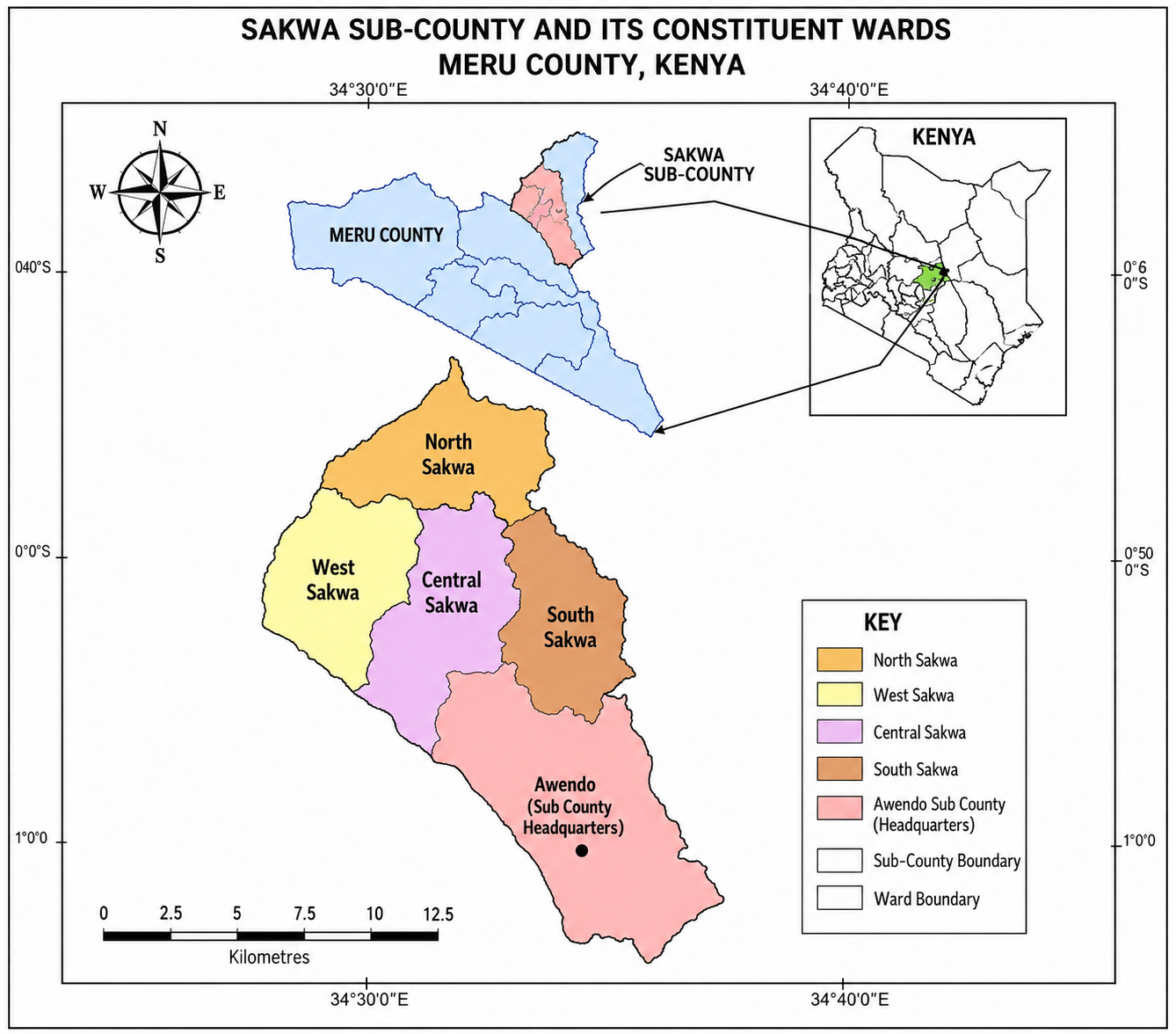
According to Odeny (2022), rural parts of Awendo Sub-County have experienced more farm crime than urban areas. For instance, in 2018, Police stations in Awendo Sub-County reported 1,915 farm crime cases in rural areas compared to 526 in urban areas. In the year 2019, there were 2049 reported cases of farm crime across the rural areas of Awendo Sub-County compared to 491 cases from urban areas of the sub-County. The same report also records 2,908 cases of farm crime victimization in rural areas of Awendo Sub-County in 2020, compared to 635 in urban areas during the same period. Is slightly more than 5% of the national average for farm crime victimization, which stood at 40,027 between 2018 and 2020. This warranted conducting research to ascertain trends in victimization and its effects on livelihoods in the study area.
3.2. Population and Sample
3.2.1. Population
The research population included all the small-scale farmers, large-scale farmers who lease farms in the study area, and the Chiefs, Assistant Chiefs, Community Policing Officials, and Police Officers in Awendo Sub-County.
3.2.2. Sample
The sample size for farmer respondents was determined using the formula proposed by Singh and Masuku (2014) for populations exceeding 10,000:
\[n = \frac{Z^{2}pq}{d^{2}}\]
Where:
n = desired sample size;
Z = standard normal deviation corresponding to the 95% confidence level (1.96);
p = estimated proportion of the target population possessing the characteristic of interest (0.50);
q = 1 - p (0.50); and
d = allowable margin of error (0.05).
Substituting the values:
\[n = \frac{(1.96)^{2}(0.50)(0.50)}{(0.05)^{2}}\]
\[n = \frac{3.8416 \times 0.25}{0.0025}\]
\[n = \frac{0.9604}{0.0025}\]
\[n = 384.16\]
The calculated sample size was rounded to 384 farmer respondents. Also, to ensure proportional representation across the research locations, Neyman's allocation formula was used:
\[n_{h} = \frac{N_{h}}{N} \times n\]
Where:
nₕ = sample size for stratum h;
Nₕ = population size of stratum h;
N = total population; and
n = total sample size.
The resulting distribution of respondents is presented in Table 3.1.
| Location | Population | Sample Size |
|---|---|---|
| North-East Sakwa | 24,195 | 79 |
| West Sakwa | 25,956 | 85 |
| South Sakwa | 39,629 | 130 |
| Central Sakwa | 27,510 | 90 |
| Total | 117,290 | 384 |
3.2.3 Key Informants
A total of four (4) key informants were purposively selected for their knowledge and experience in farm crime and rural security. The key informants comprised an Assistant County Commissioner, a Chief, a Police Officer, and a Community Policing representative.
3.2.4 Focus Group Discussion Participants
One focus group discussion (FGD) comprising eight farmers who had experienced repeated farm crime victimization was conducted. Two participants were selected from each research location with assistance from Chiefs and Assistant Chiefs.
3.3. Sample Selection Procedures
3.3.1. Selection of Farm Respondents
Farmer respondents were selected using stratified random sampling. The target population was first divided into strata by geographical location: North-East Sakwa, West Sakwa, South Sakwa, and Central Sakwa. Stratification ensured that all locations were adequately represented in this paper (Mujere, 2016). Proportionate allocation was then used to determine the number of respondents to be selected from each stratum relative to its population size. Within each stratum, simple random sampling was used to select respondents, thereby giving every eligible farmer an equal chance of participating in the research (Singh & Masuku, 2014).
3.3.2. Selection of Key Informants
Key informants were selected through purposive sampling. This technique enabled the inclusion of participants with specialized knowledge of farm crime trends, security challenges, and crime prevention strategies in Awendo Sub-County. The selected participants included Assistant County Commissioners, Chiefs, Assistant Chiefs, Police Officers, and Community Policing representatives.
3.3.3. Selection of Focus Group Discussion Participants
Participants for the focus group discussion were purposively selected with assistance from local administrators. Farmers who had experienced repeated incidents of farm crime victimization were identified and invited to participate. The selection criteria were prior victimization experience and willingness to share insights into environmental risks and the effects of farm crime on livelihoods. The FGD consisted of eight participants drawn from the four research locations to ensure geographical representation.
3.4. Instruments
3.4.1. Questionnaire
The research used a structured questionnaire with open-ended and closed-ended questions to collect primary data from farmers in Awendo Sub-County. The questionnaire captured farmers’ experiences and perceptions regarding environmental risks associated with farm crime victimization, including farm accessibility, proximity to roads and pathways, terrain characteristics, access and exit points, settlement patterns, location of residence in relation to farms, neighborhood surveillance, socioeconomic characteristics, crop choice, and perceived control over farm vulnerability. The instrument enabled respondents to provide measurable responses while allowing additional explanations where necessary. Questionnaires were selected because they provide an efficient, economical, and systematic method of collecting primary data from a relatively large population (Pandey & Pandey, 2021). The use of primary data collection instruments enhanced the rigor, breadth, and depth of understanding of the phenomenon under research (Harrison et al., 2020).
3.4.2. Interview Guide
An interview guide was used to collect qualitative data from purposively selected key informants with relevant knowledge and experience of farm crime victimization in the research area. The guide consisted of open-ended questions focusing on environmental risks influencing farm crime, including the role of farm location, settlement patterns, accessibility, plantation coverage, guardianship, and farmers’ ability to control vulnerability to crime. Key informants included security and administrative officers such as police officers, Assistant County Commissioners, Chiefs, Assistant Chiefs, and Nyumba Kumi chairpersons. The interview approach allowed respondents to provide detailed explanations, clarify responses, and highlight contextual factors surrounding farm crime victimization. Interviews are valuable qualitative instruments because they allow participants to freely express their views and provide a deeper understanding of the subject under investigation (Van Audenhove & Donders, 2019). The interviews were conducted at respondents’ convenience, with responses recorded through notetaking for subsequent analysis.
3.4.3. Focus Group Discussion Guide
A focus group discussion (FGD) guide was administered to farmers who had experienced repeated farm-crime victimization to elicit collective perspectives on environmental factors that influence their vulnerability. The participants were purposively selected based on experiences of repeated victimization, with assistance from local administrative leaders, resulting in eight discussants representing different locations within the research area. The FGD guide explored shared experiences regarding farm location, proximity to roads, accessibility, access points, terrain, security challenges, and farmers’ capacity to implement preventive measures. The researcher facilitated the discussion by explaining the research objectives, guiding participants to remain focused on the research themes, and ensuring equal participation among members. FGDs enabled participants to compare experiences, clarify issues, and generate deeper insights into common patterns of farm crime victimization. As noted by Antunes et al. (2020), FGDs provide a conducive environment for exploring shared experiences and developing a comprehensive understanding of social phenomena through group interaction.
3.5. Ethical Considerations
The research adhered to established ethical principles to protect participants’ rights, privacy, and welfare. Ethical approval was obtained from the Directorate of Postgraduate Studies at Masinde Muliro University of Science and Technology, and a research permit was subsequently obtained from the National Commission for Science, Technology and Innovation (NACOSTI). Participation was voluntary, and confidentiality and anonymity were ensured by protecting participants’ identities, given the sensitive nature of security-related information. The researcher maintained academic integrity by acknowledging all sources, accurately reporting findings, and avoiding fabrication, falsification, or misrepresentation of data. All collected information was used strictly for academic purposes, with physical records securely stored and electronic data protected through password-restricted access. The research data will be retained for five years after publication and thereafter securely destroyed in accordance with data management protocols.
3.6. Empirical Model
The empirical strategy was designed to test two linked propositions: first, that environmental risk factors are associated with the pattern of farm-crime harm; and second, that environmental conditions differentiate the livelihood consequences reported by farmers. The analysis used all 384 complete survey records. The realized location counts in the Excel dataset were North-East Sakwa (n = 91), West Sakwa (n = 107), South Sakwa (n = 82), and Central Sakwa (n = 104), which differ from the planned allocation reported in Table 3.1. The inferential results therefore rely on the realized sample rather than the planned stratum totals.
3.6.1 Pearson Chi-Square Association Model
Pearson’s chi-square test of independence was used because both the environmental risk factors and farm-crime harm were categorical. Five theoretically specified environmental constructs were examined: settlement-area risk, accessibility, residential proximity and surveillance, plantation visibility and concealment, and guardianship or control capacity. The test statistic compared each observed cell frequency with its expected frequency under the null hypothesis of independence.
\[\begin{aligned}\chi^{2} &= \sum \frac{(O-E)^{2}}{E} \\ E_{ij} &= \frac{R_{i}\times C_{j}}{N}\end{aligned}\]
In these expressions, O and E are the observed and expected cell frequencies, R_i is the total for environmental category i, C_j is the total for crime-harm category j, and N is the analytic sample. Cramér’s V was calculated to quantify the strength of association while accounting for the table's dimensions.
\[V = \sqrt{\frac{\chi^{2}}{N\times\min(r-1,c-1)}}\]
All expected cell frequencies exceeded 5, satisfying the large-sample requirement for Pearson’s chi-square approximation. Exact p values are reported with Cramér’s V so that statistical evidence is not interpreted independently of effect magnitude.
3.6.2 Regression Model
A multinomial logistic regression model was estimated because the livelihood impact was nominal and comprised three unordered categories. Fear discouraging farming was selected as the reference outcome. The model compared (a) household-income reduction with fear-related withdrawal and (b) food insecurity with fear-related withdrawal. Predictors were drawn from the closed survey items and entered simultaneously: settlement-area risk (yes versus not sure), accessibility (yes and unable to determine versus no), lack of perceived control (no versus yes), location or farm-size risk (yes versus no), and crop-choice risk (yes versus no).
\[\ln\left[\frac{P(L=k)}{P(L=0)}\right]\]
\[\ln = \beta_{0k}+\beta_{1k}S+\beta_{2k}A_{y}+\beta_{3k}A_{u}+\beta_{4k}G+\beta_{5k}F+\beta_{6k}P+\varepsilon_{k}\]
Here, L = 0 denotes fear discouraging farming, L = 1 denotes a reduction in household income, and L = 2 denotes food insecurity. S is settlement-area risk, A_y is affirmative accessibility, A_u is inability to determine accessibility, G is lack of perceived control, F is location or farm-size risk, and P is crop-choice risk. The model was estimated by maximum likelihood. Coefficients were exponentiated and reported as relative risk ratios with 95% confidence intervals.
\[RRR = \exp(\beta);\ 95\%\ CI\]
\[= \exp\left[\beta \pm 1.96\times SE(\beta)\right]\]
Overall model fit was evaluated using the likelihood-ratio chi-square test, McFadden and Nagelkerke pseudo-R² values, the Akaike information criterion, and classification accuracy. Statistical evidence was assessed at α = .05, but confidence intervals and substantive magnitude were prioritized in interpretation.
4. FINDINGS
4.1 Descriptive Findings
Table 1 presents the realized sample distribution and the principal environmental, crime-harm, and livelihood variables. Respondents identified settlement area as relevant to environmental risk in 69.5% of cases. Respondents affirmed location or farm size as a risk-related condition in 57.6% of cases, while 51.6% stated that roads made offender access easier. In addition, 63.0% of respondents selected either remote residence delaying response or living far from the farm increasing theft, indicating that spatial separation from the farm was a widespread surveillance concern. Plantation categories were evenly distributed, although sugarcane concealment was the most frequently selected condition (34.1%).
| Construct | Category or focal response | n (%) | M (SD) |
|---|---|---|---|
| Respondent location | |||
| North-East Sakwa | 91 (23.7) | — | |
| West Sakwa | 107 (27.9) | — | |
| South Sakwa | 82 (21.4) | — | |
| Central Sakwa | 104 (27.1) | — | |
| Closed environmental indicators | |||
| Settlement-area risk | Yes | 267 (69.5) | 0.70 (0.46) |
| Accessibility | Yes | 183 (47.7) | 0.48 (0.50) |
| Accessibility | Unable to determine | 100 (26.0) | 0.26 (0.44) |
| Perceived control over vulnerability | No | 180 (46.9) | 0.47 (0.50) |
| Location/farm size linked to risk | Yes | 221 (57.6) | 0.58 (0.49) |
| Crop choice linked to risk | Yes | 190 (49.5) | 0.49 (0.50) |
| Environmental opportunity conditions | |||
| Plantation condition | Bushy farms increase attacks | 126 (32.8) | — |
| Large plantations reduce visibility | 127 (33.1) | — | |
| Sugarcane plantations conceal offenders | 131 (34.1) | — | |
| Residential condition | Nearby residence improves surveillance | 142 (37.0) | — |
| Remote residence delays response | 122 (31.8) | — | |
| Living far from farm increases theft | 120 (31.2) | — | |
| Road effect | Better access improves surveillance | 186 (48.4) | — |
| Roads also make offender access easier | 198 (51.6) | — | |
| Structural risk | Multiple access paths | 105 (27.3) | — |
| Poor lighting | 100 (26.0) | — | |
| Dense vegetation | 94 (24.5) | — | |
| Location Remoteness | 85 (22.1) | — | |
| Farm-crime harm and livelihood consequence | |||
| Farm-crime harm | Crop theft causes biggest losses | 131 (34.1) | — |
| Livestock theft is most harmful | 121 (31.5) | — | |
| Vandalism destroys livelihoods | 132 (34.4) | — | |
| Livelihood consequence | Crime reduces household income | 131 (34.1) | — |
| Victimization affects food security | 138 (35.9) | — | |
| Fear discourages farming | 115 (29.9) | — | |
Note. N = 384. For dichotomous indicators, the focal response was coded 1 and all other responses were coded 0; therefore, M equals the endorsed proportion. Percentages may not sum to 100.0 because of rounding.
The three dominant farm crimes were also distributed relatively evenly: vandalism was reported in 34.4%, crop theft in 34.1%, and livestock theft in 31.5%. Livelihood consequences followed a similarly broad pattern, with food insecurity reported by 35.9%, a reduction in household income by 34.1%, and fear of discouraging farming by 29.9%. The absence of a dominant single outcome indicates that farm crime affected livelihoods through material, consumption, and behavioral pathways.
4.2. Empirical Findings
4.2.1 Environmental Risk Factors and Farm-Crime
| Environmental Risk Factors | Category | Crop theft n (%) | Livestock theft n (%) | Vandalism n (%) | χ² (df) | p | V |
|---|---|---|---|---|---|---|---|
| Settlement-area risk | Yes | 88 (33.0) | 84 (31.5) | 95 (35.6) | 0.71 (2) | .700 | .043 |
| Not sure | 43 (36.8) | 37 (31.6) | 37 (31.6) | ||||
| Accessibility | Yes | 67 (36.6) | 57 (31.1) | 59 (32.2) | 5.44 (4) | .245 | .084 |
| No | 29 (28.7) | 39 (38.6) | 33 (32.7) | ||||
| Unable to determine | 35 (35.0) | 25 (25.0) | 40 (40.0) | ||||
| Residential proximity | Nearby residence improves surveillance | 54 (38.0) | 44 (31.0) | 44 (31.0) | 2.19 (4) | .700 | .053 |
| Remote residence delays response | 40 (32.8) | 40 (32.8) | 42 (34.4) | ||||
| Living far from farm increases theft | 37 (30.8) | 37 (30.8) | 46 (38.3) | ||||
| Plantation visibility | Bushy farms | 48 (38.1) | 47 (37.3) | 31 (24.6) | 10.00 (4) | .040 | .114 |
| Large plantations | 38 (29.9) | 34 (26.8) | 55 (43.3) | ||||
| Sugarcane plantations | 45 (34.4) | 40 (30.5) | 46 (35.1) | ||||
| Guardianship capacity | Can fence/patrol | 38 (30.2) | 50 (39.7) | 38 (30.2) | 10.41 (4) | .034 | .116 |
| Limited resources | 48 (35.8) | 44 (32.8) | 42 (31.3) | ||||
| Large farms not fully monitored | 45 (36.3) | 27 (21.8) | 52 (41.9) |
Note. Percentages are row percentages. Pearson chi-square tests used complete cases (N = 384). All minimum expected cell frequencies exceeded 5. V = Cramér’s V. Effects of approximately .10 are small.
The plantation visibility and concealment construct was associated with the dominant form of farm-crime harm, χ²(4, N = 384) = 10.00, p = .040, Cramér’s V = .11. Large plantations had the highest proportion of vandalism reports (43.3%), compared with bushy farms (24.6%) and sugarcane plantations (35.1%). This pattern suggests that reduced visibility and spatial scale were more closely linked to destructive damage than to theft alone. The effect was small, indicating that plantation form is one element within a broader opportunity structure rather than a deterministic cause.
Guardianship and control capacity were also associated with the distribution of farm-crime harm, χ²(4, N = 384) = 10.41, p = .034, Cramér’s V = .12. Respondents who stated that large farms could not be fully monitored reported vandalism most frequently (41.9%) and livestock theft least frequently (21.8%). In contrast, respondents who could fence and patrol their farms reported livestock theft most frequently (39.7%). These distributions show that the form of guardianship constraint, rather than a simple presence or absence of control, corresponded with different harm profiles.
Settlement-area risk, accessibility, and residential proximity were not statistically associated with the dominant harm category. Their interpretation is therefore descriptive rather than inferential. Importantly, all tests had adequate expected frequencies, so the nonsignificant findings cannot be attributed to sparse cells in the contingency table. The combined evidence provides partial rather than universal support for the research claim: some environmental mechanisms differentiated crime-harm patterns, while others did not.
4.2.2. Environmental Predictors of Livelihood Impacts
| Predictor | B | SE | RRR | 95% CI lower | 95% CI upper | p |
|---|---|---|---|---|---|---|
| Panel A. Household-income reduction versus fear discouraging farming | ||||||
| Settlement-area risk: Yes (vs. not sure) | 0.326 | 0.277 | 1.385 | 0.804 | 2.385 | 0.240 |
| Accessibility: Yes (vs. no) | 0.176 | 0.326 | 1.192 | 0.629 | 2.259 | 0.590 |
| Accessibility: Unable to determine (vs. no) | 0.100 | 0.356 | 1.105 | 0.550 | 2.219 | 0.779 |
| Perceived control: No (vs. yes) | -0.159 | 0.260 | 0.853 | 0.513 | 1.420 | 0.542 |
| Location/farm size risk: Yes (vs. no) | -0.335 | 0.266 | 0.715 | 0.425 | 1.205 | 0.207 |
| Crop-choice risk: Yes (vs. no) | 0.018 | 0.259 | 1.018 | 0.613 | 1.693 | 0.944 |
| Panel B. Food insecurity versus fear discouraging farming | ||||||
| Settlement-area risk: Yes (vs. not sure) | 0.268 | 0.274 | 1.307 | 0.764 | 2.238 | 0.329 |
| Accessibility: Yes (vs. no) | -0.166 | 0.307 | 0.847 | 0.464 | 1.547 | 0.590 |
| Accessibility: Unable to determine (vs. no) | -0.682 | 0.357 | 0.506 | 0.251 | 1.017 | 0.056 |
| Perceived control: No (vs. yes) | 0.071 | 0.257 | 1.073 | 0.649 | 1.775 | 0.784 |
| Location/farm size risk: Yes (vs. no) | -0.418 | 0.264 | 0.658 | 0.392 | 1.105 | 0.113 |
| Crop-choice risk: Yes (vs. no) | 0.244 | 0.257 | 1.276 | 0.771 | 2.113 | 0.343 |
Note. The reference outcome was fear discouraging farming. RRR = relative risk ratio; CI = confidence interval. Overall model: LR χ²(12, N = 384) = 12.27, p = .424, McFadden R² = .015, Nagelkerke R² = .035, AIC = 857.26, and classification accuracy = 39.3%.
The multinomial logistic regression did not significantly improve fit over the intercept-only model, likelihood-ratio χ²(12, N = 384) = 12.27, p = .424. Explanatory power was low, McFadden R² = .015 and Nagelkerke R² = .035, while classification accuracy increased only from a 35.9% baseline to 39.3%. The model therefore provided little evidence that the closed environmental indicators distinguished among the livelihood consequences a respondent reported.
No predictor reached the .05 criterion in either outcome contrast. The closest estimate was for respondents who were unable to determine the role of accessibility: their relative risk of reporting food insecurity rather than fear-related withdrawal was approximately half that of respondents who answered no (RRR = 0.51; 95% CI [0.25, 1.02]; p = .056). Because the confidence interval included 1 and the overall model was not significant, treat this estimate as an imprecise tendency rather than evidence of an independent effect. Similarly, location or farm size had RRR = 0.66 for food insecurity versus fear, 95% CI [0.39, 1.10], p = .113.
The nonsignificant model does not imply that farm crime lacks livelihood consequences. Rather, the data show that income loss, food insecurity, and fear occurred across environmental categories. Environmental conditions may shape exposure and crime opportunity, but the specific livelihood manifestation is likely also influenced by unmeasured factors such as household assets, farm dependence, insurance, social support, loss value, offense frequency, and recovery capacity.
4.3. Qualitative Thematic Findings
The qualitative material was reorganized into two analytically distinct tables. Table 4.4 explains the environmental mechanisms through which opportunity and guardianship were altered. The qualitative findings explain the underlying mechanisms through which environmental conditions shape crime opportunities in Awendo Sub-County. As shown in Table 4.4, these themes illustrate how spatial attributes alter target permeability, visibility, and guardianship capability.
| Theme | Key Environmental Indicator | Illustrative Verbatim Quotes |
|---|---|---|
| Road Proximity & Spatial Permeability | Open access routes, roadside proximity, multiple entry/exit paths | "Farms situated along main access roads are most vulnerable because offenders can easily enter and retreat. Farms open in multiple directions are even worse off, as thieves exploit various unmonitored pathways." — KII 1 (Police Officer) |
| Residential Distance & Surveillance Deficits | Remote homesteads, absentee ownership, extensive land holdings | "Living far from the farm drastically reduces continuous oversight, often leading to unmonitored crop theft and partial harvests. Large sugarcane tracts are practically impossible for a single household to guard continuously." — KII 2 (Assistant County Commissioner) |
| Plantation Cover & Offender Concealment | Dense vegetation, overgrown fields, tall sugarcane coverage | "Dense sugarcane fields act as natural shields for offenders, hiding stolen property and allowing criminals to evade detection. In extreme cases, these overgrown areas become secondary crime scenes where bodies are discovered during harvest." — KII 3 (Chief) |
| Resource-Constrained Guardianship | Financial barriers to fencing, inability to hire private security, labor trade-offs | "Many smallholder farmers simply lack the financial capacity to install perimeter fencing or hire guards. They are forced to leave their fields unattended during the day to pursue other off-farm income activities." — KII 4 (Community Policing Rep) |
Note. N = 384 survey respondents complemented by 4 Key Informant Interviews (KII 1–4) and 1 Focus Group Discussion (with 8 farmers). Qualitative excerpts illustrate environmental mechanisms rather than prevalence rates.
Table 4.5 synthesises how environmentally enabled farm crime impacts household livelihoods across material, economic, and behavioural dimensions.
| Livelihood Dimension | Core Impact Mechanism | Primary Form of Crime Harm |
|---|---|---|
| Direct Production & Asset Loss | Depletion of standing crops and household wealth | Crop theft & Livestock rustling |
| Capital Destruction & Infrastructure Damage | High repair/replacement costs and destroyed farm implements | Vandalism & Arson |
| Household Economic Contraction | Loss of primary disposable household income and savings | Income reduction |
| Consumption & Food Security Strain | Immediate household dietary deficits and reduced food stocks | Food insecurity |
| Behavioral & Psychological Withdrawal | Reduced agricultural investment and abandoned farm operations due to fear | Fear-induced withdrawal |
| Structural Protection Constraints | Financial inability to invest in protective infrastructure (fencing/patrols) | Heightened exposure |
Note. Categorizations derived from open-ended responses regarding crime harm, livelihood impacts, and protective capacity (N = 384). Categories represent overlapping vulnerability pathways rather than mutually exclusive outcomes.
The qualitative thematic findings demonstrate that significant quantitative patterns reflect plausible opportunity structures rather than isolated statistical artifacts. While spatial environment determines offender access and the immediate mode of crime harm, the ultimate livelihood impact, whether experienced as income loss, food insecurity, or fear-related withdrawal, is mediated by household coping capacity, asset reserves, and broader social vulnerability.
5. DISCUSSION
5.1. Environmental Opportunity Structures and Routine Activity Theory
The findings require interpretation in light of the article’s two-part claim, not statistical significance alone. The first component proposed that environmental risks shape opportunities for farm crime by influencing accessibility, concealment, target suitability, and guardianship. The second proposed that these environmentally enabled harms contribute to livelihood insecurity. Taken together, the evidence supports the first component more strongly than the second. Plantation visibility and guardianship capacity were significantly associated with the dominant form of farm-crime harm, and the qualitative accounts supplied a credible explanation of how those conditions operated. Conversely, the multinomial model did not show that the measured environmental variables independently differentiated income reduction, food insecurity, and fear. This pattern is theoretically important because it identifies the point at which environmental opportunity structures cease to provide a sufficient explanation and household vulnerability becomes more salient.
Routine Activity Theory provides the most direct explanation for the quantitative and qualitative convergence. In the farming context, the suitable target is not confined to a household or a single asset. It includes crops, livestock, farm inputs, infrastructure, and extensive land that may remain unattended for long periods. Roads, paths, open boundaries, distant residences, and dense plantation cover alter the conditions under which a motivated offender can reach these targets without encountering a capable guardian. This interpretation is consistent with Bunei and Barasa’s (2017) application of a routine-activities approach to farm victimization in Kenya and with the wider rural-crime literature, which links dispersed properties, weak surveillance, and delayed response to agricultural offending (Barclay, 2018; Ceccato, 2021; Donnermeyer, 2018). The present study advances that literature by demonstrating that the relevant environmental mechanism is not rurality in the abstract but the specific configuration of permeability, visibility, and guardianship within the farm landscape.
The descriptive findings illustrate the conditional role of accessibility. Slightly more respondents stated that roads made offender access easier, 198 (51.6%), than stated that roads improved legitimate surveillance, 186 (48.4%). This near-even division shows why road proximity should not be classified as an inherently protective or inherently criminogenic attribute. Ceccato (2015) noted that accessible locations may enable movement, services, and surveillance, whereas remote locations may restrict guardianship and timely intervention. The Awendo evidence adds a critical qualification: connectivity becomes risky when it increases offender mobility more rapidly than it increases observation and control. The qualitative references to busy roads operating throughout the day and to farms open in several directions further indicate that permeability, rather than simple distance from a road, is the operative concept. This reframing is novel because it shifts the analysis from static proximity measures to the balance between access and guardianship that the same infrastructure creates.
Plantation visibility produced the clearest statistically supported environmental pattern, χ²(4, N = 384) = 10.00, p = .040, V = .114. Large plantations were disproportionately associated with vandalism, whereas bushy farms were associated with a comparatively higher proportion of crop and livestock theft. Although the effect was small, the pattern was substantively coherent with the qualitative evidence that dense sugarcane and extensive plantations conceal offenders, stolen property, and, in extreme accounts, other criminal activity. Donnermeyer (2018) and Barclay (2018) emphasize that the spatial scale and physical openness of farms complicate protection, while Gladkova (2023) situates agricultural harm within the distinctive material conditions of farming and food production. The current result sharpens these arguments by identifying plantation morphology as a crime-opportunity mechanism. The relevant risk is not simply that sugarcane is cultivated, but that its height, density, farm extent, and limited sightlines create concealment and reduce the probability of detection.
5.2. Guardianship, Protective Capacity, and Unequal Environmental Risk
The association between guardianship capacity and farm-crime harm, χ²(4, N = 384) = 10.41, p = .034, V = .116, further supports the routine-activity explanation. Farms that could not be fully monitored due to their size had a comparatively high rate of vandalism, whereas farmers who could fence or patrol reported livestock theft as the dominant harm. The result should not be read to mean that fencing eliminates crime or that one form of protection produces one form of victimization. Rather, it demonstrates that the distribution of harm changes with the farmer’s ability to observe, regulate entry, and respond. Shim and Hayes (2024) similarly emphasize household-level guardianship as a determinant of victimization risk, while Bunei et al. (2014) and Rono et al. (2014) observed that farmers’ own preventive practices are central to rural crime control. The Awendo findings extend this reasoning by showing that guardianship is not merely present or absent; it is conditioned by farm size, residential distance, income, and the opportunity cost of maintaining continuous watch.
This resource-conditioned view of guardianship explains why environmental exposure is socially unequal. The same road, plantation edge, or remote location may create different levels of practical vulnerability depending on whether a farmer can finance fencing, lighting, hired guards, transport, or repeated inspection. The focus-group evidence that small-scale farmers had to leave farms unattended while pursuing other livelihood activities makes this inequality explicit. Grote and Neubacher (2016) argue that rural crime in developing countries must be understood within broader institutional and economic conditions, and Clack and Minnaar (2018) similarly describe rural crime as embedded in weakly protected and spatially dispersed environments. The present study contributes a micro-level explanation: environmental risk becomes consequential through the farmer’s capacity to convert space into a defensible environment. Therefore, interventions that merely advise farmers to improve surveillance may reproduce inequality unless they also address the financial and collective resources needed to carry out that surveillance.
The small Cramér’s V values are also analytically meaningful. They indicate that plantation conditions and guardianship contribute to the pattern of harm but do not operate as single or dominant causes. Rural crime is produced through several interacting conditions, including offender motivation, commodity value, timing, local social relations, police response, reporting behavior, and target availability. This is compatible with Donnermeyer’s (2018) international synthesis and Rono’s (2016) account of agricultural crime in Africa, both of which position farm crime as a heterogeneous phenomenon rather than as the product of a single environmental feature. Accordingly, the research’s contribution does not rest on claiming large deterministic effects. Its contribution is the identification of theoretically coherent, statistically detectable environmental mechanisms within a setting where quantitative evidence has been limited.
5.3. Livelihood Consequences and the Explanatory Boundary of Strain Theory
Strain Theory is useful for interpreting what occurs after victimization. Crop theft removes expected produce, livestock theft removes both productive capital and stored household wealth, and vandalism imposes repair and replacement costs. These losses impede livelihood goals and expose households to adverse conditions that may manifest as economic strain, consumption pressure, insecurity, and fear. The descriptive findings demonstrate that these consequences were widespread: 131 respondents (34.1%) reported reduced household income, 138 (35.9%) reported food insecurity, and 115 (29.9%) reported fear that discouraged farming. Gladkova (2023) emphasizes that harms associated with farming extend beyond the immediate offence, while Zaykowski (2011) highlights the range of responses to victimization. Pleggenkuhle and Schafer’s (2018) work on rural fear of crime also supports treating psychological withdrawal as a substantive livelihood outcome rather than a secondary reaction.
The multinomial regression, however, establishes an important boundary around the strain explanation. The model was not significant, LR χ²(12, N = 384) = 12.27, p = .424, and none of the environmental predictors independently distinguished income reduction or food insecurity from fear-related withdrawal. This does not contradict the existence of strain. Instead, it suggests that environmental exposure explains the opportunity for crime more readily than it explains the form through which strain is ultimately expressed. Once a loss occurs, the resulting livelihood consequences are likely mediated by farm dependence, household assets, offence severity, repeated victimization, social support, access to credit, food reserves, and recovery assistance. In theoretical terms, Strain Theory helps explain why victimization may disrupt livelihoods, but the current variables are insufficient to predict whether that disruption will be experienced primarily as income loss, food insecurity, or behavioral withdrawal.
This distinction also guards against an overly linear interpretation of the central claim. The evidence does not show that a particular environmental condition directly and uniquely produces a particular livelihood outcome. Rather, it supports a sequential process in which environmental risk factors influence opportunity and immediate harm, after which household resources and coping capacity shape the livelihood expression of that harm. The literature reviewed in this article points toward this broader process. Ariga (2018) associates farm losses with reduced agricultural engagement; Shim and Hayes (2024) highlight the importance of guardianship; and Pandelaki et al. (2025) demonstrate that plantation systems can reshape land use and livelihoods. The present findings connect these strands but also show that an empirical model of livelihood consequences must include the household's mediating and moderating characteristics, not environmental exposure alone.
5.4. Novelty and Adjudication of the Claim
The mixed-methods evidence strengthens the interpretation by explaining both the statistically significant and nonsignificant results. For plantation visibility and guardianship, the interview and focus-group material identified concrete mechanisms that made the quantitative associations plausible: concealment, uncontrolled entry, residential distance, unmonitorable farm scale, and insufficient resources for fencing or patrols. For livelihood outcomes, the qualitative material showed that income loss, food insecurity, and fear were overlapping rather than mutually exclusive pathways. This overlap helps explain why a nominal model that forced each respondent into a single dominant consequence had limited discriminatory power. In this respect, qualitative evidence did more than confirm the survey results; it identified the mechanisms underlying the significant relationships and the measurement limitation of the null model, reflecting the integration expected in rigorous mixed-methods research (Harrison et al., 2020).
The article makes four connected contributions to the farm-crime literature. First, it disaggregates the rural environment into permeability, visibility, residential surveillance, plantation concealment, and resource-based guardianship rather than treating isolation as a single risk category. Second, it demonstrates the dual character of roads and access infrastructure, which can support surveillance while simultaneously facilitating offender entry and escape. Third, it identifies plantation morphology and the capacity to monitor large farms as empirically detectable correlates of the pattern of farm-crime harm in a sugarcane-producing Kenyan landscape. Fourth, it separates explanations of crime opportunity from explanations of livelihood consequences. This last contribution is particularly important because it prevents environmental criminology from being stretched beyond its strongest explanatory domain and demonstrates where a household resilience or vulnerability model must be added.
On this basis, the central claim is supported in a qualified, rather than absolute, form. The evidence supports the claim that risk factors shape opportunities for farm crime and are associated with the pattern of immediate harm. This judgment is justified by the statistically significant associations for plantation visibility and guardianship capacity, the consistent descriptive patterns, and the convergence of qualitative explanations with Routine Activity Theory and the cited rural-crime literature. The evidence also supports the broader assertion that farm crime undermines livelihoods, as reflected in income reductions, food insecurity, fear, and asset destruction in the survey and qualitative accounts. Nevertheless, the multinomial model does not support the stronger claim that measured environmental risk factors directly determine specific livelihood consequences. This article therefore confirms the environmental opportunity pathway but leaves the environmental-to-livelihood pathway as an indirect and conditional relationship requiring direct victimization measures and household-level mediators.
6. CONCLUSION
This article concludes that the central claim was partially supported. The evidence supports the proposition that risk factors shape opportunities for farm crime and influence the pattern of immediate harm. Plantation visibility and concealment were significantly associated with farm-crime harm, and guardianship capacity was significant as well. Qualitative accounts independently explained these associations by dense plantation cover, multiple access routes, residential distance, limited sightlines, constraints on large-farm monitoring, and insufficient resources for fencing and patrols. This convergence provides a defensible justification for accepting the opportunity-structure component of the claim, although the small effect sizes show that environmental conditions are contributory rather than deterministic.
The evidence also establishes that farm crime is associated with serious livelihood insecurity, including reduced income, food insecurity, asset destruction, and fear-related withdrawal from farming. However, the stronger proposition that the measured environmental factors directly determine which livelihood consequence occurs was not supported. The multinomial model was nonsignificant, and no predictor was significant. The most defensible interpretation is therefore sequential: environmental conditions shape crime opportunity and the form of immediate harm, while household dependence, asset reserves, offense severity, repeat victimization, social support, and recovery capacity shape whether the harm is experienced principally as income loss, food insecurity, or fear.
Theoretically, Routine Activity Theory was strongly supported as an explanation of environmental opportunity and guardianship in the farm setting. Strain Theory remained useful for interpreting the livelihood disruption that follows victimization, but it was insufficient to differentiate specific consequences without additional household-level variables. The article’s principal novelty is therefore the demonstration that the environmental production of farm-crime opportunity and the social production of livelihood consequences are connected but analytically distinct processes.
The supported claims in conclusion remain relevant beyond Kenyan farm crime-related experiences. Rural agricultural communities across Africa, Latin America, and Asia face similar challenges involving dispersed farms, limited visibility, weak guardianship, and constrained security resources. The study therefore provides a useful framework for addressing farm crime globally by combining environmental measures such as fencing, improved visibility, secure access, and community patrols with measures that strengthen household resilience and recovery after victimization.
DECLARATION
The authors declare no conflict of interest of any form regarding this work, and is, thus, their original work done independently.
References
Antunes, R. P., Sales, C. M. D., & Elliott, R. (2020). The clinical utility of the Personal Questionnaire (PQ): a mixed methods study. Counselling Psychology Quarterly, 33(1), 25–45. https://doi.org/10.1080/09515070.2018.1439451
Ariga, M. A. (2018). Factors affecting the performance of Mumias Sugar Company in Kenya (Doctoral dissertation, United States International University-Africa). http://erepo.usiu.ac.ke/11732/4521
Barclay, E. (2018). The context of farm crime in Australia. Acta Criminological: Southern African Journal of Criminology, 31(4), 23-40. https://hdl.handle.net/10520/EJC-15975affe5
Bunei, E. K., & Barasa, B. (2017). Farm Crime Victimisation in Kenya: A Routine Activity Approach. International Journal of Rural Criminology, 3(2), 224–249. https://doi.org/10.18061/1811/81046
Bunei, E. K., Rono, J. K., & Chessa, S. R. (2014). Crime Prevention on Farms: The Opinion of Farmers. International Journal of Rural Criminology, 2(2), 209–224. https://doi.org/10.18061/1811/61594
Ceccato, V. (2021). Crime and Safety in Rural Contexts: Innovative Methods. International Criminal Justice Review, 31(4), 365–368. https://doi.org/10.1177/10575677211041941
Clack, W., & Minnaar, A. (2018). Rural crime in South Africa: an exploratory review of ‘farm attacks and stock theft as the primary crimes in rural areas. Acta Criminologica: African Journal of Criminology & Victimology, 31(1), 103-135. https://hdl.handle.net/10520/EJC-11c61e6cc3
Davies, P., Nurse, A., & Rowe, M. (2022). green crimes and green criminology. In Green crimes and green criminology (Vol. 0, pp. 275-290). SAGE Publications Ltd, https://doi.org/10.4135/9781036231750.n16
Donnermeyer, J. F. (2018). The impact of crime on farms: An international synthesis. Acta Criminologica: African Journal of Criminology & Victimology, 31(4), 1-22.
Gladkova, Ekaterina, 'The Harms and Crimes of Farming/Food' (22 Feb. 2023), in Henry N Pontell (ed.), Oxford Research Encyclopedia of Criminology and Criminal Justice (New York, NY, online edn, Oxford Academic, 31 Aug. 2016 - ), https://doi.org/10.1093/acrefore/9780190264079.013.776
Grote, U., & Neubacher, F. (2016). Rural Crime in Developing Countries: Theoretical Framework, Empirical Findings, Research Needs. SSRN Electronic Journal. https://doi.org/10.2139/ssrn.2756542
Harrison, R. L., Reilly, T. M., & Creswell, J. W. (2020). Methodological Rigor in Mixed Methods: An Application in Management Studies. Journal of Mixed Methods Research, 14(4), 473–495. https://doi.org/10.1177/1558689819900585
Kamau, J. W., Stellmacher, T., Biber-Freudenberger, L., & Borgemeister, C. (2018). Organic and conventional agriculture in Kenya: A typology of smallholder farms in Kajiado and Murang’a counties. Journal of Rural Studies, 57, 171–185. https://doi.org/10.1016/j.jrurstud.2017.12.014
Kenya National Bureau of Statistics. (2022). Home - Kenya National Bureau of Statistics, Nairobi, Kenya. Economic Survey 2022. https://www.knbs.or.ke/wp-content/uploads/2022/05/2022
Kenya, R. (2019). Kenya Population and Housing Census; Vol. 1. Counting Our People for Sustainable Development and Devolution of Services. Nairobi, Kenya: Government Printer.
Lohr, S. (2019). National crime victimization survey. In Measuring crime: Behind the statistics (p. 13). Chapman and Hall/CRC. https://doi.org/10.1201/9780429201189-4
Lyson, T. A. (2019). Entry into Farming: Implications of a Dual Agricultural Structure. In Agricultural Change, 155–176. https://doi.org/10.4324/9780429040641-8
Mujere, N. (2016). Sampling in research. In Mixed methods research for improved scientific study (pp. 107-121). Pennsylvania. IGI Global.
National Crime Research Centre., Migori County crime outlook (2018). Retrieved 9 May 2022, from https://www.crimeresearch.go.ke/migori/.
Odeny, M. (2022). Gun-wielding thugs raid Migori homes, targeting utensils, gadgets. The Star. Retrieved 3 October 2022, from https://www.the-star.co.ke/counties/nyanza/2022-06-01-thugs-raid-migori-homes-targeting-electronics-and-utensils/.
Pandelaki, T., Sunito, M. A., & Kolopaking, L. M. (2025). From Traditional Agricultural Practices to Monoculture Plantations: Impacts on Indigenous Communities’ Land Tenure,Land Use, and Livelihoods. Sodality: Jurnal Sosiologi Pedesaan, 13(1), 13–29. https://doi.org/10.22500/13202564283
Pandey, P., & Pandey, M. M. (2021). Research methodology tools and techniques. Bridge Centre.
Pleggenkuhle, B., & Schafer, J. A. (2018). Fear of crime among residents of rural counties: an analysis by gender. Journal of Crime and Justice, 41(4), 382–397. https://doi.org/10.1080/0735648X.2017.1391109
Puspitasari, I., Prasetyo, H., Triadi, I., &. (2025). Optimal Sentencing Patterns for Corporations Involved in Environmental Destruction Causing Forest and Land Fires (Case Study: Court Decision Number 71/PID.B/LH/2021/PN.SNT). International Journal of Social Science and Human Research, 08(06). https://doi.org/10.47191/ijsshr/v8-i6-28
Rono J.K. (2016). Agricultural crimes in Africa: Trends and perspectives, in Donnermeyer, J.F. (Ed.). In: The Routledge International Handbook of Rural Criminology pp 117-126). London, Routledge.
Rono, J. K., Bunei, E. K., & Chessa, S. R. (2014). Factors Influencing Farm Crime in Kenya: Farmers' Opinions and Experiences. International Journal of Rural Criminology, 2(1), 75–100. https://doi.org/10.18061/1811/58846
Sanghera, G. S., Jamwal, N. S., & Sanghera, P. S. (2022). Factors Affecting Production Potentials and Adaptability of Sugar Beet Under Subtropical Conditions of Punjab. Sugar Beet Cultivation, Management and Processing, 161–194. https://doi.org/10.1007/978-981-19-2730-0_10
Sharif, S. M., & Uddin, Md. K. (2021). Environmental crimes and green criminology in Bangladesh. Criminology &Amp; Criminal Justice, 23(3), 490–510. https://doi.org/10.1177/17488958211057696
Shim, H., & Hayes, B. E. (2024). Household Guardians: A Multilevel Analysis of Household-Level Guardianship and Individual-Level Victimization Risks. Crime &Amp; Delinquency, 72(3), 738–763. https://doi.org/10.1177/00111287241290774
Singh, A. S., & Masuku, M. B. (2014). Sampling techniques & determination of sample size in applied statistics research: An overview. International Journal of Economics, Commerce and Management, 2(11), 1-22.
Van Audenhove, L., Donders, K. (2019). Talking to People III: Expert Interviews and Elite Interviews. In: Van den Bulck, H., Puppis, M., Donders, K., Van Audenhove, L. (eds) The Palgrave Handbook of Methods for Media Policy Research. Palgrave Macmillan, Cham. https://doi.org/10.1007/978-3-030-16065-4_10
Zaykowski, H. (2015). Reconceptualizing Victimization and Victimization Responses. Crime & Delinquency, 61(2), 271-296.https://doi.org/10.1177/0011128711398022