


Rural women empowerment is a central objective of social inclusion initiatives across the Global South, yet outcomes remain uneven and conceptually contested. Participation in collective platforms such as self-help groups and cooperatives is frequently treated as evidence of empowerment, obscuring the relational processes through which inclusion is enabled, mediated, and constrained. This study addresses this gap by applying Social Network Theory, focusing explicitly on social ties as a single analytical tenet. Using a theory-driven qualitative relational synthesis, the study analyses fifteen peer-reviewed empirical case studies from rural contexts in South Asia and Sub-Saharan Africa. Case studies are treated as sources of relational evidence, and empirical findings are systematically extracted to identify how bonding ties, bridging ties, and their interaction with gendered power relations operate as mechanisms shaping access, participation, and agency. The findings show that bonding ties enable collective participation but can generate social closure, while bridging ties expand institutional and economic access yet often produce differentiated inclusion when mediated by a few actors. Empowerment thus emerges not as a direct outcome of participation, but as a conditional, relationally filtered process. The study advances a relational explanation for persistent variation in empowerment outcomes and highlights the need to move beyond participation metrics towards relationally informed approaches.
1. Introduction
Rural women empowerment has occupied a central place in development policy and academic debate for several decades, yet it remains conceptually unsettled and empirically uneven. Across low- and middle-income countries, rural women are routinely positioned as critical agents of agricultural productivity, household resilience, and community development (Aziz & Anjum, 2024); (Schneider et al., 2024). In response, a wide array of social inclusion initiatives ranging from self-help groups and cooperatives to community-driven development and livelihood programmes have been implemented with the stated aim of enhancing women’s participation, access, and agency. Despite this sustained attention, evidence consistently points to fragmented, fragile, and highly context-dependent empowerment outcomes.
A dominant explanation for these inconsistencies has been framed in terms of resource deficits, institutional weakness, or programme design failures. While such explanations capture important dimensions of rural inequality, they rest on an implicit assumption that empowerment is primarily an outcome of inputs delivered to individuals or groups. This assumption has increasingly been challenged within sociological and feminist scholarship, which emphasises that empowerment is not a linear or additive process but a socially mediated one (Deveaux, 1994); (Kesby, 2005); (VanderPlaat, 1999). Access to resources, institutions, and decision-making spaces is not simply granted through formal inclusion; it is negotiated through social relations that structure who participates, who is heard, and who benefits.
This paper argues that the persistent gap between social inclusion initiatives and empowerment outcomes cannot be adequately understood without foregrounding the relational architecture of rural social life. In many rural contexts, social relations shaped by kinship, gender norms, informal authority, and collective histories mediate access to opportunities more powerfully than formal programme rules. Yet, much of the empowerment literature continues to treat social relations as background context rather than as analytically central mechanisms. As a result, participation is frequently conflated with empowerment, and inclusion is measured without sufficient attention to how it is socially produced and unevenly distributed.
Social Network Theory (SNT) offers a particularly powerful framework for addressing this analytical gap. By shifting the unit of analysis from isolated individuals to patterned relationships, the theory conceptualises power, access, and agency as emergent properties of social ties as also observed by (Borgatti & Ofem, 2010); (Merchant, 2012). Within this framework, empowerment is not simply a function of what women have, but of how they are connected, who they interact with, through what kinds of ties, and with what relational consequences. Importantly, Social Network Theory does not assume that social relations are inherently empowering; rather, it treats them as structures that can both enable and constrain inclusion (Kesby, 2005).
According to Sanyal (2009), while Social Network Theory has been applied extensively in studies of information diffusion, collective action, and organisational behaviour, its application to rural women empowerment remains limited and fragmented. Existing studies often invoke concepts such as “networks” or “social capital” descriptively, without systematically unpacking the specific relational mechanisms through which inclusion initiatives operate (Klingler-Vidra & Liu, 2020). Moreover, where multiple tenets of Social Network Theory are invoked simultaneously, analytical depth is often sacrificed for breadth (Quatman & Chelladurai, 2008).
In response, this paper adopts a deliberate strategy of theoretical concentration rather than theoretical expansion. It focuses exclusively on a single tenet of Social Network Theory, social ties, to examine their differentiated and sometimes contradictory effects on social inclusion outcomes. Social ties are understood here as patterned relational connections among actors, encompassing both bonding ties, which link socially similar actors through dense and inward-looking relationships, and bridging ties, which connect groups to external institutions, markets, and authorities. Rather than asking whether social ties uniformly promote empowerment, the paper interrogates how different configurations of ties function as relational filters that shape inclusion and exclusion.
The study employs a systematic qualitative synthesis of secondary case studies from Sub-Saharan Africa and South Asia, treating case studies as empirical data through which relational mechanisms can be identified and compared. By tracing keywords, themes, and interactional patterns across cases, the analysis reconstructs how social ties mediate access to resources, participation in decision-making, social recognition, and informational inclusion.
Accordingly, this paper pursues three objectives. First, it examines how bonding ties within rural women’s groups generate the interpersonal trust and cohesion necessary for collective participation, while also creating conditions under which inclusion becomes internally bounded through social closure and normative enforcement. Second, it analyses how bridging ties linking women’s groups to external factors such as markets, NGOs, and state institutions expand access to resources and decision-making arenas, yet frequently result in differentiated and unequal inclusion when these linkages are asymmetrically mediated. Third, the paper critically interrogates the ambivalence of social ties, demonstrating how trust-based relationships can operate simultaneously as enabling resources and as mechanisms of surveillance, discipline, and subtle exclusion. Together, these objectives show how social inclusion initiatives are not inherently empowering, but relationally produced and unevenly experienced. In doing so, the paper positions social ties not as background context, but as central explanatory mechanisms for understanding variation in rural women’s empowerment outcomes.
2. Literature Review
2.1. Conceptualising Rural Women Empowerment: From Inputs to Social Processes
Rural women empowerment is frequently invoked as a development objective, yet it remains conceptually heterogeneous because it is asked to perform multiple functions at once: it is treated as a normative aspiration, a measurable outcome, and a policy instrument. Early development paradigms often operationalised empowerment through “inputs” such as education, income, assets, or service access, implying that empowerment would follow once material constraints were alleviated (Calvès, 2009); (Narayan-Parker, 2005). While such approaches capture an important enabling condition, they risk collapsing empowerment into welfare improvement, thereby obscuring power relations and the social processes through which agency is exercised and recognised.
The more theoretically robust literature conceptualises empowerment as a process of change in the capacity to make meaningful choices, particularly under conditions of structural constraint. Kabeer’s (1999) framework remains foundational here, distinguishing empowerment through the interrelation of resources, agency, and achievements. This formulation is analytically significant because it rejects the idea that empowerment is a direct output of inputs; rather, it is produced through the ways resources become convertible into agency within specific social and institutional conditions. Sen’s (1999) capabilities perspective similarly emphasises that what matters is not merely resource possession but the freedoms and social conversion factors that enable individuals to pursue valued lives. In rural contexts, these conversion factors are deeply relational, shaped by gender norms, kinship obligations, and informal authority, which regulate whether women’s participation becomes socially legitimate and materially consequential.
Empowerment is therefore better understood as a relational social process rather than as an individual attribute. Feminist scholarship emphasises that empowerment unfolds within and against power relations, including “power over”, “power to”, “power with”, and “power within” (Rowlands, 1997). This conceptualisation matters for rural women because empowerment often entails collective bargaining, norm negotiation, and institutional recognition, not simply individual choice. Consequently, empowerment must be located within the social structures through which women’s claims are authorised or dismissed. Critiques of “empowerment-through-participation” reinforce this point: participation can become performative, producing inclusion in form while leaving power relations intact (Kesby, 2005); (Cornwall, 2003).
This process view also aligns with scholarship showing that empowerment is unevenly distributed within groups and can coexist with internal hierarchies. Agarwal (2010) demonstrates that women’s collective participation may increase voice for some while reproducing normative constraints for others, particularly where institutional rules or leadership practices do not address power asymmetries. Thus, conceptualising empowerment as a social process requires treating “inputs” not as empowerment itself, but as potential resources whose empowerment effects depend on relational and institutional mediation.
2.3. The Turn to Relational Explanations
In response to these limitations, a growing body of scholarship has called for relational approaches to empowerment and inclusion. Relational perspectives emphasise that access, agency, and recognition are produced through social interaction rather than conferred by policy design (Cleaver, 2017); (Tadros, 2014). In rural settings characterised by dense kinship networks, informal authority, and gendered norms, relational positioning often matters more than formal eligibility. However, while relational language has become increasingly common in the literature, it is often employed loosely. Concepts such as “social capital”, “networks”, and “community” are frequently invoked without analytical precision, leading to conceptual ambiguity and limited explanatory power (Bhandari & Yasunobu, 2009); (Cleaver, 2017). This has prompted calls for more theoretically grounded applications of relational frameworks that can specify how and why social relations shape empowerment outcomes.
3. Methods
3.1. Study Philosophy
This study is grounded in an interpretivist sociological epistemology that conceptualises empowerment and social inclusion as relationally produced phenomena, rather than as objective states or linear outcomes (Bell & Sengupta, 2021); (Phillips, 2023). From this standpoint, social reality is constituted through patterned interaction, and analytical attention is directed towards the social ties through which access, participation, and recognition are negotiated. Empowerment is therefore treated as a contingent process shaped by relational configurations, rather than as a measurable outcome attributable to programme inputs alone.
The analytical logic of the study is explicitly mechanism-oriented and theory-concentrated. Rather than evaluating whether social inclusion initiatives succeed or fail, the study asks how bonding and bridging social ties shape the conditions under which empowerment becomes possible, partial, or illusory. This logic aligns directly with Social Network Theory, which treats social outcomes as emergent properties of relational structures. Within this framework, secondary empirical studies are not a methodological compromise but an appropriate source of relational evidence, provided they are systematically selected and theoretically interrogated.
3.2. Research Design
The research design adopts a focused qualitative synthesis, in which published empirical studies are treated as relational data rather than as illustrative examples. The design departs from broad systematic reviews by deliberately narrowing the analytical scope to a single tenet of Social Network Theory, social ties, to achieve depth of explanation. Case studies are analysed not for programme outcomes per se, but for the relational processes they document, including trust formation, collective mobilisation, external linkage, mediation, and normative control.
This approach enables cross-contextual comparison of relational mechanisms without erasing social specificity. The aim is analytical generalisation, whereby recurrent relational mechanisms are identified across heterogeneous settings, rather than empirical representativeness or statistical inference.
3.3. Data Sources
The empirical corpus comprises 15 peer-reviewed academic studies published between 2009 and 2021, drawn from international journals in development studies, sociology, economics, public health, and gender studies. These studies were selected because they provide empirically rich accounts of rural women’s collective action, group-based empowerment, and interaction with external institutions, even where Social Network Theory was not explicitly named. The focus was not on programme typology but on the presence of relational processes that allow social ties to be analytically reconstructed.
The temporal window of 2009–2021 was selected deliberately. Empirically, this period corresponds to the consolidation of group-based empowerment and participatory inclusion models such as self-help groups, participatory learning and action groups, and community-driven development within development policy and practice. Theoretically, this period reflects a maturing literature that moves beyond early instrumental empowerment models towards more relational and process-oriented analyses (Agarwal, 2010); (Cleaver, 2017); (Kabeer, 1999). Studies published prior to 2009 were more likely to focus narrowly on microcredit or human capital inputs without sustained analysis of relational mechanisms, while studies after 2021 were excluded to ensure analytical completeness and citation stability.
Geographically, the selected studies span Sub-Saharan Africa and South Asia, regions where rural women empowerment initiatives have been most extensively institutionalised and empirically studied. Specifically, the African cases include studies from Kenya, Ethiopia, Malawi, Tanzania, and multi-country Sub-Saharan contexts, while the Asian cases are concentrated in India, Bangladesh, and Nepal. These settings were not selected for representativeness but because they offer analytically rich contexts in which collective participation, social norms, and institutional mediation intersect in visible ways.
3.4. Inclusion and Exclusion Criteria, and Rationale
Studies were included in the analytical corpus if they met four conditions. First, rural women had to constitute the primary actors under study. Second, the intervention or social process examined had to involve collective, group-based, or networked participation, rather than individual-level outcomes alone. Third, the study had to provide sufficient empirical depth to permit inference about social ties, including bonding, bridging, mediation, or relational power dynamics. Fourth, the study had to be published in a peer-reviewed academic journal to ensure methodological transparency and scholarly scrutiny.
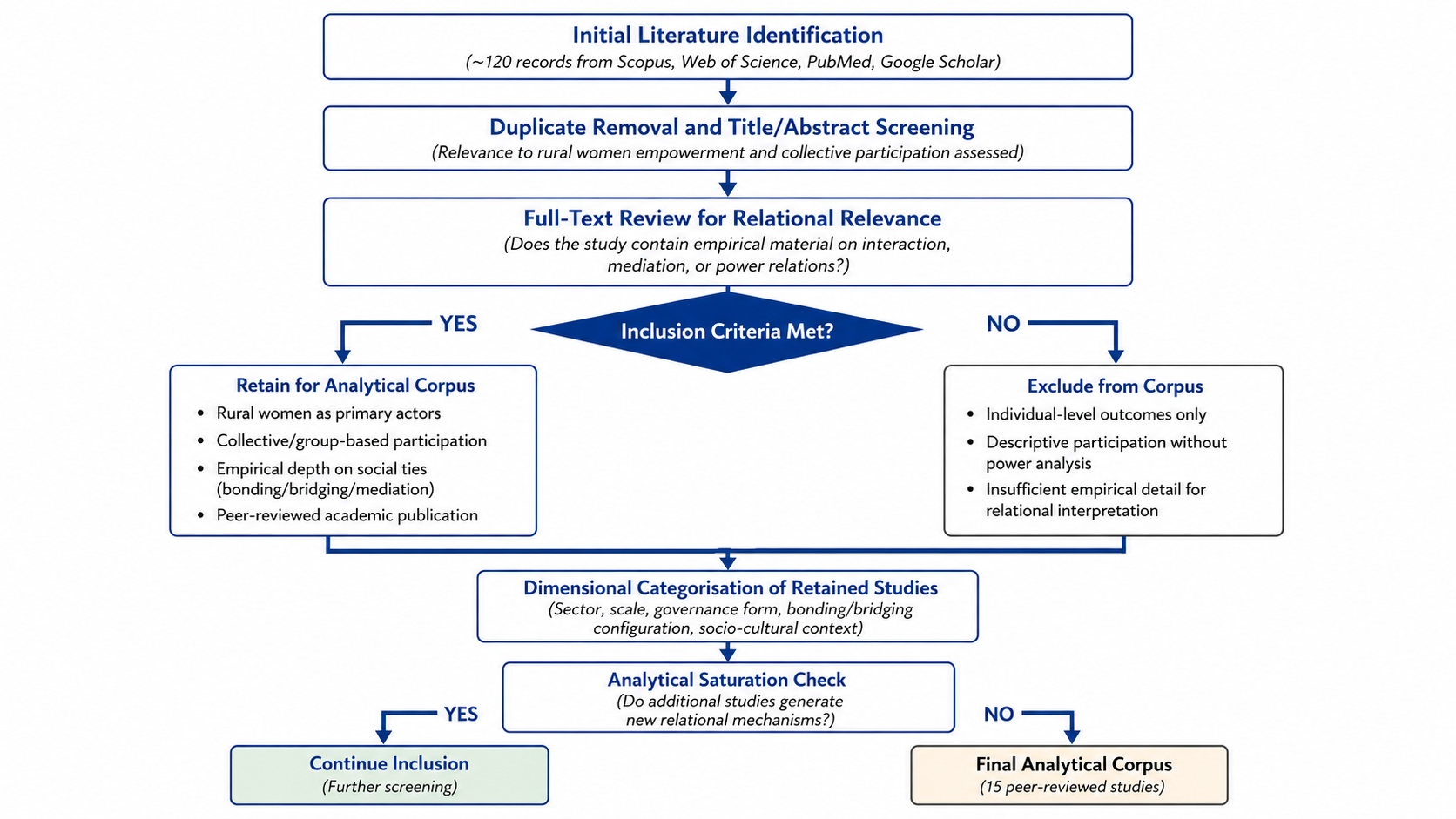
Importantly, these criteria were applied analytically rather than exhaustively. The aim was not to capture every study that might meet the criteria, but to assemble a corpus capable of supporting robust relational explanation. Studies were excluded where empowerment was operationalised solely through individual economic indicators, where participation was reported descriptively without analysis of interaction or power, or where empirical detail was insufficient to support relational interpretation. Studies focused exclusively on urban contexts or on male-dominated networks were also excluded.
This purposive selection strategy is consistent with qualitative synthesis approaches that prioritise explanatory depth and theoretical contribution over numerical coverage. By making this logic explicit, the study clarifies why the final corpus of 15 studies is both sufficient and appropriate for the analytical objectives pursued.
3.5. Search Strategy
The search strategy followed a theory-driven purposive logic rather than an exhaustive or purely systematic approach. Searches were conducted across Scopus, Web of Science, PubMed, and Google Scholar using combinations of terms relating to rural women empowerment and social inclusion, alongside relational concepts central to Social Network Theory. These included women’s groups, self-help groups, collective action, social ties, networks, trust, linkages, participatory groups, and empowerment.
The initial search yielded approximately 120 records. After removal of duplicates and screening of titles and abstracts, 38 studies were retained for full-text review. Screening at this stage focused on whether studies contained sufficient empirical material to infer relational processes, rather than on programme success or outcome metrics. Of these, 15 studies met all inclusion criteria and were retained for in-depth analysis.
The purpose of this procedure was not to identify all possible studies meeting the criteria, but to reach analytical saturation, that is, the point at which additional studies no longer yielded substantively new relational mechanisms within the analytical framework. Once recurrent patterns relating to bonding ties, bridging ties, and ambivalent relational effects were consistently observed across multiple contexts, further case inclusion was deemed analytically redundant.
3.6. Data Analysis
Each of the 15 retained studies was analysed along a common set of analytically consequential dimensions. These included the sectoral domain of the intervention, organisational scale, form of collective organisation, nature of bonding ties, form and control of bridging ties, and the socio-institutional context in which these ties operated. These dimensions were treated not as background descriptors but as conditions shaping how relational mechanisms unfolded.
Data analysis followed a layered interpretive strategy. Initial readings identified recurrent relational concepts and empirical claims made by the original authors. Through iterative comparison, these were consolidated into analytically distinct patterns corresponding to bonding ties, bridging ties, and ambivalent relational effects. Analysis then progressed to the identification of relational mechanisms, defined as theoretically informed explanations linking specific configurations of social ties to particular social inclusion outcomes. Only mechanisms that recurred across multiple studies and contexts were retained, ensuring that findings reflected systematic patterns rather than isolated cases. These mechanisms directly structured the Results section and the associated tables and figure.
4. Findings
This section presents the findings of the theory-driven qualitative relational synthesis. Evidence is organised around three analytically distinct but empirically intertwined dimensions of social ties: bonding ties, bridging ties, and their ambivalent interaction under gendered power relations. Tables 4.1–4.3 function as annotated evidence matrices. For each reviewed study, the paper distinguishes explicitly between the author’s original framing (claim) and the empirical evidence extracted from reported results and observations, and specifies: (i) the level at which ties operate and how they are created and maintained, (ii) the gendered dynamics shaping participation and access, and (iii) the conditions under which ties enable or constrain empowerment.
4.1. Bonding Ties: Collective Capacity and the Limits of Internal Inclusion
Table 4.1, see Appendix I, summarises empirical evidence on bonding ties, or intra-group ties among women, extracted from reviewed studies. The column Author framing (claim) captures how the original study theorises or positions empowerment and participation. The column Extracted empirical evidence (from study results/observations) reports what the original authors documented, including quantitative results, qualitative observations, or reported patterns, rather than new findings by this paper. The columns Tie level & maintenance and Gendered dynamics specify: (i) where and how bonding ties are formed and sustained and (ii) how gender norms, sanctions, and voice shape participation. The final columns identify the conditions under which bonding ties enable mobilisation or become constraining and interpret the implications for social inclusion. The detailed empirical synthesis of bonding ties and their associated relational mechanisms is presented in Appendix I.
4.2. Bridging Ties: External Linkages and Differentiated Inclusion
Table 4.2, see Appendix II, synthesises evidence on bridging ties, or connections linking women’s groups to markets, services, NGOs, and state institutions. It distinguishes Author framing (claim) from Extracted empirical evidence and specifies the level and maintenance of bridging ties, including inter-group and institutional interface, who brokers the links, and how they are sustained. The table explicitly records gendered conditions of access, such as leader mediation, male gatekeeping, and norms of mobility, and identifies mechanisms through which bridging ties either expand inclusion or produce differentiated outcomes, for example elite capture. A structured synthesis of the empirical evidence on bridging ties and their differentiated effects is provided in Appendix II.
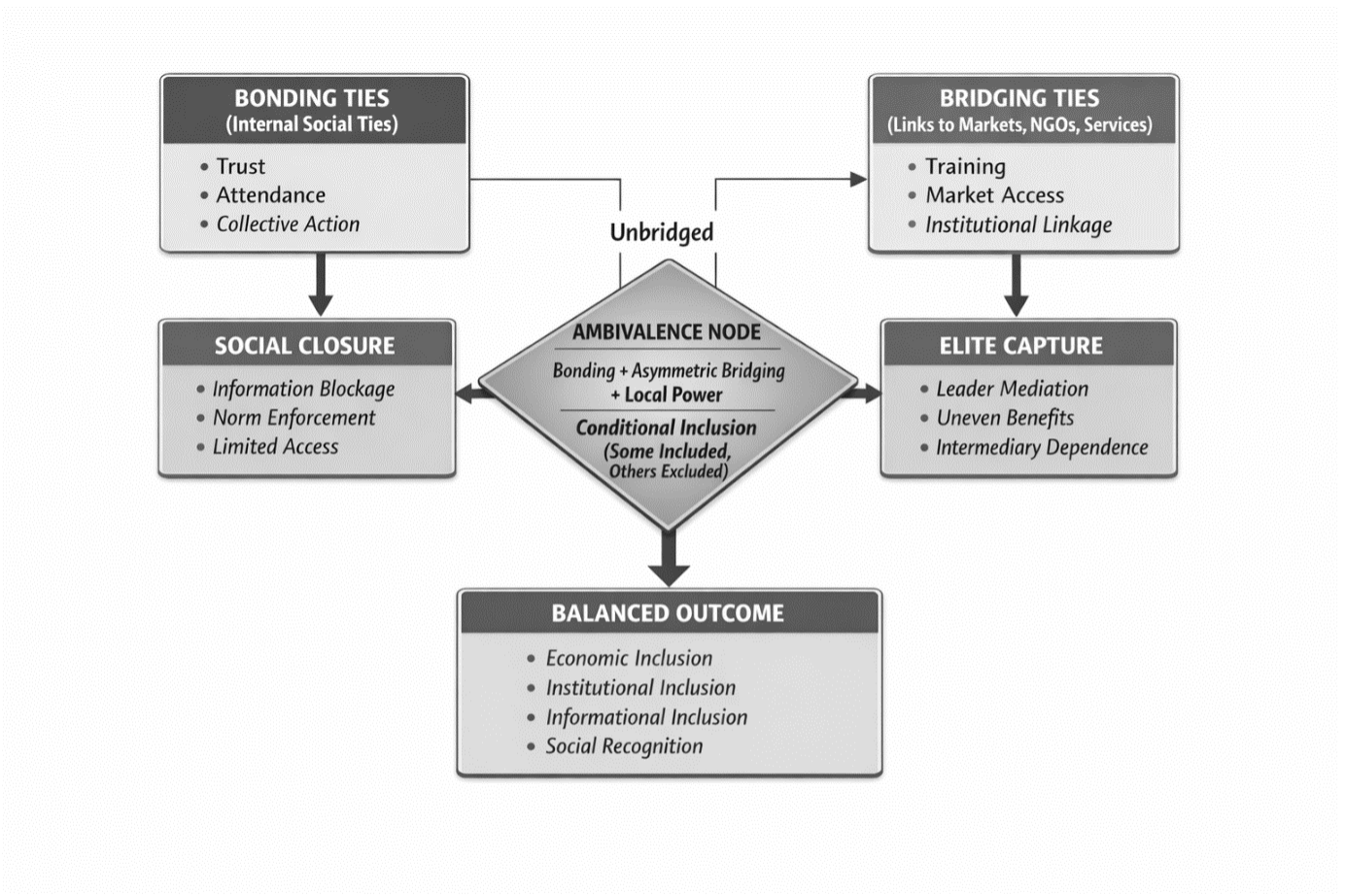
The chart in Figure 4.1 shows that bonding ties generate the trust and cohesion necessary for collective participation, yet, when not complemented by outward linkages, tend to produce social closure through information blockage and normative enforcement. Bridging ties extend access to markets, services, and institutions, but where these ties are asymmetrically mediated, they frequently result in elite capture and differentiated benefits. The interaction of dense bonding ties with uneven bridging and local power relations produces ambivalent outcomes, characterised by conditional inclusion in which some women benefit while others remain marginal. Sustained, multidimensional inclusion emerges only where bonding and bridging ties are relationally balanced and external linkages are inclusively mediated.
5. Discussion
5.1. Bonding Ties: Collective Capacity, Social Closure, and the Relational Limits of Internal Inclusion
This study’s first objective was to examine how bonding ties within women’s groups generate the relational conditions necessary for collective participation while also producing limits to inclusion. The findings provide strong support for the long-standing argument in the literature that dense, trust-based intra-group relations constitute a foundational resource for collective action (Sanyal, 2009); (Agarwal, 2010). However, by systematically distinguishing between author framings and extracted empirical evidence, this study advances the literature by demonstrating that the effects of bonding ties are not uniformly empowering but are instead relationally contingent and internally differentiated.
Bonding ties operate as relational processes through which repeated interaction, shared obligations, and peer monitoring generate trust, reciprocity, and mutual accountability. These processes correspond to what relational sociology identifies as mechanisms of collective mobilisation and social reinforcement, where sustained interaction produces the conditions for coordinated action (Emirbayer, 1997); (Crossley, 2016). Empirically, this is reflected in higher attendance rates, stronger group cohesion, and improved uptake of interventions in mature groups (Swain & Wallentin, 2009); (Kumar et al., 2021); (Nichols, 2021). In this sense, bonding ties enable what Rowlands (1997) conceptualises as “power with,” facilitating collective identity formation and shared agency. However, the findings complicate celebratory accounts of bonding social capital by showing that these same relational processes also generate mechanisms of social closure and normative enforcement. As intra-group ties intensify, peer monitoring can shift from supportive accountability to disciplinary control, where dissent becomes costly and conformity is enforced through social sanctioning (Cleaver, 2017); (Tadros, 2014). This aligns with broader critiques in the literature that dense networks, while cohesive, can restrict autonomy and limit the circulation of new information (Banerjee et al., 2013).
Importantly, the study demonstrates that these dynamics are deeply embedded in gendered power relations. Women’s participation in bonding ties is not simply a matter of group membership but is mediated by norms governing mobility, labour, and public engagement. As such, bonding ties do not dissolve patriarchal constraints but instead operate within them, shaping the extent to which participation translates into meaningful agency (Alemu, 2018); (Sanyal, 2009). This finding reinforces Kabeer’s (1999) argument that the transformation of resources into agency is contingent on social relations rather than guaranteed by participation.
Generally, these findings suggest that bonding ties function as relational filters: they enable participation by lowering social barriers and building trust, yet simultaneously delimit inclusion by reproducing internal hierarchies and normative control. This duality explains why participation may be sustained without producing transformative empowerment, thereby addressing the participation–empowerment gap identified in the literature.
5.2. Bridging Ties: Institutional Access, Mediated Linkage, and Differentiated Inclusion
The second objective of the study was to analyse how bridging ties link women’s groups to external actors and expand access to institutional, economic, and informational resources. Consistent with existing scholarship, the findings confirm that bridging ties are indispensable for translating internal collective capacity into broader forms of inclusion (Prost et al., 2013); (Tripathy et al., 2010). However, the analysis extends the literature by demonstrating that bridging ties operate through relational mechanisms of mediation and gatekeeping, which fundamentally shape their distributional effects.
Bridging ties are not spontaneously generated but are typically constructed through facilitation, programme design, or leadership mediation. As relational processes, they function through linkage and brokerage mechanisms, whereby certain actors connect otherwise disconnected social spaces (Borgatti & Ofem, 2010). These connections enable flows of information, resources, and institutional recognition, thereby expanding women’s opportunity structures. Empirical evidence across the reviewed studies shows that such linkages are associated with improved decision-making capacity, access to services, and enhanced livelihood outcomes (Nyangena & Sterner, 2008); (Seward et al., 2017). However, the study reveals that bridging ties are rarely evenly distributed. Instead, they are frequently mediated by a limited number of actors, including group leaders, facilitators, or local elites. This introduces mechanisms of gatekeeping and selective access, where the benefits of external linkages are filtered through existing social hierarchies (Bandiera et al., 2017); (Tadros, 2014). Women with higher social capital, education, or mobility are better positioned to access and leverage these ties, while others remain marginal.
This finding directly engages with and extends the literature on social capital, which often treats bridging ties as inherently beneficial. By contrast, this study shows that the empowering potential of bridging ties depends on the conditions of their governance, including coverage, inclusivity of facilitation, and institutional responsiveness (Gram et al., 2019); (Nair et al., 2021). Where these conditions are weak, bridging ties may reproduce inequality rather than mitigate it.
Gendered constraints further shape these dynamics. Norms restricting women’s mobility and public engagement limit their direct access to institutions, reinforcing dependence on intermediaries. As a result, bridging ties may expand opportunity spaces at the group level while producing differentiated inclusion at the individual level.
In relation to the study’s objective, these findings demonstrate that bridging ties are best understood not as neutral conduits of access but as relationally mediated pathways, whose effects depend on who controls them and how they are structured. This insight helps explain why similar inclusion initiatives yield uneven outcomes across contexts, despite comparable programme designs.
5.3. Ambivalence of Social Ties: Interaction Effects, Normative Control, and Conditional Inclusion
The third objective of the study was to interrogate the ambivalence of social ties by examining how bonding and bridging ties interact under gendered power relations to produce uneven empowerment outcomes. This represents the central theoretical contribution of the paper.
The findings show that empowerment outcomes cannot be attributed to bonding or bridging ties in isolation. Instead, they emerge from their interaction within specific relational configurations, shaped by local power structures and gender norms. This interaction generates what the study conceptualises as relational ambivalence, where the same social ties simultaneously enable and constrain inclusion.
From a relational perspective, this ambivalence can be understood as the co-existence of multiple mechanisms operating through the same network structures. Dense bonding ties generate trust and collective efficacy but also intensify monitoring, obligation, and normative enforcement. Bridging ties extend access to external resources but, when asymmetrically mediated, introduce gatekeeping and selective benefit distribution. When these dynamics intersect, they produce conditions under which inclusion becomes conditional rather than universal.
Empirical evidence supports this interpretation. Women may be formally included in participatory spaces yet remain marginal in decision-making or constrained in their ability to act (Agarwal, 2009); (Morrison et al., 2010). Gendered sanctions play a critical role in this process: women who deviate from expected norms or lack social standing may face subtle forms of exclusion, including silencing, pressure to conform, or withdrawal from participation (Cleaver, 2017). These processes often manifest as “quiet exclusion,” which is not captured by conventional participation metrics.
In this paper, relational processes refer to the patterned interactions through which social ties generate outcomes, including: (1) trust formation and collective mobilisation through bonding; (2) brokerage and linkage through bridging; (3) monitoring and normative enforcement through bonding; (4) gatekeeping and selective access through bridging; and (5) their interaction producing conditional inclusion through ambivalence. Thus, these processes collectively constitute a relational architecture in which empowerment is not a direct outcome of participation but a contingent effect of how social ties are configured and governed.
5.4. Synthesis: Social Ties as Relational Filters of Empowerment
Bringing these findings together, the study demonstrates that social ties function as relational filters through which access, participation, and agency are differentially distributed. Bonding ties enable participation but can constrain autonomy; bridging ties expand access but often unevenly; and their interaction under gendered power relations produces conditional inclusion.
This synthesis directly addresses the broader theoretical gap identified in the literature. While previous studies have recognised the importance of social relations, they have often treated them descriptively rather than analytically. By focusing on social ties as a single tenet of Social Network Theory, this study provides a more precise explanation of how relational mechanisms produce variation in empowerment outcomes.
6. Conclusion
This paper conceptualised rural women empowerment by shifting analytical attention away from participation as an assumed proxy for inclusion and towards the relational processes through which empowerment is produced, mediated, and constrained. The paper demonstrates that empowerment outcomes are not inherent properties of social inclusion initiatives, but emergent effects of how bonding and bridging ties are configured, governed, and embedded within gendered rural power relations.
The synthesis of fifteen peer-reviewed case studies shows that bonding ties play a foundational role in enabling collective participation, trust, and mutual support among rural women. Dense intra-group relations lower barriers to engagement and sustain collective action, particularly in socially restrictive contexts. However, the findings also show that bonding ties are inherently ambivalent. When internal cohesion intensifies normative enforcement, peer monitoring, or leadership dominance, bonding ties become mechanisms of social closure rather than empowerment. Participation may be sustained, yet agency remains conditional and unevenly distributed.
Bridging ties emerge as critical for translating internal collective capacity into economic, informational, and institutional inclusion. Connections to markets, health systems, NGOs, and state actors expand women’s opportunity structures and potential influence. Yet the analysis reveals that bridging ties are frequently mediated through a small number of actors and shaped by gendered norms of mobility, authority, and legitimacy. Where control over external linkages is concentrated, bridging ties reproduce intra-group inequality and elite capture rather than collective empowerment.
The study highlights the ambivalence of social ties as a central explanatory mechanism. Empowerment outcomes are shaped by the interaction of dense bonding ties, asymmetric bridging ties, and entrenched gender norms. This interaction produces what the paper conceptualises as conditional inclusion, in which some women benefit from participation while others remain marginal, silenced, or quietly excluded. This explains the persistent heterogeneity observed across empowerment initiatives and challenges celebratory accounts of social capital and participation.
The paper makes three key contributions. Theoretically, it demonstrates the value of theoretical concentration, showing how deep engagement with a single Social Network Theory tenet yields clearer explanatory insight than broader but superficial applications. Methodologically, it illustrates how secondary case studies can be systematically analysed as relational evidence to identify mechanisms rather than outcomes. Empirically, it provides a coherent relational explanation for why similar inclusion initiatives produce divergent empowerment effects across rural contexts.
These findings have important implications. For research, they underscore the need for primary social network studies capable of mapping tie formation, mediation, and power over time. For policy and practice, they suggest that empowerment strategies must move beyond participation metrics to address how social ties are structured, who controls external linkages, and how gendered norms shape inclusion. Only by attending to these relational conditions can social inclusion initiatives become genuinely transformative rather than merely participatory.
6.2. Limitations and Future Research
The study acknowledges that secondary empirical studies vary in methodological design, scale, and analytical focus. Reflexivity was therefore integral to the synthesis. Interpretive claims were grounded in convergence across multiple studies rather than in singular findings, and contradictory evidence was treated as analytically productive. At the same time, the study recognises the limits of secondary analysis, particularly the inability to observe tie strength, directionality, or temporal evolution directly. These limitations are not framed as weaknesses but as analytical boundaries that inform the study’s contribution.
- Agarwal, B. (2009). Rulemaking in community forestry institutions: The difference women make. Ecological Economics, 68(8–9), 2296–2308. https://doi.org/10.1016/j.ecolecon.2009.02.017
- Agarwal, B. (2010). Gender and green governance: The political economy of women’s presence within and beyond community forestry. Oxford University Press.
- Alemu, S. H., Van Kempen, L., & Ruben, R. (2018). Women empowerment through self-help groups: The bittersweet fruits of collective apple cultivation in Highland Ethiopia. Journal of Human Development and Capabilities, 19(3), 308–330. https://doi.org/10.1080/19452829.2018.1454407
- Arnstein, S. R. (1969). A ladder of citizen participation. Journal of the American Institute of Planners, 35(4), 216–224. https://doi.org/10.1080/01944366908977225
- Aziz, M., & Anjum, G. (2024). Transformative strategies for enhancing women’s resilience to climate change: A policy perspective for low-and middle-income countries. Women's Health, 20, 17455057241302032. https://doi.org/10.1177/17455057241302032
- Bandiera, O., Burgess, R., Das, N., Gulesci, S., Rasul, I., & Sulaiman, M. (2017). Women’s empowerment in action: Evidence from randomized evaluations. Working papers / LSE/DFID papers.
- Banerjee, A., Chandrasekhar, A. G., Duflo, E., & Jackson, M. O. (2013). The diffusion of microfinance. Science, 341(6144). https://doi.org/10.1126/science.1236498
- Bell, E., & Sengupta, S. S. (2021). Empowering methodologies in organisational and social research. In Empowering methodologies in organisational and social research (pp. 1–18). Routledge India.
- Bhandari, H., & Yasunobu, K. (2009). What is social capital? A comprehensive review of the concept. Asian Journal of Social Science, 37(3), 480–510. https://doi.org/10.1163/156853109X436847
- Borgatti, S. P., & Ofem, B. (2010). Social network theory and analysis. Social Network Theory and Educational Change, 17, 29.
- Calvès, A.-E. (2009). Empowerment: The history of a key concept in contemporary development discourse. Revue Tiers Monde, 200(4), 735–749. https://doi.org/10.3917/rtm.200.0735
- Cleaver, F. (2017). Development through bricolage: Rethinking institutions for natural resource management. Routledge. https://doi.org/10.4324/9781315094915
- Cornwall, A. (2003). Whose voices? Whose choices? Reflections on gender and participatory development. World Development, 31(8), 1325–1342. https://doi.org/10.1016/S0305-750X(03)00086-X
- Crossley, N. (2016). Social networks and relational sociology. In S. Abrutyn (Ed.), Handbook of Contemporary Sociological Theory. Springer. https://doi.org/10.1007/978-3-319-32250-6_9
- Deveaux, M. (1994). Feminism and empowerment: A critical reading of Foucault. Feminist Studies, 20(2), 223–247. https://doi.org/10.2307/3178151
- Emirbayer, M. (1997). Manifesto for a relational sociology. American Journal of Sociology, 103(2), 281–317.
- Gram, L., Morrison, J., Saville, N., Yadav, S. S., Shrestha, B., Manandhar, D., Costello, A., & Skordis-Worrall, J. (2019). Do participatory learning and action women’s groups alone or combined with cash or food transfers expand women’s agency in rural Nepal? Journal of Development Studies, 55(8), 1670–1686.
- Greguletz, E., Diehl, M. R., & Kreutzer, K. (2019). Why women build less effective networks than men: The role of structural exclusion and personal hesitation. Human Relations, 72(7), 1234–1261. https://doi.org/10.1177/0018726718804303
- Hager, T., Mellacher, P., & Rath, M. (2025). Gender norms and network structure: A model of the intrahousehold division of labor. Feminist Economics, 31(3), 237–274. https://doi.org/10.1080/13545701.2025.2549406
- Haugh, H. M., & O’Carroll, M. (2019). Empowerment, social innovation and social change. In Handbook of inclusive innovation (pp. 486–502). Edward Elgar Publishing. https://doi.org/10.4337/9781786436016.00039
- Hilson, G., Sauerwein, T., & Owen, J. (2020). Large and artisanal scale mine development: The case for autonomous co-existence. World Development, 130, 104919. https://doi.org/10.1016/j.worlddev.2020.104919
- Jupp, D., Ali, S. I., & Barahona, C. (2010). Measuring empowerment? Ask them. Sida Studies in Evaluation, 1, 7–99.
- Kabeer, N. (1999). Resources, agency, achievements: Reflections on the measurement of women’s empowerment. Development and Change, 30(3), 435–464. https://doi.org/10.1111/1467-7660.00125
- Kesby, M. (2005). Retheorizing empowerment-through-participation as a performance in space: Beyond tyranny to transformation. Signs: Journal of Women in Culture and Society, 30(4), 2037–2065. https://doi.org/10.1086/428422
- Klingler-Vidra, R., & Liu, Y. (2020). Inclusive innovation policy as social capital accumulation strategy. International Affairs, 96(4), 1033–1050. https://doi.org/10.1093/ia/iiaa091
- Kumar, N., Raghunathan, K., Arrieta, A., Jilani, A., & Pandey, S. (2021). The power of the collective empowers women: Evidence from self-help groups in India. World Development, 146, 105579. https://doi.org/10.1016/j.worlddev.2021.105579
- Merchant, G. (2012). Unravelling the social network: Theory and research. Learning, Media and Technology, 37(1), 4–19. https://doi.org/10.1080/17439884.2011.567992
- Morrison, J., Thapa, R., Basnet, M., Budhathoki, B., Tumbahangphe, K., Manandhar, D., Costello, A., & Osrin, D. (2010). Exploring the first delay: A qualitative study of home deliveries in Makwanpur district Nepal. BMC Pregnancy and Childbirth, 14, 89. https://doi.org/10.1186/1471-2393-14-89
- Nair, N., Tripathy, P. K., Gope, R., Rath, S., Pradhan, H., Rath, S., Kumar, A., Nath, V., Basu, P., Ojha, A., Copas, A., Houweling, T. A., Haghparast-Bidgoli, H., Minz, A., Baskey, P., Ahmed, M., Chakravarthy, V., Mahanta, R., & Prost, A. (2021). Effectiveness of participatory women's groups scaled up by the public health system to improve birth outcomes in Jharkhand, eastern India: A pragmatic cluster non-randomised controlled trial. BMJ Global Health, 6(11), e005066. https://doi.org/10.1136/bmjgh-2021-005066
- Narayan-Parker, D. (Ed.). (2005). Measuring empowerment: Cross-disciplinary perspectives. World Bank Publications.
- Nichols, C. (2021). Self-help groups as platforms for development: The role of social capital. World Development, 146, 105575. https://doi.org/10.1016/j.worlddev.2021.105575
- Nyangena, W., & Sterner, T. (2008). Social capital and institutions in rural Kenya: Is Machakos unique? Environment for Development Initiative. http://www.jstor.org/stable/resrep14863
- Phillips, M. J. (2023). Towards a social constructionist, criticalist, Foucauldian-informed qualitative research approach: Opportunities and challenges. SN Social Sciences, 3, 175. https://doi.org/10.1007/s43545-023-00774-9
- Pretty, J. N. (1995). Participatory learning for sustainable agriculture. World Development, 23(8), 1247–1263. https://doi.org/10.1016/0305-750X(95)00046-F
- Prost, A., Colbourn, T., Seward, N., Azad, K., Coomarasamy, A., Copas, A., Houweling, T. A. J., Fottrell, E., Kuddus, A., Lewycka, S., MacArthur, C., Manandhar, D., Morrison, J., Mwansambo, C., Nair, N., Nambiar, B., Osrin, D., Pagel, C., Pulkki-Brännström, A.-M., Rosato, M., Skordis-Worrall, J., Saville, N., & Costello, A. (2013). Women’s groups practising participatory learning and action to improve maternal and newborn health in low-resource settings: A systematic review and meta-analysis. The Lancet, 381(9879), 1736–1746. https://doi.org/10.1016/S0140-6736(13)60685-6
- Quatman, C., & Chelladurai, P. (2008). Social network theory and analysis: A complementary lens for inquiry. Journal of Sport Management, 22(3), 338–360. https://doi.org/10.1123/jsm.22.3.338
- Rowlands, J. (1997). Questioning empowerment: Working with women in Honduras. Oxfam GB.
- Sanyal, P. (2009). From credit to collective action: The role of microfinance in promoting women's social capital and normative influence. American Sociological Review, 74(4), 529–550. https://doi.org/10.1177/000312240907400402
- Schneider, K. R., De la O Campos, A. P., Cavatassi, R., & Davis, B. (2024). Resilient and inclusive rural transformation in sub-Saharan Africa under climate, demographic, and social change: Challenges and opportunities for income growth and job creation. Global Food Security, 43, 100815. https://doi.org/10.1016/j.gfs.2024.100815
- Sen, A. (1999). Development as freedom. Oxford University Press.
- Seward, N., Neuman, M., Colbourn, T., Osrin, D., Lewycka, S., Azad, K., Costello, A., & Prost, A. (2017). Effects of women’s groups practising participatory learning and action on women’s agency: A meta-analysis of individual-level data from randomised trials. BMJ Global Health, 2(4), e000371. https://doi.org/10.1136/bmjgh-2017-000371
- Swain, R. B., & Wallentin, F. Y. (2009). Does microfinance empower women? Evidence from self-help groups in India. International Review of Applied Economics, 23(5), 541–556. https://doi.org/10.1080/02692170903007540
- Tadros, M. (2014). Devolving the power to divide: Sectarian relations in Egypt (2011–12). IDS Bulletin, 45(5), 69–80. https://doi.org/10.1111/1759-5436.12105
- Tripathy, P., Nair, N., Barnett, S., Mahapatra, R., Borghi, J., Rath, S., & Costello, A. (2010). Effect of a participatory intervention with women's groups on birth outcomes and maternal depression in Jharkhand and Orissa, India: A cluster-randomised controlled trial. The Lancet, 375(9721), 1182–1192. https://doi.org/10.1016/S0140-6736(09)62042-0
- VanderPlaat, M. (1999). Locating the feminist scholar: Relational empowerment and social activism. Qualitative Health Research, 9(6), 773–785. https://doi.org/10.1177/104973299129122270
Appendices
| Study | Tie level & how bonding ties are created/maintained | Author’s claim | Empirical evidence (from study results/observations) | Gendered dynamics in rural context | When bonding becomes constraining (conditions) | Mechanism & implication for inclusion |
|---|---|---|---|---|---|---|
| Sanyal (2009) | Intra-group ties formed through regular meetings, joint repayment, peer monitoring, collective problem-solving; maintained by routine interaction and shared sanctions. | Microfinance groups can convert credit into collective capacity via social capital and “normative influence”. | Groups developed solidaristic ties that facilitated collective action beyond finance, such as norm-setting and joint action, but also relied on strong internal discipline. | Women’s collective action shaped by gendered legitimacy; participation can challenge local norms yet remains socially negotiated. | When peer discipline dominates and dissent is costly; when collective norms silence marginal members. | Bonding generates “power with”, but may also institutionalise social discipline; conditional inclusion. |
| Banerjee et al. (2013) | Bonding emerges from clustered village social networks; maintained through homophily, caste/gender, and repeated local interaction. | Network structure shapes diffusion: clustered ties accelerate within-group but impede cross-group reach. | Adoption diffusion moved through existing clustered ties; segregation limited spread beyond clusters. | Gender and caste structure access to network information and adoption pathways. | When clusters remain socially closed, restricting external information and institutional access. | Bonding supports internal uptake but produces closure, limiting broader inclusion and opportunity diffusion. |
| Nichols (2021) | Bonding maintained through meeting attendance norms and internal social capital; sustained by perceived benefits and group discipline. | SHGs can be effective platforms when attendance norms and social capital are strong. | Attendance and uptake varied by SHG maturity and socio-economic context; weaker groups had limited uptake. | Women’s attendance constrained by time poverty and local gender norms; poorer women less able to sustain participation. | When attendance norms exclude poorer/less mobile women; when maturity becomes gatekeeping. | Bonding underpins participation but can stratify inclusion: mature groups amplify benefits; weak groups lag. |
| Kumar et al. (2021) | Bonding ties sustained through group membership and repeated participation; strength varies by context and maturity. | Collective membership increases empowerment measurable through WEAI-related metrics. | SHG membership associated with higher empowerment outcomes; heterogeneity across states and group maturity. | Empowerment gains occur within gendered household bargaining contexts; not uniform across women. | When benefits accrue mainly to active/connected members; when marginal women cannot participate fully. | Bonding correlates with empowerment but is uneven: inclusion depends on ability to remain engaged. |
| Alemu (2018) | Bonding created via women’s SHG organisation around production; maintained through joint work, meetings, peer accountability. | SHGs in productive sectors can shift women’s empowerment and attitudes. | Reported empowerment changes among members, including attitudinal shifts; examined changes in male attitudes. | Explicitly treats gender norms and male attitudes as mediators of empowerment. | When gender norms restrict market mobility or leadership; when men control benefits of group gains. | Bonding can build confidence and economic agency, but empowerment depends on male norm shifts and control of proceeds. |
| Study | Tie level & how bridging ties are created/maintained | Author’s claim | Empirical evidence (from study results/observations) | Gendered dynamics in rural context | Where/when bridging becomes unequal (conditions) | Mechanism & implication for inclusion |
|---|---|---|---|---|---|---|
| Nyangena & Sterner (2008) | Bridging/linking ties created via institutional engagement, community interfaces, extension connections; maintained through repeated cross-scale interaction. | Bonding, bridging, and linking social capital relate differently to women’s decision-making. | Linking connections strongly associated with women’s participation in farm decisions, with context interactions. | Gendered constraints shape who can access institutions and information channels. | When institutional access is mediated by male gatekeepers or a few female leaders. | Bridging/linking ties enable institutional inclusion; unequal control produces differentiated access. |
| Tripathy et al. (2010) | Bridging formed through facilitated groups connecting community action to health system and collective strategies; maintained by facilitation and community engagement. | Participatory women’s groups improve birth outcomes when mobilisation connects to services. | Effects depended on mobilisation processes and community linkage; outcomes tied to participation coverage. | Gender norms affect meeting attendance, voice in community actions, and ability to enact strategies. | Low coverage or weak linkage limits reach; marginal women excluded from group influence. | Bridging through facilitation expands inclusion; inadequate coverage yields uneven inclusion. |
| Gram et al. (2019) | Bridging depends on facilitation connecting group learning to broader community institutions; maintained through continued cycles. | PLA may or may not shift outcomes; effectiveness depends on context and implementation. | Found limited evidence of impact for PLA alone in some contexts; highlights implementation and social conditions. | Women’s participation constrained by gendered mobility and social permission. | When facilitation is insufficient to overcome gendered constraints; when ties remain internal. | Bridging requires institutional traction; without it, participation may not convert to empowerment. |
| Prost et al. (2013) | Bridging ties connect women’s groups to health knowledge and community action; maintained through cycles and coverage. | Women’s PLA groups improve maternal/newborn survival under adequate coverage. | Outcomes stronger where participation/coverage adequate; indicates a pathway via collective action and linkage. | Gendered health decision-making shapes uptake; women’s voice matters in household/community. | When coverage is low or community power blocks implementation. | Bridging + sufficient coverage converts ties into institutional inclusion, especially health; otherwise limited effects. |
| Seward et al. (2017) | Bridging created via group-to-community diffusion and facilitation; maintained through repeated group cycles. | The pathways through which women’s groups improve outcomes is assessed trial evidence. | Analysed pathways, for example behaviour diffusion and collective action, and highlighted variability across sites. | Gendered norms shape diffusion of practices and whose behaviours change. | When diffusion remains within certain subgroups; when marginal women lack reach. | Bridging effects operate through diffusion and collective action; unequal diffusion produces conditional inclusion. |
| Nair et al. (2021) | Bridging ties created at institutional scale via government facilitators linking groups to health systems; maintained through implementation systems. | Scaling PLA through government can work, with variation by implementation strength. | Evidence shows implementation fidelity and contextual factors shape effectiveness at scale. | Gender norms influence reach and participation; institutionalisation can broaden reach. | When implementation weak or facilitators rely on local elites. | Institutional bridging can broaden inclusion if design mitigates local gatekeeping and ensures coverage. |
| Study | Relational condition (ties + power) | Author framing (claim) | Empirical evidence (from study results/observations) | Gendered mechanism (norms/voice/control) | What this reveals about “conditional inclusion” | Implication for this paper’s tie mechanisms |
|---|---|---|---|---|---|---|
| Agarwal (2009) | Dense local ties + gendered participation structures. | Women’s participation changes governance outcomes. | Women’s participation associated with different governance outcomes; participation shaped by institutional and social constraints. | Gendered barriers to effective participation; norms shape voice and influence. | Participation may be present but not equally effective; inclusion uneven. | Bonding ties can coexist with constrained voice; inclusion depends on institutional conditions. |
| Agarwal (2010) | Group composition + intra-group power asymmetries. | Women’s proportional strength affects participation and outcomes. | Demonstrates “critical mass” effects and how group composition shapes effective participation. | Gendered hierarchy influences whether women speak and influence decisions. | Inclusion becomes conditional on proportions and institutional context. | Bonding ties enable participation only when governance rules and proportions reduce marginalisation. |
| Morrison et al. (2010) | Group ties + social norms + facilitation. | Women’s groups improve outcomes via social processes. | Documented how group discussion, mutual learning, and collective action operate; noted barriers and who is excluded. | Gender norms influence who attends and who can act publicly; voices vary. | Some women benefit more than others; “quiet exclusion” can occur. | Shows how ties are made and maintained in practice and where normative control shapes outcomes. |
The author confirms sole responsibility for the conception, design, analysis, interpretation, drafting, revision, and approval of the final manuscript.
The author received no specific funding for this work.
The author declares that there are no commercial or financial relationships that could be construed as a potential conflict of interest.
All claims expressed in this article are solely those of the author and do not necessarily represent those of the publisher, editors, reviewers, or affiliated institutions. Any product, service, or claim that may be evaluated in this article is not guaranteed or endorsed by the publisher.

Creative Commons License
This work is licensed under a Creative Commons Attribution 4.0 International License .
Copyright © 2026 The Author(s). Published by HRL Journal Service.
2.2. Social Inclusion Initiatives and Participation
Social inclusion initiatives frequently target participation as both a means and a proxy for empowerment, especially through group-based platforms such as self-help groups, cooperatives, and community-driven development. The assumption is often that once women are “included” in groups or participatory spaces, empowerment will follow through improved access and voice. Yet the literature consistently warns against equating participation with empowerment because participation varies in depth, authority, and consequences. Arnstein’s (1969) classic “ladder of participation” remains instructive: participatory forms range from symbolic consultation to genuine citizen power, and the mere presence of participation does not indicate control over decisions. Subsequent work similarly differentiates participation as nominal membership, active engagement, influence over agendas, and authority over outcomes (Cornwall, 2003); (Pretty, 1995).
This distinction directly informs the participation–empowerment gap identified by the reviewer. Participation can be conceptualised as part of an empowerment continuum, but only if the pathway is made explicit: participation becomes empowering when it is linked to expanding influence, knowledge, control over resources, and recognition within institutional arenas. In Kabeer’s (1999) terms, participation can be a site where resources are transformed into agency, but this transformation is contingent on power relations and enabling structures. Where participatory spaces are tightly controlled, participation may serve as a technology of governance rather than empowerment, producing compliance and legitimacy for programmes without redistributing power (Kesby, 2005); (Cornwall, 2003).
A theoretically coherent way to express this continuum is to conceptualise participation as a necessary but insufficient condition for empowerment. Participation may generate informational gains, social confidence, and collective identity, yet empowerment requires movement beyond presence to influence where women can shape decisions, secure claims, and convert participation into material or institutional outcomes (Rowlands, 1997); (Agarwal, 2010). This is why the literature frequently reports uneven outcomes: women may participate but remain marginal in decision-making, dependent on intermediaries, or subject to normative enforcement (Cleaver, 2017); (Tadros, 2014). These patterns indicate that participation becomes empowering only when the relational and institutional conditions allow participation to be consequential.
Accordingly, the relevant theoretical question is not whether women participate, but what participation does: whether it expands women’s access to information and assets, increases their influence over decisions, and alters the recognition of their claims within household and community structures (Kabeer, 1999); (Sen, 1999); (Agarwal, 2010). This reframing is essential for the present study because it justifies analysing social inclusion not as a binary outcome but as a relationally mediated process whose effects vary across actors and contexts.