


Rapid population growth and climate-related stressors continue to pressure food production systems across Eastern Africa. Consequently, the adoption of climate-resilient livestock breeds has become an important strategy for enhancing productivity and adaptation. This article examined trends in the adoption of climate-resilient livestock breeds in Eastern Africa from 1990 to 2020 using a quantitative desk review. Secondary panel data on four widely promoted breeds were compiled from the International Livestock Research Institute (ILRI), FAOSTAT, national statistical bureaus, World Bank assessments, CGIAR publications, and peer-reviewed literature. Results show a sustained increase in the uptake of improved livestock breeds throughout the study period. Crossbred dairy cattle recorded the highest adoption rates, reaching 68.3% in Rwanda, 62.1% in Kenya, and 55.4% in Uganda. Sahiwal cattle adoption reached 58.4% in Kenya, while Galla goat adoption increased steadily, led by Kenya at 55.3%. Red Maasai and Dorper sheep registered comparatively lower adoption levels. Overall adoption increased from 3.4-8.1% in 1990 to 25.3-50.3% in 2020, with Rwanda and Kenya recording the highest rates. These findings highlight progress in livestock adaptation while revealing disparities linked to infrastructure, policy support, extension services, and access to improved genetics.
Keywords: Climate-resilient livestock breeds; Crossbred dairy cattle; Sahiwal cattle; Galla goats; Eastern Africa.
1. Introduction
Animal production sustains livelihoods and contributes remarkably to food security and the economies of the global South (Michalk et al., 2019). In the Eastern African countries (Kenya, Tanzania, Uganda, Rwanda, Burundi, Ethiopia, and South Sudan), the livestock sector supports millions of households and accounts for a substantial percentage of agricultural GDP (Erdaw, 2023). Pastoral communities in northern Kenya, southern Ethiopia, and parts of Tanzania rely almost entirely on livestock for survival, while smallholder farmers in the Kenya highlands integrate animals with crops such as maize, bananas, and cassava. Cattle, goats, sheep, camels, and poultry are the dominant species, contributing significantly to household income, nutrition, and cultural identity (Hunt et al., 2019). Livestock systems in the region vary, ranging from pastoralist herding in arid and semi-arid lands to mixed crop-livestock farming in highlands and intensive smallholder operations in urban centers. Rural-urban migration to cities such as Nairobi, Dar es Salaam, Kampala, and Addis Ababa has significantly increased demand for dairy and poultry products in the region (Lee-Smith et al., 2029). Despite this, Enahoro et al. (2019) show that the Eastern African region’s per capita milk and meat consumption remains relatively low compared to global averages, amid rapidly rising population growth, urbanization, and income levels.
Amid these dynamics, animal production in Eastern Africa is gradually being complicated by climate change. In particular, the region has become remarkably vulnerable to rising temperatures, prolonged droughts, erratic rainfall patterns, and increased frequency of extreme weather events (Duku et al., 2025). Climate challenges heighten animal feed and water shortages through reduced pasture productivity, higher disease prevalence, and heat stress on animals (Easter et al., (2018). For instance, Simpskin et al. (2019) shows how persistent droughts in the Horn of Africa and the south of Kenya have repeatedly caused massive livestock losses, undermining food security and triggering humanitarian crises, while vector-borne diseases, including East Coast Fever and Rift Valley Fever, have been spreading more easily under changing climatic conditions in the region. Marshall et al. (2019) indicates that some traditional livestock breeds, especially cattle, are well-adapted to local conditions, but their productivity is extremely low, making them uneconomical amid the rising needs of the people they support in the region.
According to Duku et al. (2025), climate-resilient animal production has become an urgent necessity in Eastern Africa, given the demand for animal products and erratic weather conditions. In response, various governments have supported initiatives, ranging from breeding and promoting heat-tolerant, disease-resistant livestock breeds to improving feed resources with drought-tolerant forages; adopting climate-smart management practices like enhanced water harvesting, fodder conservation, and agroforestry integration; and enhancing value chains for better market access (Otieno, 2024). Resilient systems are seen as avenues for stabilizing animal productivity, reducing vulnerability of pastoral and smallholder communities, and supporting sustainable intensification (Hunting et al., 2029). According to Khonje and Qaim (2024), increasing the availability of animal-source foods is also vital to addressing pervasive malnutrition, particularly stunting and micronutrient deficiencies, which remain widespread among children in some countries in East Africa.
Venturing into climate-resilient animal production is justified by productivity requirements and the need to achieve broader goals of poverty reduction, gender empowerment (greater women’s involvement in animal production), environmental sustainability, and the resilience of rural economies (Lee-Smith et al., 2019). In East Africa, sustainable livestock development is essential to meet the nutritional needs of the growing population without placing excessive pressure on natural resources or relying on imports (Otieno, 2024). Despite these imperatives, significant knowledge gaps persist regarding adoption rates of improved, climate-resilient livestock breeds. Contemporary empirical evidence from technical reports and academic journals points to limited access to inputs among farmers, inadequate extension services, cultural preferences for indigenous breeds, and insufficient policy support as major hindrances to the widespread uptake of these breeds in the region. The existing studies on this subject, such as Flax et al. (2023) and Oloo et al. (2023), tend to be fragmented, project-specific, or focused on narrow geographic areas, complicating the process of drawing robust regional conclusions about adoption trends and patterns. This underscores the critical need for rigorous studies of current adoption levels, barriers, and enablers. Such research is pivotal to creating an effective roadmap for evidence-based interventions by policymakers, development partners, and extension services that are actively involved in efforts to accelerate the transformation of the livestock sector. The study is also vital for securing animal production systems that are productive, equitable, and resilient to future climate challenges in Eastern Africa, supporting millions of residents of the region who may be vulnerable to climate stressors.
2. Methodology
2.1. Study Location
The focus of this study was Eastern African countries (Kenya, Tanzania, Uganda, Rwanda, Burundi, Ethiopia, and South Sudan). These nations have diverse livestock production systems (Kidane & Makonnen, 2024) Otieno (2024) indicates that livestock supports substantial portions of rural livelihoods, particularly in drought-prone areas of East Africa. The research data covered arid and semi-arid pastoral regions (northern Kenya, southern Ethiopia, and parts of Tanzania), regional highlands which are mixed crop-livestock zones (central Kenya, Uganda, Rwanda, and Burundi), and peri-urban intensive systems around major cities (Nairobi, Kampala, and Addis Ababa). The selection of these locations hinged on their high dependence on animal production for livelihoods and food security, high vulnerability to climatic variability (droughts, erratic rainfall, and heat stress), and active promotion of climate-resilient practices by the government, ILRI, national veterinary services, and development partners. The study utilized data spanning 1990–2020.
2.2. Research Design
This study employed a quantitative survey research design grounded in secondary data. A desk-based approach was adopted to facilitate systematic synthesis of existing evidence on practices for rearing improved heat- and disease-tolerant livestock breeds (Guerin, Janta & van Gorp, 2018). The main livestock species of interest were cattle, goats, and sheep. These animals were selected because their products are widely consumed in the region and are reared outside urban settings by the most vulnerable communities (Otieno, 2024). The design combined cross-sectional analysis of current adoption patterns with longitudinal elements drawn from time-series reports across Eastern African countries, enabling regional comparisons and trend identification. This aligned with the study’s objectives of mapping adoption levels by description.
2.3. Population and Sample
The target population consisted of livestock-keeping households and communities across major production zones in the selected Eastern African countries. This included pastoralists, agro-pastoralists, and smallholder mixed farmers, who collectively manage the majority of the region’s livestock (Hunt et al., 2019). The study purposively drew from secondary sources, including national livestock censuses, ILRI reports, FAO databases, project evaluations, and peer-reviewed studies. This created a synthesized meta-sample representing thousands of livestock keepers across varied agro-ecological zones of Eastern Africa.
2.4. Inclusion Criteria
Inclusion criteria were being in the Eastern Africa region (Kenya, Tanzania, Uganda, Rwanda, Burundi, Ethiopia, and South Sudan), quantitative data, and coverage of climate-resilient livestock (heat-tolerant, disease-resistant, feed-efficient). Stratification was performed by country and species for balanced representation.
2.5. Data Collection
Data were collected by systematic extraction, synthesis, and extrapolation of statistics from secondary sources (Cooper et al., 2019). Sources of data included technical reports from the International Livestock Research Institute (ILRI), FAO STAT, national bureaus of statistics, World Bank evaluations, CGIAR publications, and academic impact assessments on improved breeds, fodder technologies, and climate-smart livestock practices. Multiple sources were cross-verified to minimize bias and resolve inconsistencies. The main adoption metric was the percentage of resilient breeds adopted. Where possible, figures were extrapolated to broader populations using weighting factors based on livestock population densities, production shares, or household survey frames. Temporal data were then standardized to analyze trends over the three-decade period.
2.6. Ethical Considerations
The study’s ethical considerations included rigorous citation of all sources used in the data. The study also conducted a transparent discussion of data limitations inherent in secondary materials (Almusaed, Almssad & Yitmen, 2025). The study also acknowledged underlying limitations, including potential selection bias in data from project-based studies and gaps in coverage for certain countries or species, such as chicken.
3. Findings
The data show a consistent increase in the adoption of climate-resilient livestock breeds across Eastern Africa between 1990 and 2020. Adoption was generally low in 1990, ranging from 3.4% in Burundi to 8.1% in Kenya, but increased steadily over the four decades. Rwanda recorded the highest adoption rate by 2020 (50.3%), followed by Kenya (41.9%), Uganda (38.3%), and Tanzania (35.4%). Ethiopia (30.1%) and Burundi (25.3%) also made significant progress, though at slower rates. South Sudan, with data available since 2010, saw adoption increase from 5.1% to 12.4% by 2020, suggesting growing regional acceptance of climate-resilient livestock breeds, despite differences in adoption across countries.
| Country | 1990 | 2000 | 2010 | 2020 |
|---|---|---|---|---|
| Kenya | 15.1% | 28.4% | 45% | 62.1% |
| Uganda | 10.3% | 22% | 38.3% | 55.4% |
| Tanzania | 8.4% | 18.1% | 32.4% | 48.1% |
| Ethiopia | 5.3% | 12.4% | 24.3% | 40.3% |
| Rwanda | 12.3% | 30.1% | 50.1% | 68.3% |
| Burundi | 4.4% | 10.3% | 18.3% | 30.3% |
The data indicate a substantial increase in the adoption of crossbred dairy cattle across Eastern Africa between 1990 and 2020. Adoption rates rose steadily in all countries, reflecting growing investment in improved dairy genetics and livestock productivity. Kenya and Rwanda consistently led the region, with adoption increasing from 15.1% to 62.1% and from 12.3% to 68.3%, respectively. Uganda and Tanzania also experienced significant growth, reaching 55.4% and 48.1% by 2020. Although Ethiopia and Burundi recorded comparatively lower adoption rates, they showed notable improvements, rising to 40.3% and 30.3%, respectively, signifying widespread uptake of crossbred dairy cattle. However, adoption levels varied across countries due to differences in livestock development programs and farmers’ access to improved breeds.
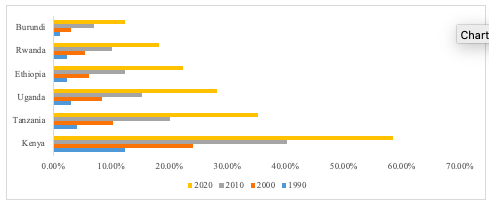
Table 2 shows that Eastern African countries have experienced a steady increase in Sahiwal cattle adoption between 1990 and 2020. Adoption rates improved across all countries, reflecting growing recognition of the breed's adaptability, disease tolerance, and productivity. Kenya remained the regional leader, with adoption rising from 12.4% in 1990 to 58.4% in 2020. Tanzania and Uganda also recorded substantial growth, reaching 35.3% and 28.2%, respectively, by 2020. Ethiopia, Rwanda, and Burundi experienced gradual increases, although adoption remained comparatively lower at 22.4%, 18.2%, and 12.3%, respectively. Overall, the data indicate expanding adoption of Sahiwal cattle across the region, with differences among countries reflecting variations in breeding programs, extension services, and access to improved livestock genetics.
| Country | 1990 | 2000 | 2010 | 2020 |
|---|---|---|---|---|
| Kenya | 2.3% | 8.1% | 18% | 32.3% |
| Tanzania | 0.9% | 2.4% | 6.3% | 12% |
| Uganda | 0.6% | 0.8% | 0.8% | 2.1% |
| Ethiopia | 0.5% | 0.7% | 0.8% | 1.3% |
| Rwanda | 0.7% | 0.8% | 0.8% | 1.1% |
| Burundi | 0.1% | 0.1% | 0.3 % | 0.4% |
Table 2 indicates a gradual increase in the adoption of Red Maasai and Dorper sheep breeds across Eastern Africa between 1990 and 2020, although overall adoption remained relatively low. Kenya recorded the highest adoption throughout the period, increasing from 2.3% in 1990 to 32.3% in 2020. Tanzania also showed notable progress, reaching 12.0% by 2020. In contrast, Uganda, Ethiopia, Rwanda, and Burundi experienced only modest increases, with adoption remaining below 3% in most cases, reflecting potential limited access to improved breeding stock, inadequate extension services, and lower preference for investing in these sheep breeds.
| Country | 1990 | 2000 | 2010 | 2020 |
|---|---|---|---|---|
| Kenya | 8.3% | 18.1% | 35.1% | 55.3% |
| Tanzania | 3.1% | 8.3% | 18.2% | 32.2% |
| Ethiopia | 2.4% | 6.1% | 14.2% | 28.3% |
| Uganda | 1.1% | 4.3% | 10.3% | 20.2% |
| Rwanda | 0.8% | 2.2% | 6.1% | 12.1% |
| Burundi | 0.3% | 1.2% | 4.2% | 8.3% |
Table 3 findings show a steady increase in the adoption of Galla goat breeds across Eastern Africa between 1990 and 2020. Adoption rates rose consistently in all countries, reflecting growing recognition of the breed's resilience to drought, diseases, and harsh environmental conditions. Kenya recorded the highest adoption throughout the period, increasing from 8.3% in 1990 to 55.3% in 2020. Tanzania and Ethiopia also experienced substantial growth, reaching 32.2% and 28.3%, respectively, by 2020. Uganda recorded moderate progress, while Rwanda and Burundi maintained comparatively lower adoption rates despite steady improvements, signaling broader uptake of Galla goats across the region. However, adoption levels varied due to differences in livestock development initiatives, breeding programs, and farmers' access to improved genetic resources.
4. Discussion
The findings demonstrate a sustained growth in the adoption of climate-resilient livestock breeds across Eastern Africa between 1990 and 2020, consistent with theories of agricultural innovation diffusion and livestock intensification. According to Dearing and Cox (2018), the Diffusion of Innovations Theory, proposed by Everett Rogers, posits that the adoption process progresses through awareness, evaluation, trial, and eventual adoption. The observed increase in adoption of climate-resilient livestock breeds, crossbred dairy cattle, Sahiwal cattle, Galla goats, and Red Maasai and Dorper sheep reflects progressive movement from early adopters to broader farmer populations as awareness, institutional support, and perceived benefits expanded over time.
Crossbred dairy cattle recorded the highest adoption levels, reaching 68.3% in Rwanda, 62.1% in Kenya, and 55.4% in Uganda by 2020. Ideally, crossbred dairy cattle offer higher milk yields, improved feed conversion efficiency, and greater profitability, making them attractive investments despite their higher management requirements. Their adoption trend aligns with Agricultural Household Theory, which posits that farmers adopt technologies that maximize productivity and household welfare under resource constraints (Barrett & Just, 2022). Similarly, adoption of Sahiwal cattle increased substantially, particularly in Kenya (58.4%), reflecting farmers' preference for breeds that combine high productivity with tolerance to heat, parasites, and endemic diseases, which are characteristic of climate change. Galla goat adoption rose from 8.3% to 55.3% in Kenya and to 32.2% in Tanzania. The trends also align with climate adaptation theory, where livestock systems evolve in response to increasing drought frequency and environmental stress.
Conversely, Red Maasai and Dorper sheep exhibited relatively low adoption across most countries despite gradual increases. Kenya peaked at 32.3% by 2020, whereas adoption remained below 12% in most neighbouring countries. This pattern can be explained by Transaction Cost Economics, which suggests that adoption depends not only on perceived usefulness but also on farmers' ability to access breeding stock, veterinary services, markets, and extension services (Cypers et al., 2021). High acquisition costs, limited breeding infrastructure, and weak value chains may have constrained wider dissemination of these improved sheep breeds. The variation in adoption across countries may further reflect differences in institutional capacity, livestock breeding policies, extension systems, and investment in genetic improvement. Rwanda and Kenya have implemented stronger livestock development strategies and farmer support programs, consistently achieving higher adoption rates than Burundi and Ethiopia.
5. Conclusion
The findings of this study demonstrate a consistent increase in the adoption of climate-resilient livestock breeds across Eastern Africa between 1990 and 2020, reflecting growing recognition of improved livestock genetics as a key strategy for enhancing productivity and climate resilience. Crossbred dairy cattle recorded the highest adoption rates, followed by Sahiwal cattle and Galla goats, while Red Maasai and Dorper sheep exhibited comparatively slower uptake. This sheds light on the growing awareness among farmers in East Africa, especially in Kenya and Rwanda, of the need to raise more productive animals. Nevertheless, disparities in adoption rates exist across countries, indicating that access to improved breeding stock, veterinary services, credit, and markets remains uneven across the region. However, more work needs to be done in Eastern African countries like Burundi to accelerate adoption of climate-resilient livestock breeds to reduce population vulnerability to the effects of climate change. Governments and development partners need to strengthen national breeding programs, expand farmer extension and training services, improve access to affordable, improved livestock genetics, and enhance livestock value chains. Greater investment in climate-smart livestock research and regional collaboration will further promote widespread adoption and improve the resilience and productivity of livestock systems across Eastern Africa.
- Almusaed, A., Almssad, A., & Yitmen, I. (2025). Ethical considerations in research and writing. In Practice of research methodology in civil engineering and architecture: A comprehensive guide (pp. 851–889). Springer Nature Switzerland.
- Barrett, C. B., & Just, D. R. (Eds.). (2022). Handbook of agricultural economics (Vol. 6). Elsevier.
- Cooper, H., Hedges, L. V., & Valentine, J. C. (Eds.). (2019). The handbook of research synthesis and meta-analysis (3rd ed.). Russell Sage Foundation.
- Cuypers, I. R. P., Hennart, J.-F., Silverman, B. S., & Ertug, G. (2021). Transaction cost theory: Past progress, current challenges, and suggestions for the future. Academy of Management Annals, 15(1), 111–150. https://doi.org/10.5465/annals.2019.0051
- Dearing, J. W., & Cox, J. G. (2018). Diffusion of innovations theory, principles, and practice. Health Affairs, 37(2), 183–190. https://doi.org/10.1377/hlthaff.2017.1104
- Duku, C., Diro, G. T., Demissie, T., & Dawit, S. (2025). Climate change impacts livestock carrying capacity in East Africa. Regional Environmental Change, 25(3), 110.
- Easter, T. S., Killion, A. K., & Carter, N. H. (2018). Climate change, cattle, and the challenge of sustainability in a telecoupled system in Africa. Ecology and Society, 23(1), Article 10. https://doi.org/10.5751/ES-09872-230110
- Enahoro, D. K., Njiru, N., Thornton, P. K., & Staal, S. J. (2019). A review of projections of demand and supply of livestock-derived foods and the implications for livestock sector management in LSIL focus countries.
- Erdaw, M. M. (2023). Contribution, prospects and trends of livestock production in sub-Saharan Africa: A review. International Journal of Agricultural Sustainability, 21(1), 2247776. https://doi.org/10.1080/14735903.2023.2247776
- Flax, V. L., Ouma, E. A., Baltenweck, I., Omosa, E., Girard, A. W., Jensen, N., & Dominguez-Salas, P. (2023). Pathways from livestock to improved human nutrition: Lessons learned in East Africa. Food Security, 15(5), 1293–1312. https://doi.org/10.1007/s12571-023-01382-4
- Guerin, B., Janta, B., & van Gorp, A. (2018). Desk-based research and literature review. In Evaluating interventions that prevent or counter violent extremism (pp. 63–76).
- Hunt, S., Eshete, G., Tadesse, M., & Eshetu, Z. (2019). Review of agricultural production systems in eastern Africa in relation to food and nutrition security and climate change.
- Khonje, M. G., & Qaim, M. (2024). Animal-sourced foods improve child nutrition in Africa. Proceedings of the National Academy of Sciences, 121(50), e2319009121. https://doi.org/10.1073/pnas.2319009121
- Kidane, G., & Makonnen, B. T. (2024). Dryland agriculture and climate change adaptation in Sub-Saharan Africa: A case of policies, technologies, and strategies in Ethiopia.
- Lee-Smith, D., Prain, G., Cofie, O., van Veenhuizen, R., & Karanja, N. (2019). Urban and peri-urban farming systems: Feeding cities and enhancing resilience. In Farming systems and food security in Africa (pp. 504–531). Routledge.
- Marshall, K., Gibson, J. P., Mwai, O., Mwacharo, J. M., Haile, A., Getachew, T., Mrode, R., & Kemp, S. J. (2019). Livestock genomics for developing countries: African examples in practice. Frontiers in Genetics, 10, Article 297. https://doi.org/10.3389/fgene.2019.00297
- Michalk, D. L., Kemp, D. R., Badgery, W. B., Wu, J., Zhang, Y., & Thomassin, P. J. (2019). Sustainability and future food security: A global perspective for livestock production. Land Degradation & Development, 30(5), 561–573. https://doi.org/10.1002/ldr.3217
- Oloo, R. D., Ojango, J. M. K., Ekine-Dzivenu, C. C., Gebreyohanes, G., Mrode, R., Mwai, O. A., & Chagunda, M. G. G. (2023). Enhancing individual animal resilience to environmental disturbances to address low productivity in dairy cattle performing in sub-Saharan Africa. Frontiers in Animal Science, 4, Article 1254877. https://doi.org/10.3389/fanim.2023.1254877
- Otieno, M. (2024). Sustainable agroecological practices in Sub-Saharan Africa in the face of climate change. Springer Nature.
- Simpkin, P., Cramer, L. K., Ericksen, P. J., & Thornton, P. K. (2020). Current situation and plausible future scenarios for livestock management systems under climate change in Africa.
Not provided.
The author received no specific funding for this work.
None declared.
All claims expressed in this article are solely those of the author and do not necessarily represent those of the publisher, editors, reviewers, or affiliated institutions. Any product, service, or claim that may be evaluated in this article is not guaranteed or endorsed by the publisher.

Creative Commons License
This work is licensed under a Creative Commons Attribution 4.0 International License.
Copyright © 2026 The Author(s). Published by HRL Journal Service.