


Climate-related disasters disproportionately affect Persons with Disabilities (PWDs), yet disability-inclusive emergency response remains inadequately understood in Kenya. In this article, the rights perceived by PWDs as infringed during climate-related disasters were assessed, the ways these infringements relate to gaps in emergency response systems were examined, and best practices for inclusive disaster management were identified. A qualitative case study was conducted in flood-prone sub-counties of Kisumu County using four Focus Group Discussions (FGDs) involving purposively selected PWDs, caregivers, chiefs, emergency responders, humanitarian actors, and social welfare officers. Data were transcribed verbatim and analysed inductively using NVivo 14. Findings indicate that systemic exclusion from disaster planning results in inaccessible early warning systems, inadequate evacuation, limited healthcare, and poor shelter provision, leading to violations of the rights to health, dignity, shelter, food, information, and participation. Recommended practices include disability-disaggregated data systems, accessible multi-format communication, inclusive shelter design, responder training, caregiver integration, and meaningful participation of PWDs in disaster planning to strengthen disability-inclusive climate resilience.
1. Introduction
Climate change has become one of the defining global challenges of the twenty-first century, intensifying the frequency, magnitude and complexity of disasters such as floods, droughts, heatwaves, storms and sea-level rise. Beyond their environmental consequences, these hazards have evolved into significant human rights concerns because they disproportionately affect socially marginalised populations, particularly persons with disabilities (PWDs), who frequently experience greater exposure, lower adaptive capacity and unequal access to emergency assistance. Globally, more than one billion people live with some form of disability, representing approximately 16% of the world’s population, many of whom continue to encounter barriers to healthcare, education, mobility, communication and disaster preparedness even before emergencies occur. Consequently, climate-related disasters often amplify existing inequalities by limiting access to life-saving information, evacuation services, shelter, healthcare, food, water, sanitation and social protection (UNDRR, 2015; WHO, 2022; Kälin, 2024; Stein & Stein, 2022).
The impacts of climate change are particularly severe across Africa, where high levels of poverty, weak infrastructure, limited institutional capacity and increasing climate variability combine to heighten disaster risks. Recurrent floods, prolonged droughts, food insecurity, displacement and disease outbreaks have become increasingly common across many African countries, with vulnerable populations bearing the greatest burden. Recent studies demonstrate that emergency response systems across the continent remain largely designed around able-bodied populations, resulting in inaccessible early warning systems, evacuation procedures, temporary shelters and humanitarian assistance for PWDs (Eriksen et al., 2025; Grech & Weber, 2025; Dae-Wook Kim, 2025). Consequently, disability-related vulnerabilities are frequently created or intensified by institutional exclusion rather than by impairment itself, reinforcing a growing call for rights-based and disability-inclusive disaster risk reduction.
Kenya mirrors many of these continental challenges. The country continues to experience increasingly frequent climate-related disasters, including riverine and flash floods, prolonged droughts, landslides and extreme heat events that disrupt livelihoods, damage infrastructure and threaten public health. These hazards disproportionately affect PWDs because emergency preparedness and response systems often fail to accommodate diverse functional needs. Humanitarian organisations and recent empirical studies report that many PWDs experience difficulties accessing early warning information, evacuation routes, emergency shelters, healthcare services, relief supplies and post-disaster recovery programmes, thereby undermining their rights to life, dignity, health, food, water, shelter and participation (Masakhwe et al., 2020; Funke & Dijkzeul, 2025; Njelesani, 2025). Such exclusion reflects persistent institutional and operational barriers that continue to characterise disaster management despite growing policy recognition of disability inclusion.
Within Kenya, Kisumu County presents a particularly important context for examining disability rights during climate-related disasters. Located along the shores of Lake Victoria, the county experiences recurrent flooding, especially within Nyando, Nyakach, Muhoroni and Ahero, resulting in repeated displacement of households, destruction of livelihoods, disruption of essential public services and heightened humanitarian needs. These recurring climate shocks disproportionately affect PWDs because existing vulnerabilities associated with mobility limitations, dependence on assistive devices, chronic health conditions, communication barriers and socio-economic marginalisation frequently intersect with inadequate emergency preparedness and response systems. Although county disaster management structures have been established, evidence suggests that disability inclusion remains inconsistently implemented, creating significant gaps between policy intentions and practical emergency response (Masakhwe et al., 2020).
The protection of PWDs during climate-related disasters is supported by an extensive international and national legal framework. Article 11 of the United Nations Convention on the Rights of Persons with Disabilities requires states to protect PWDs during situations of risk, including humanitarian emergencies and natural disasters. Similarly, the Sendai Framework for Disaster Risk Reduction 2015–2030 recognises disability inclusion as a central principle of disaster risk governance by promoting accessible early warning systems, meaningful participation of PWDs and inclusive recovery processes (UNDRR, 2015). In Kenya, these commitments are reinforced through Article 2(6) of the Constitution of Kenya (2010), which domesticates ratified international treaties, while Articles 27 and 54 guarantee equality, non-discrimination, dignity, accessibility and the full participation of PWDs. These constitutional provisions are complemented by the Persons with Disabilities Act (2025), the National Disaster Risk Management Policy, and the National Disaster Risk Management Strategy (2025–2030), all of which require disability-inclusive disaster preparedness, emergency response and recovery.
Despite these progressive legal and policy commitments, substantial implementation gaps persist between legislative obligations and actual emergency response practices. Existing international literature predominantly documents disability vulnerability or evaluates humanitarian policies at a broad level, while Kenyan studies remain relatively limited in examining how PWDs themselves perceive rights infringements during climate-related disasters and the extent to which such infringements are associated with operational weaknesses within county-level emergency response systems. Furthermore, limited empirical evidence integrates the perspectives of rights-holders, caregivers and duty-bearers to identify context-specific strategies capable of strengthening disability-inclusive emergency governance in disaster-prone counties such as Kisumu. Addressing this gap is essential for translating legal commitments into practical interventions that uphold disability rights before, during and after climate-related disasters.
Accordingly, this article examines access to rights by PWDs during climate-related disasters in Kisumu County, Kenya. Specifically, the article sought to: (i) identify the rights that PWDs perceive to have been infringed during climate-related disasters; (ii) examine the extent to which these infringements are linked to gaps within emergency response systems; and (iii) identify best practices for strengthening future disability-inclusive emergency responses.
2. Literature Review
Climate change has increasingly emerged as both an environmental and a human rights challenge, with its adverse impacts disproportionately affecting socially marginalised populations, particularly PWDs. Although international frameworks such as the United Nations Office for Disaster Risk Reduction’s Sendai Framework for Disaster Risk Reduction 2015–2030 and the United Nations recognise the need for disability-inclusive disaster risk reduction, evidence from both developed and developing countries suggests that emergency preparedness and response systems remain inadequately adapted to the diverse needs of PWDs. Consequently, climate-related disasters frequently transform pre-existing social inequalities into severe human rights violations, reinforcing exclusion, vulnerability and unequal access to life-saving services. This review is organised around the article’s objectives by examining: (i) rights perceived to be infringed during climate-related disasters, (ii) the relationship between these infringements and emergency response gaps, and (iii) best practices for strengthening disability-inclusive emergency responses.
2.1 Rights Infringements Experienced by PWDs During Climate-Related Disasters
The relationship between climate change and disability rights has received growing scholarly attention, with researchers increasingly arguing that climate-related disasters should be understood not merely as natural hazards but as events that expose and intensify existing structural inequalities. Walter Kälin (2024) contends that displacement resulting from climate change creates disproportionate risks for PWDs because emergency systems are rarely designed to accommodate diverse functional needs. Similarly, Peter J. Stein and Michael Ashley Stein (2022) argue that climate justice cannot be achieved without simultaneously protecting disability rights, as failures in evacuation, healthcare, shelter and emergency communication directly undermine internationally recognised human rights.
The Social Model of Disability provides an important theoretical lens for understanding these infringements by emphasising that disability is primarily created by environmental, institutional and societal barriers rather than individual impairments. In the context of climate-related disasters, inaccessible evacuation routes, inaccessible shelters, exclusionary communication systems and inadequate emergency planning collectively transform natural hazards into preventable human rights violations. Consistent with this perspective, Karin L. Van Den Broek and colleagues (2024) argue that institutional decision-making frequently overlooks the lived realities of marginalised populations, thereby reinforcing exclusion during climate adaptation and disaster preparedness initiatives.
Several studies demonstrate that these infringements extend beyond the immediate threat to life. According to Stein and Stein (2022), disasters frequently disrupt healthcare systems, interrupt access to essential medication, assistive technologies, rehabilitation services and psychosocial support, thereby compromising the right to health. Likewise, Hughes (2020) argues that displacement often undermines the rights to adequate housing, food, water, privacy and dignity, particularly among socially disadvantaged households. These findings are reinforced by Sesay and Bradley (2021), who demonstrate that disaster survivors frequently experience human rights violations arising not only from the hazard itself but also from institutional failures before, during and after disaster response.
Emerging evidence from climate justice research further illustrates that disability-related vulnerability is socially produced rather than inevitable. Eriksen et al. (2025) found that PWDs frequently encounter multiple and overlapping barriers, including inaccessible infrastructure, discriminatory institutional practices, poverty and limited participation in disaster planning, which collectively reduce their adaptive capacity during climate shocks. Similarly, Bah (2025) argues that the heightened vulnerability of PWDs during disasters is largely attributable to inadequate planning, inaccessible emergency systems and persistent social exclusion rather than disability itself. These observations align with the growing body of scholarship advocating a transition from charity-based approaches toward legally enforceable rights-based disaster governance that recognises PWDs as active rights-holders rather than passive beneficiaries of humanitarian assistance.
Although the international literature provides compelling evidence regarding disability rights violations during climate-related disasters, much of this evidence originates from global or cross-country analyses with comparatively limited attention to localised governance systems within low- and middle-income countries. Moreover, relatively few studies examine how PWDs themselves perceive rights infringements within devolved disaster management structures in Kenya, highlighting the need for context-specific evidence capable of informing inclusive emergency policy and practice.
2.2 Emergency Response Gaps and Disability Rights
The realisation of disability rights during climate-related disasters is intrinsically linked to the effectiveness of emergency response systems. While international legal frameworks, including the Convention on the Rights of Persons with Disabilities (CRPD) and the Sendai Framework for Disaster Risk Reduction, require governments to adopt inclusive disaster risk reduction strategies, evidence suggests that the implementation of these commitments remains inconsistent, particularly in low- and middle-income countries. Consequently, many emergency response systems continue to operate using generalised approaches that inadequately address the diverse needs of PWDs, resulting in systemic exclusion throughout the disaster management cycle.
A recurring finding within the literature is that emergency preparedness and response mechanisms are predominantly designed for able-bodied populations. Grech and Weber (2025) argue that mainstream disaster management frameworks frequently fail to integrate disability inclusion into preparedness planning, emergency communication, evacuation procedures, temporary shelters and post-disaster recovery programmes. Rather than representing isolated operational shortcomings, these failures reflect deeply embedded institutional assumptions that overlook disability as a critical dimension of disaster risk governance. Similarly, Funke and Dijkzeul (2025) observe that disability inclusion remains inadequately institutionalised within humanitarian systems because operational guidelines often exist only at policy level, with limited translation into practical implementation during emergencies.
Communication barriers represent one of the most significant contributors to rights infringements during disasters. Early warning systems frequently rely on conventional communication channels that exclude persons with hearing, visual, intellectual or multiple impairments. Consequently, many PWDs receive evacuation information late or fail to receive it altogether, increasing exposure to injury, displacement and mortality. Dae-Wook Kim (2025) argues that African governments must move beyond formal ratification of disability rights instruments by ensuring that emergency information is disseminated through accessible and multisensory communication platforms capable of reaching all disability groups. Njelesani (2025) similarly emphasises that disability-inclusive public policies must be co-created with PWDs themselves, as participatory policy design substantially improves the accessibility and responsiveness of emergency interventions.
Institutional coordination also remains a persistent weakness within disaster governance. McNabb and Swenson (2022) note that effective emergency management requires clearly defined institutional responsibilities, coordinated decision-making and accountability across multiple agencies before, during and after disasters. However, disaster response frequently suffers from fragmented mandates, overlapping institutional responsibilities, inadequate resource allocation and weak inter-agency coordination, thereby delaying the delivery of humanitarian assistance to vulnerable populations. Eriksen et al. (2025) further demonstrate that such institutional fragmentation disproportionately affects PWDs because disability-specific needs often become secondary to generalised emergency operations.
The Kenyan context reflects many of these global challenges. Masakhwe, Onkware and Kilonzo (2020), in their study conducted in Kisumu County, found that restrictive humanitarian policies, inadequate disability-sensitive planning and limited participation of PWDs in disaster governance significantly undermined their wellbeing during disasters. The authors argue that humanitarian interventions frequently adopt standardised response mechanisms that fail to recognise the diverse functional needs of PWDs, resulting in unequal access to relief supplies, healthcare services, temporary shelter and recovery support. Their findings illustrate that disability exclusion is not simply an operational oversight but a manifestation of broader governance shortcomings that perpetuate social inequalities during climate emergencies.
Despite the growing body of literature documenting institutional barriers, important knowledge gaps remain. Existing studies primarily examine emergency response from institutional or humanitarian perspectives, with comparatively limited attention to how PWDs themselves perceive the relationship between rights infringements and operational failures within devolved disaster management systems. Moreover, much of the international evidence focuses on broad humanitarian crises or comparative policy analyses, providing limited empirical understanding of localised governance dynamics within Kenyan counties that experience recurrent climate-related disasters. Addressing this gap requires context-specific evidence that directly links the lived experiences of PWDs with institutional preparedness and emergency response practices, thereby informing more inclusive and rights-based disaster governance.
2.3 Best Practices for Strengthening Disability-Inclusive Emergency Responses
The growing recognition of disability rights within climate governance has shifted scholarly attention from documenting vulnerabilities to identifying practical strategies for strengthening disability-inclusive emergency responses. Rather than treating PWDs as passive recipients of humanitarian assistance, contemporary research advocates for rights-based, participatory and inclusive disaster risk reduction approaches that actively involve PWDs throughout disaster preparedness, response, recovery and reconstruction processes. This paradigm shift aligns with the principles of the CRPD and the Sendai Framework for Disaster Risk Reduction, both of which emphasise equal participation, accessibility and non-discrimination as fundamental components of resilient disaster governance.
One of the most widely recommended strategies is the adoption of universal design principles within emergency planning and infrastructure development. Kosanic et al. (2022) argue that climate adaptation policies should incorporate universal accessibility standards into evacuation routes, emergency shelters, healthcare facilities, transportation systems and public communication platforms to ensure equitable access for all citizens regardless of functional ability. Similarly, Jevtić et al. (2025) identify accessible infrastructure, assistive technologies and disability-responsive emergency planning as critical determinants of resilience among PWDs during disasters. These interventions not only improve emergency response outcomes but also contribute to broader social inclusion beyond disaster contexts.
Inclusive communication systems constitute another critical pillar of disability-inclusive disaster management. Evidence consistently demonstrates that conventional warning systems often exclude persons with hearing, visual, intellectual and multiple impairments because emergency information is disseminated through single communication channels. Grech and Weber (2025) therefore advocate for multisensory early warning systems that combine visual alerts, audio messages, tactile communication methods, simplified language, Braille and Kenyan Sign Language interpretation to ensure equitable access to life-saving information. Njelesani (2025) further emphasises that communication strategies should be co-designed with PWDs to ensure that accessibility measures reflect the diverse realities of different disability groups rather than relying on generalised assumptions.
Meaningful participation of PWDs throughout disaster governance has also emerged as a defining characteristic of effective emergency response systems. Engelman, Craig and Iles (2022) argue that disability justice requires recognising PWDs as agents of change whose lived experiences provide essential knowledge for designing inclusive climate adaptation and disaster response policies. Likewise, Funke and Dijkzeul (2025) contend that humanitarian organisations should institutionalise disability inclusion through continuous engagement with Organizations of PWDs, ensuring that preparedness plans, contingency strategies and post-disaster recovery programmes are informed by those most affected. Such collaborative approaches strengthen community ownership while improving the relevance, effectiveness and sustainability of disaster interventions.
Strengthening institutional coordination and accountability is equally important. McNabb and Swenson (2022) observe that disaster preparedness requires clearly defined institutional mandates, coordinated inter-agency planning, regular simulation exercises and adequate resource allocation to ensure timely and effective emergency response. These recommendations are complemented by Eriksen et al. (2025), who advocate for localised disability registries, community-based vulnerability mapping and integrated social protection systems that enable emergency responders to identify and support PWDs before disasters occur. Together, these interventions promote proactive rather than reactive disaster management while reinforcing the realisation of disability rights throughout the disaster management cycle.
Although the existing literature provides substantial evidence that climate-related disasters disproportionately affect PWDs, various significant gaps remain. First, much of the current scholarship focuses on documenting vulnerability, rights violations or broad policy challenges without systematically examining how specific rights infringements are perceived by PWDs themselves during climate-related disasters. Second, while previous studies identify institutional weaknesses within disaster management systems, relatively few empirically investigate the direct relationship between perceived rights infringements and operational gaps in emergency response, particularly within devolved governance structures. Third, most available studies are global, regional or comparative in nature, limiting their applicability to localised contexts characterised by unique governance arrangements, socio-economic conditions and climate hazards.
Although Masakhwe et al. (2020) examined the wellbeing of PWDs during disasters in Kisumu County, their study primarily focused on restrictive humanitarian policies and wellbeing outcomes, leaving limited empirical evidence on the broader spectrum of disability rights infringements, institutional response gaps and practical strategies for strengthening disability-inclusive emergency responses. Furthermore, recent international studies have largely emphasised conceptual frameworks, legal obligations and humanitarian policy reforms, with comparatively limited qualitative evidence drawn directly from the lived experiences of PWDs, caregivers and duty-bearers operating within county-level emergency response systems in Kenya.
Consequently, there remains a significant empirical and contextual gap regarding how disability rights are experienced, protected or violated during climate-related disasters and how these experiences can inform more inclusive emergency governance. This article addresses these gaps by examining the rights perceived by PWDs to have been infringed during climate-related disasters, analysing the extent to which such infringements are associated with emergency response system failures, and identifying context-specific best practices for strengthening disability-inclusive emergency responses in Kisumu County, Kenya.
3. Methodology
3.1 Research Design
This article employed a qualitative case study design to examine disability rights in Kisumu County, Kenya, during climate-related emergencies. A qualitative case study was considered appropriate because it facilitates an in-depth exploration of complex social phenomena within their real-life context, enabling the researchers to understand how and why emergency response systems influence the realisation of the rights of PWDs.
3.2 Study Area
Kisumu County was purposively selected because it represents one of Kenya’s most climate-vulnerable counties, experiencing recurrent climate-related emergencies including riverine flooding, flash floods, prolonged rainfall events and associated disease outbreaks. Located along the northeastern shores of Lake Victoria, the county contains extensive low-lying floodplains traversed by major river systems, particularly the Nyando River, making several sub-counties highly susceptible to seasonal flooding.
Figure 1 illustrates the spatial density of climate emergencies across Kisumu County. Areas shaded in darker colours represent locations experiencing the highest frequency and severity of climate-related emergencies, with Nyando, Nyakach, Ahero and parts of Muhoroni emerging as persistent hotspots. These areas have experienced repeated flood events that have resulted in displacement of households, destruction of infrastructure, interruption of health services, crop losses and increased humanitarian needs.
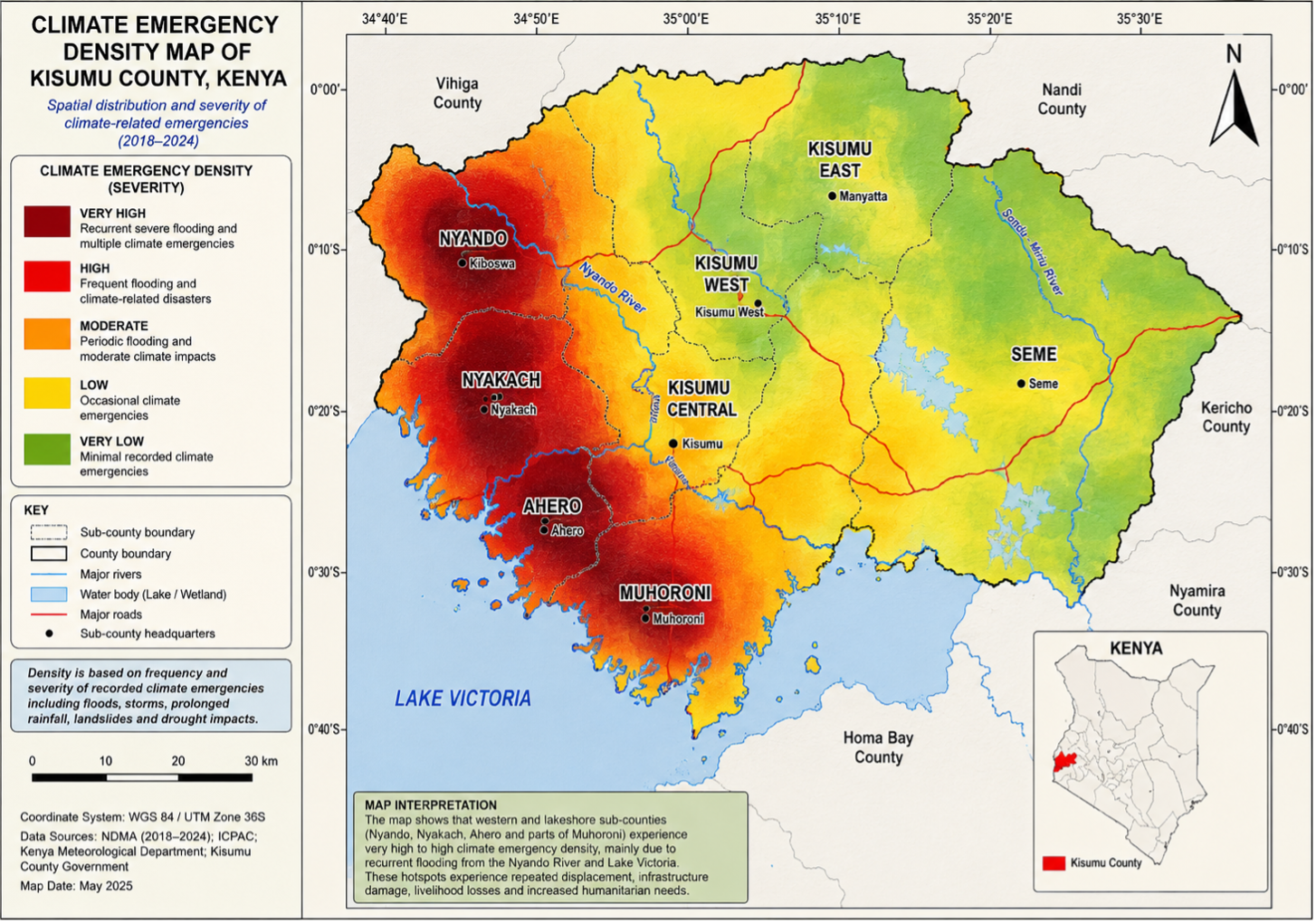
The concentration of recurrent climate emergencies in these locations provides a strong empirical justification for selecting Kisumu County as the study site. Because persons with disabilities are disproportionately affected by disruptions in mobility, healthcare, communication, shelter and emergency assistance during disasters, examining disability rights within a county characterised by repeated climate shocks offers an appropriate context for assessing the adequacy of disability-inclusive emergency response systems. Consequently, Kisumu provides an information-rich setting for investigating how recurrent climate emergencies intersect with disability inclusion and emergency governance.
The spatial concentration of recurrent climate emergencies presented in Figure 1 demonstrates that Kisumu County experiences persistent and severe climate hazards, thereby providing an appropriate empirical setting for examining disability rights and emergency response during climate-related disasters.
3.3 Study Population and Sample
The target population comprised PWDs residing in flood-prone areas of Kisumu County, their primary caregivers, and key institutional stakeholders involved in disaster preparedness and emergency response. These included local chiefs, officers from the Kenya Red Cross and Civil Society Organisations (CSOs), county and national emergency management personnel, social welfare officers, and disability and disaster management experts. Table 3.1 presents the characteristics of the study participants.
| Participant category | Characteristics | Rationale for inclusion |
|---|---|---|
| Persons with physical disabilities | Adults residing in flood-prone communities and directly affected by climate-related disasters | To document lived experiences of mobility, evacuation, shelter, healthcare and protection during emergencies. |
| Persons with sensory disabilities | Adults with hearing and/or visual impairments who had experienced climate-related disasters | To examine accessibility of communication, early warning systems and emergency information. |
| Persons living with chronic health conditions | Adults requiring continuous medical support during emergencies | To assess continuity of healthcare and access to essential services during disasters. |
| Primary caregivers | Family members providing daily care to PWDs | To understand caregiving responsibilities, evacuation challenges and continuity of support. |
| Chiefs | Local administrative leaders from flood-prone locations | To examine community coordination, identification of vulnerable households and emergency preparedness. |
| Kenya Red Cross and CSO representatives | Officers involved in humanitarian response | To assess operational emergency response practices and institutional coordination. |
| County and national emergency personnel | Disaster management practitioners | To examine policy implementation, emergency planning and operational challenges. |
| Social welfare officers | Officers working on disability issues | To provide technical and policy perspectives on disability-inclusive emergency response. |
Participants were selected using purposive sampling because they possessed direct lived experience or professional responsibility relevant to the study objectives. This approach ensured the inclusion of information-rich participants capable of providing detailed insights into disability rights, institutional preparedness and emergency response during climate-related disasters. Sample selection was guided by the principle of information power, whereby participants were recruited based on their ability to provide comprehensive information relevant to the study objectives rather than achieving statistical representativeness. Data collection continued until thematic saturation was achieved, with no substantially new information emerging from subsequent discussions.
3.4 Data Collection
The study relied on primary qualitative data collected through Focus Group Discussions (FGDs), selected because they facilitate interaction among participants with shared experiences while generating rich contextual evidence on disability rights and emergency response.
To promote free expression and accommodate participants’ functional needs, homogeneous FGDs were conducted rather than mixing participants with different disability categories or institutional roles. Persons with physical disabilities, persons with sensory disabilities, caregivers, and duty-bearers participated in separate discussions, thereby minimising communication barriers, power imbalances and participant inhibition.
The discussions were guided by a semi-structured FGD guide aligned with the study objectives and explored three broad areas: perceived rights infringements during climate-related disasters, emergency response gaps, and recommendations for strengthening disability-inclusive emergency responses.
| FGD | Participant category | Accessibility measures | Purpose |
|---|---|---|---|
| FGD 1 | Persons with physical disabilities | Accessible venue, caregiver support where required | To explore experiences of evacuation, shelter, healthcare, mobility and protection. |
| FGD 2 | Persons with sensory disabilities | Kenyan Sign Language interpretation and adapted communication | To examine access to information, early warning systems and communication during emergencies. |
| FGD 3 | Caregivers | Standard facilitation with probing | To document caregiving experiences, continuity of care and household coping mechanisms. |
| FGD 4* | Duty-bearers (chiefs, CSOs, county and national emergency personnel, social welfare officers) | Semi-structured facilitation | To examine institutional preparedness, coordination, policy implementation and operational response challenges. |
3.5 Research Instrument
Data were collected using a semi-structured Focus Group Discussion guide specifically developed around the article’s three research objectives. The instrument was selected because it combines consistency across discussion groups with sufficient flexibility to probe participants’ lived experiences and emerging issues. Separate probes were tailored for each participant category to ensure that questions reflected their roles and experiences. For PWDs, the guide explored experiences of rights infringements, accessibility barriers, evacuation, healthcare, communication, shelter and participation during climate-related disasters.
Where appropriate, caregivers were asked about continuity of care, assistive devices and household coping strategies, while duty-bearers and technical experts responded to questions on policy implementation, institutional preparedness, coordination and disability-inclusive emergency planning.
To ensure equitable participation, the instrument was administered using disability-sensitive communication approaches, including Kenyan Sign Language interpretation for participants with hearing impairments and simplified verbal explanations where necessary. These adaptations ensured that all participants could meaningfully contribute irrespective of their functional limitations while maintaining consistency across all FGDs.
3.6 Ethical Considerations
Ethical approval was obtained from the Kisii University Research Review Committee before data collection. During research, verbal and written consents were sought from caregivers. Research assistants were trained on disability-sensitive research, ethical engagement with vulnerable participants and confidentiality procedures. The principles of Free, Prior and Informed Consent (FPIC) with participants were adhered to. They received clear information about the research objectives, potential risks and their right to withdraw at any stage without penalty (Hofbauer, 2022). Accessible communication formats, including simplified language and Sign Language interpretation where necessary, were used to facilitate informed participation. To protect participants’ privacy, all data were anonymised using alphanumeric codes and handled confidentially throughout the research.
3.7 Data Analysis
Audio recordings from the Focus Group Discussions (FGDs) were transcribed verbatim, verified for accuracy against the original recordings, and imported into NVivo 14 as individual transcript documents. Data analysis followed an inductive thematic analysis approach, allowing themes to emerge directly from participants’ narratives rather than being predetermined.
For the first objective, which sought to identify the rights perceived by PWDs to have been infringed during climate-related disasters, each transcript was read repeatedly to achieve familiarity with the data. Open coding was then undertaken by assigning descriptive codes to text segments describing participants’ experiences of rights violations. Similar codes were iteratively grouped into broader thematic categories representing specific rights, including the rights to life, health, dignity, food, water, shelter, information, participation and protection. Coding frequencies and reference counts generated by NVivo were used to determine the relative prominence of each theme, with percentage occurrences calculated based on the total number of coded references.
To address the second objective, which examined the extent to which perceived rights infringements were associated with emergency response system gaps, transcripts were re-examined to identify statements describing institutional, structural, operational, communication and policy-related deficiencies. These were coded into corresponding categories and analysed using Matrix Coding Queries to examine relationships between identified rights infringements and specific emergency response gaps. Comparative analysis across participant groups, including PWDs, caregivers and duty-bearers, enabled the identification of convergent and divergent perspectives, thereby strengthening the credibility of the findings through data triangulation.
For the third objective, participants’ recommendations for improving disability-inclusive emergency responses were extracted from all transcripts and coded inductively into intervention categories. Related recommendations were subsequently consolidated into broader themes representing policy reforms, institutional strengthening, accessible communication systems, disability-inclusive planning, capacity building, community participation and resource allocation. Word Frequency and Text Search Queries were employed to identify recurrent concepts and verify thematic consistency, while Framework Matrices were used to compare recommendations across participant categories. The final themes were interpreted in relation to the article’s objectives and contextualised within existing disability rights, climate adaptation and disaster risk management literature to develop evidence-based recommendations.
4. Findings
4.1 Rights Perceived to Be Infringed During Climate-Related Disasters
| Theme | Keywords | Excerpt | Percentage (%) |
|---|---|---|---|
| Right to health | Medical; disease; sickness; care | “...provide water, food, and medical care for chest/flood complications.” | 17.2 |
| Right to shelter & housing | Resettlement; swept; infrastructure; shelter | “Resettlement challenges and long settling times.” | 17.4 |
| Right to dignity & protection | Mercy; well-wishers; ID cards; recognised | “No framework; left at mercy of well-wishers/church.” | 17.4 |
| Right to life & safety | Death; drowned; evacuate; safety | “Deaths; farms swept; hard for PWD to evacuate without help.” | 15.9 |
| Right to accessible information | Info; warnings; communication; guidelines | “No policies in place; no communication or warnings made.” | 13.0 |
| Right to participation | Engage; training; drills; collaborate | “Framework not adhered to; responders don’t engage PWDs.” | 10.1 |
| Right to food & water | Food; starvation; hunger; water | “Many households with PWDs experienced hunger and lacked adequate food and safe drinking water before relief supplies arrived.” | 8.7 |
Table 4.1 shows that climate disasters trigger infringement of human rights for PWDs, who are subjected to severe secondary trauma. This includes the loss of dignity (17.4%), shelter (17.4%) and health (17.2%). These deprivations compel them into inaccessible housing and an undignified reliance on charity rather than state protection. This situation is worsened by a lack of inclusive communication (13.0%) and disability-mapped data, which directly threatens the right to life and safety (15.9%) because responders cannot locate or evacuate individuals with limited mobility. Furthermore, it was observed that PWDs are not fully engaged in the design of emergency response policies and frameworks.
4.2 Rights Infringement and Emergency-Inclusive Response Gaps
| Right | Verbatim | Structural gap | Operational gap | Percentage (%) |
|---|---|---|---|---|
| Right to dignity and protection | “Left at the mercy of well-wishers.” | Policy lacks mechanisms to protect cash transfers or ID rights during displacement. | State-led protection systems collapse; aid shifts to an ad-hoc model. | 17.4 |
| Right to health | “Lack of medical care... [needing] chest complications [tracked] for those immobile in floods.” | No protocol requiring responders to track medical histories or transport assistive devices. | Total absence of specialised, adaptive medical care at relief sites. | 17.4 |
| Right to shelter and housing | “Inaccessible toilet doors and sleeping spaces.” | Frameworks fail to legally define evacuation “safe locations” as physically accessible. | Evacuation infrastructure is built with structural barriers. | 17.4 |
| Right to life and safety | “Teams [who] don’t know locations of PWD.” | No legal mandate or system to maintain an updated disability register. | Responders remain blind to the locations and coordinates of vulnerable citizens. | 15.9 |
| Right to accessible information | “No communication or warnings made... caught off guard.” | Statutory laws fail to specify inclusive communication formats for sensory-impaired individuals. | Total breakdown in early warning and mass alert systems. | 13.0 |
| Right to participation | “Responders don’t engage PWD... [frameworks are] not adhered to.” | Disaster risk frameworks are designed for rather than with PWDs. | PWDs are systemically excluded from disaster drills and safety training. | 10.1 |
| Right to food and water | “Hunger and starvation.” | Distribution policies rely on a centralised, “one-size-fits-all” model. | Failure to implement a mandated door-to-door supply delivery protocol. | 8.7 |
Emergency frameworks are consistently designed for, rather than with, PWDs, as findings indicate a participation rate as low as 10.1% in the design of emergency response frameworks. This lack of involvement means that PWDs are largely excluded from planning, leading to a “one-size-fits-all” strategy that ignores the practical realities of disability logistics. Findings further reveal that structural exclusion directly triggers critical blind spots during emergency responses, leaving field teams without specialised protocols. Specifically, the data reveal a total lack of localised disability registers (15.9%) and inclusive communication tools (13.0%). Without these tools, responders are unable to locate, warn or prioritise vulnerable individuals during a crisis (Table 4.2).
4.3 Practices to Strengthen Disability-Inclusive Emergency Response
| Response | Verbatim | Gap | Best practice | Percentage (%) |
|---|---|---|---|---|
| Inclusive resettlement & supply chains | “County support and ensure full resettlement/supplies.” | PWDs face severe hunger, starvation and long delays in returning to safe housing. | Mandate full county support for localised resettlement and dedicated supply chains. | 26.1 |
| Inclusive infrastructure & shelter design | “Inclusive shelter design... toilet doors and movement areas are inaccessible.” | Evacuation centres, sleeping spaces and toilet doors are physically inaccessible. | Legally enforce inclusive shelter design standards for all relief facilities. | 17.4 |
| Continuity of assistive care | “Caregivers be informed on medical history... access to assistive devices.” | Loss of medical devices and lack of specialised, disability-aware healthcare. | Integrate caregiver networks and ensure immediate access to adaptive/assistive devices. | 17.4 |
| Specialised training for responders | “Train responders to lift/transport [and conduct] drills with the PWD community.” | Response teams lack the technical skills to safely lift or transport individuals with mobility impairments. | Train responders on adaptive handling techniques and integrate PWDs into simulation drills. | 15.9 |
| Inclusive communication & liaisons | “Each county has sign language community liaison officers.” | Emergency alerts and mass warnings are completely inaccessible to sensory-impaired individuals. | Deploy certified Sign Language Community Liaison Officers across all administrative units (counties). | 13.0 |
| Mapping & data disaggregation | “Teams don’t know locations of PWDs... collaborate through chiefs.” | Response teams operate blindly because they do not know where PWDs live. | Establish data-sharing protocols to map and locate PWDs through localised administration (chiefs). | 10.1 |
According to Table 4.3, respondents suggested establishment of local resettlement centres with a steady supply of necessities for PWDs (26.1%). They also emphasised the need for all-inclusive designs that accommodate PWDs at these resettlement centres (17.4%), noting, for example, that the centres should have PWD-friendly toilets. Additionally, participants highlighted the importance of establishing caregiver networks and ensuring they are provided with assistive devices (17.4%). To address tactical field gaps, respondents suggested training emergency responders on adaptive handling techniques and conducting routine simulation drills (15.9%). Finally, they observed that responders should be trained in sign language (13.0%) and recommended establishing data-sharing protocols to map PWDs through local chiefs (10.1%) because emergency teams often do not know the locations of PWDs.
5. Discussion
5.1 Infringed Rights during Climate-Related Disasters
PWDs in Kisumu County face serious rights infringements during climate disasters. Specifically, they face severe threats to their health, safety and lives, alongside a loss of shelter, dignity, protection, accessible information, food and the right to participation. Among these, the rights to health, shelter and dignity are the most frequently infringed. These findings validate Critical Disability Theory (CDT) and Amartya Sen’s Capability Approach. CDT argues that disability is not merely a medical impairment, but rather a product of societal barriers and systemic neglect.
While Kenya boasts a robust legal framework including Article 54 of the Constitution (Constitution of Kenya, 2010), the Persons with Disabilities Act (GoK, 2003), and the National Climate Change Action Plan, the data reveal that local disaster response mechanisms remain largely exclusionary. The fact that most respondents are left at the mercy of well-wishers and churches highlights a failure by the Kisumu County Disaster Management unit to operationalise inclusive institutional protection, effectively leaving PWDs politically and socially invisible during emergencies.
To bridge these gaps, Kenya must pivot from a paternalistic, charity-based model of disaster relief to a legally binding, rights-based approach. The Kisumu County Government, for example, should urgently domesticate the global Sendai Framework for Disaster Risk Reduction by generating disability-disaggregated data to map out where PWDs live prior to flood seasons. Additionally, policy frameworks must mandate that PWDs are co-designers of county emergency drills and early warning communication channels. Without translating these statistics into inclusive county budgets and structural policy reforms, PWDs in climate-vulnerable zones will continue to experience disproportionate state abandonment under the guise of natural disasters.
These findings respond to a growing body of international and regional literature demonstrating that climate-related disasters disproportionately compromise the fundamental rights of PWDs. Similar findings have been reported by Stein and Stein (2022), who observed that disasters frequently undermine the rights to health, dignity, shelter and personal security because emergency response systems are rarely designed to accommodate diverse functional needs. Likewise, Eriksen et al. (2025) found that inaccessible evacuation procedures, disrupted healthcare services and inadequate social protection mechanisms expose PWDs to heightened risks during climate emergencies. Within the African context, Grech and Weber (2025) similarly argue that disability-related vulnerabilities arise less from impairment itself than from institutional exclusion, inaccessible infrastructure and weak disaster governance. These observations resonate with evidence from Kisumu County reported by Masakhwe et al. (2020), who found that restrictive humanitarian practices and inadequate disability-sensitive planning left many PWDs dependent on informal support systems during disasters. The consistency between the present findings and previous studies suggests that the persistent infringement of disability rights is not an isolated local phenomenon but reflects broader structural shortcomings in disaster governance. This reinforces the need for disability-inclusive emergency planning and implementation.
5.2 Rights Infringement and Emergency-Inclusive Response Gaps
This paper establishes that rights infringements lead directly to critical structural and operational gaps in emergency responses. Because emergency mechanisms are designed for, rather than with, PWDs, local responses rely on rigid, “one-size-fits-all” strategies that ignore disability logistics. These structural exclusions cause immediate operational failures. First, a lack of localised disability registers forces responders to deploy “blind,” without the geospatial data needed to locate trapped individuals. Second, deficits in inclusive communication tools cause a total breakdown in sensory-accessible early warning alerts. Finally, these failures trigger a collapse in basic survival support, creating severe operational gaps in shelter accessibility, medical care tracking and door-to-door food distribution.
This lack of inclusive response exposes a systemic failure to enforce Kenya’s existing legislative frameworks. On a national scale, these operational blind spots directly contradict the Persons with Disabilities Act (GoK, 2003) and the National Disaster Risk Management Policy, which mandate PWD inclusion in emergency planning. Furthermore, leaving displaced individuals dependent on ad-hoc charity abdicates the state’s constitutional mandate under Article 54 of the Constitution of Kenya, which guarantees dignity and protection (Constitution of Kenya, 2010). To bridge these gaps, county authorities should transition from a paternalistic relief model to an accountable, rights-based approach. This requires translating national policies into localised, legally binding protocols such as disability-disaggregated data tracking and inclusive communication channels before disaster seasons strike.
Theoretically, these empirical findings validate Critical Disability Theory (CDT) and substantiate Amartya Sen’s Capability Approach. CDT argues that vulnerability is not an inevitable consequence of impairment but is actively manufactured by a society that refuses to accommodate differences. The low participation rate in framework design provides clear proof of institutional ableism, showing that emergency systems are built around the assumption of a standard, fully mobile body. Simultaneously, the data supports the Capability Approach by demonstrating how climate hazards strip PWDs of their functional capabilities. When evacuation infrastructure contains physical barriers and lacks medical tracking, the state destroys the “conversion factors” required to turn aid into actual safety, converting environmental hazards into absolute deprivations of human capability.
The relationship established in this article between rights infringements and emergency response system failures is strongly supported by existing scholarship on disability-inclusive disaster risk reduction. Funke and Dijkzeul (2025) argue that humanitarian response systems continue to operate within generalised emergency frameworks that inadequately recognise disability-specific needs, resulting in exclusion throughout preparedness, response and recovery phases. Similarly, McNabb and Swenson (2022) identify fragmented institutional coordination, weak accountability mechanisms and poor inter-agency collaboration as major contributors to ineffective emergency responses for vulnerable populations. In Kenya, Masakhwe et al. (2020) reported that the absence of disability-sensitive planning, limited stakeholder coordination and inadequate policy implementation significantly constrained humanitarian assistance to PWDs during disasters in Kisumu County. Comparable findings were also reported by Njelesani (2025), who demonstrated that limited participation of PWDs in emergency planning contributes to inaccessible communication systems and ineffective disaster interventions. Collectively, these studies support the present findings that rights infringements are closely associated with systemic weaknesses within emergency response systems rather than being unavoidable consequences of climate-related disasters.
5.3 Practices to Strengthen Disability-Inclusive Emergency Response
This article identifies key best practices to transform reactive disaster management into a proactive, resilient system. First, logistics should be reformed through localised resettlement frameworks and dedicated supply chains to prevent housing delays and starvation. Second, relief facilities should prioritise inclusive infrastructure, ensuring pathways and sanitation systems preserve human dignity. Third, emergency frameworks should integrate caregiver networks and guarantee immediate access to adaptive medical devices. To bridge tactical field gaps, response teams require specialised training in adaptive handling, complemented by community-wide simulation drills. Finally, preparedness should rely on inclusive communication through certified sign language liaison officers and localised data mapping with administrative chiefs to eliminate operational blindness.
These community-driven solutions directly reinforce key statutory mandates within the Kenyan policy space. The demand for localised data mapping and sign language liaisons implements the accessibility provisions of the Persons with Disabilities Act (2003). Furthermore, enforcing inclusive shelter standards and dedicated supply chains provides a concrete operational roadmap for the National Climate Change Action Plan and County Integrated Development Plans (CIDPs). By establishing these localised networks, county governments can fulfil the National Disaster Management Policy, which mandates decentralised risk reduction over ad-hoc relief. Implementing these practices enables local authorities to move away from exclusionary responses and build an institutional framework that secures statutory rights.
Theoretically, these proposed practices operationalise Amartya Sen’s Capability Approach and fulfil the core tenets of Critical Disability Theory (CDT). Within the Capability Approach, accessible shelters, caregiver networks and assistive devices act as institutional “conversion factors” that allow vulnerable individuals to transform emergency resources into actual safety and health. Simultaneously, integrating PWDs into simulation drills and training responders in adaptive handling directly dismantles the structural ableism critiqued by CDT. Instead of treating PWDs as passive objects of charity, this framework repositions them as active co-designers of climate resilience, ensuring they can reclaim their fundamental rights to life, dignity and safety.
The best practices identified in this article closely align with contemporary evidence advocating a transition from reactive humanitarian assistance towards proactive and disability-inclusive disaster risk reduction. Kosanic et al. (2022) similarly recommend integrating universal design principles into evacuation infrastructure, emergency shelters, healthcare facilities and communication systems to improve accessibility during disasters. Jevtić et al. (2025) further emphasise that accessible infrastructure, assistive technologies and disability-responsive preparedness planning substantially enhance resilience among PWDs. Consistent with the present findings, Grech and Weber (2025) advocate for multisensory early warning systems, while Engelman et al. (2022) argue that meaningful participation of PWDs in disaster planning produces more responsive and sustainable emergency interventions. Within Kenya, the recommendations advanced by this study complement the findings of Masakhwe et al. (2020), who called for stronger institutional coordination, disability-sensitive humanitarian planning and greater involvement of PWDs in disaster governance. Taken together, the literature and the present findings demonstrate that disability-inclusive emergency response requires coordinated policy implementation, accessible infrastructure, participatory governance and sustained institutional investment, rather than isolated humanitarian interventions.
6. Conclusion
6.1 Summary
This article aligns directly with global agreements, such as the UN Convention on the Rights of Persons with Disabilities (CRPD) and the Sendai Framework for Disaster Risk Reduction. While existing literature often treats rights violations, such as the loss of shelter or health, and operational solutions as separate topics, the unique value of this research lies in bridging that gap. It illustrates exactly how every right violated in the field corresponds directly to a specific structural solution left out of the policy rulebook. For instance, the loss of human dignity in evacuation shelters connects directly to the absence of trained responders and fractured local supply chains. Consequently, these findings demand that the Kisumu County Government move past broad national rhetoric and translate these global agreements into localised, legally binding county disaster protocols.
This research changes the perception of how emergency planning for vulnerable groups should be approached. The findings demonstrate that an inclusive response cannot be achieved through ad-hoc, last-minute fixes after a disaster has already occurred. Instead, it challenges policymakers to recognise that protecting PWDs is not an act of benevolence or charity, but a strict statutory duty to safeguard human life. Practically, this requires the immediate establishment of localised, disability-disaggregated registers and the deployment of multi-sensory early warning systems before disaster seasons strike. Until PWDs are actively brought to the table to co-design disaster frameworks, state protection systems will continue to systematically fail the populations who need them most.
The article’s results provide critical empirical validation for Critical Disability Theory (CDT) and Amartya Sen’s Capability Approach within the context of climate justice. By mapping precise operational failures to specific rights infringements, the findings prove CDT’s core assertion that vulnerability is actively manufactured by ableist institutional neglect rather than a person’s medical impairment. Furthermore, the data expand the Capability Approach by demonstrating how structural barriers in emergency infrastructure destroy the essential “conversion factors” PWDs need to turn standard relief resources into actual safety and survival. Ultimately, this research implies that under climate stress, exclusionary governance aggressively converts environmental hazards into an absolute deprivation of human capability.
6.2 Limitations and Future Directions
Though data collection was limited to Kisumu County, which might affect the transferability of the findings, this was addressed by purposively sampling diverse stakeholder groups. The qualitative design also limits statistical generalisability but provides rich, in-depth insights into participants’ experiences through rigorous NVivo analysis. Reliance on retrospective accounts may have introduced recall bias, which was minimised through participant validation during Focus Group Discussions and triangulation across stakeholder groups.
- Muhammed Bah, Y. (2025). Causes of persons with disabilities vulnerability to disaster: Lessons for disaster management and reduction planners. International Journal of Development Research, 69236–69243. https://doi.org/10.37118/ijdr.29935.10.2025
- Bramley, G. (2017). Housing and the living environment. Poverty and Social Exclusion in the UK (Vol. 2). https://doi.org/10.1332/policypress/9781447334224.003.0010
- Constitution of Kenya. (2010). National Council for Law Reporting. http://kenyalaw.org
- Dae-Wook Kim. (2025). The role of the Committee on the Rights of Persons with Disabilities in ensuring disability-inclusive responses to climate change in Africa. African Disability Rights Yearbook, 12(1). https://doi.org/10.29053/adry.v12i1.5528
- Engelman, A., Craig, L., & Iles, A. (2022). Global disability justice in climate disasters: Mobilizing people with disabilities as change agents. Health Affairs, 41(10), 1496–1504. https://doi.org/10.1377/hlthaff.2022.00474
- Eriksen, S. H., Bell, S. L., Mfitumukiza, D., Raanaas, R. K., Dani, R. P., Delic-Klevstad, N., … Ssennoga, M. K. (2025). Between a rock and a hard place: Exploring the lived experience of disability and climate injustice. Climate and Development, 1–14. https://doi.org/10.1080/17565529.2025.2592263
- Frintová, D. (2023). Implementation of Article 12 of the UN Convention on the Rights of Persons with Disabilities in the Czech Republic. Models of Implementation of Article 12 of the Convention on the Rights of Persons with Disabilities (CRPD), 140–166. https://doi.org/10.4324/9781003463016-12
- Funke, C., & Dijkzeul, D. (2025). Translating disability inclusion into the humanitarian system. In Disability Inclusion in Humanitarian Crises (Palgrave Studies in Disability and International Development). Palgrave Macmillan. https://doi.org/10.1007/978-3-031-53809-4_4
- Government of Kenya. (2003). The Persons with Disabilities Act (Act No. 14 of 2003). National Council for Law Reporting. https://new.kenyalaw.org/akn/ke/act/2003/14/eng@2022-12-31
- Government of Kenya. (2025). The Persons with Disabilities Act (Act No. 4 of 2025). National Council for Law Reporting. https://new.kenyalaw.org/akn/ke/act/2025/4/eng@2025-05-13
- Grech, S., & Weber, J. (2025). Disability inclusive disaster risk reduction. An Introduction to Disability Inclusive Disaster Risk Reduction, 1–20. https://doi.org/10.4324/9781003353188-1
- Hofbauer, J. A. (2022). Free, Prior and Informed Consent (FPIC). Elgar Encyclopedia of Human Rights, 249–259. https://doi.org/10.4337/9781789903621.free.prior.informed.consent
- Hughes, C. C. (2020). A house but not a home: How surveillance in subsidized housing exacerbates poverty and reinforces marginalization. Social Forces, 100(1), 293–315. https://doi.org/10.1093/sf/soaa108
- Intergovernmental Authority on Development Climate Prediction and Applications Centre (ICPAC). (2026). Dual climate risks emerging: Extremely dry conditions expected across northern Greater Horn of Africa during July–September, followed by intensely wet October–December rains over equatorial and southern parts of the region. https://www.icpac.net/publications/
- Jevtić, M., Cvetković, V. M., Gačić, J., & Raonić, Z. (2025). Factors of vulnerability and resilience of persons with disabilities during disasters: Challenges and strategies for inclusive risk reduction. https://doi.org/10.20944/preprints202503.1928.v1
- Kälin, W. (2024). Disaster and climate change-induced displacement of persons with disabilities: A human rights perspective. In M. H. Rioux, A. Buettgen, E. Zubrow, & J. Viera (Eds.), Handbook of Disability. Springer. https://doi.org/10.1007/978-981-19-6056-7_27
- Kenya Meteorological Department. (2026). State of the climate report (2025). https://meteo.go.ke/publications/
- Kosanic, A., Petzold, J., Martín-López, B., & Razanajatovo, M. (2022). An inclusive future: Disabled populations in the context of climate and environmental change. Current Opinion in Environmental Sustainability, 55, 101159. https://doi.org/10.1016/j.cosust.2022.101159
- Masakhwe, P. W., Onkware, K., & Kilonzo, S. (2020). A restrictive humanitarian policy and the wellbeing of the disabled in disasters in Kisumu County. International Journal of Disaster Response and Emergency Management (IJDREM), 3(2), 48–56. https://doi.org/10.4018/IJDREM.20200701.oa1
- McNabb, D. E., & Swenson, C. R. (2022). Emergency management responsibilities. Disaster Management Policies and Practices, 87–103. https://doi.org/10.4324/9781003310280-7
- Mylius, B. (2025). Engaging ethically with narratives from historically marginalized cultures in response to climate change. In Global Climate Crisis (pp. 20–41). Edward Elgar Publishing. https://doi.org/10.4337/9781035308880.00006
- Njelesani, J. (2025). Co-creating inclusive and non-ableist public health policies with persons with disabilities; comment on “How did governments address the needs of people with disabilities during the COVID-19 pandemic? An analysis of 14 countries’ policies based on the UN Convention on the Rights of Persons With Disabilities”. International Journal of Health Policy and Management, 14(1), 1–4. https://doi.org/10.34172/ijhpm.8694
- Noorda, A. Y. (2022). Chapter 1: The need to provide international protection to persons mobile in the context of disasters and climate change. In Climate Change, Disasters and People on the Move. Brill | Nijhoff. https://doi.org/10.1163/9789004522367_003
- Onowugbeda, S. (2025). Environmental harm and human rights violations by multinational corporations: Legal and institutional perspectives under the revised binding treaty. https://doi.org/10.2139/ssrn.5347327
- Sesay, M., & Bradley, M. (2021). “When the ground opened”: Responsibility for harms and rights violations in disasters – Insights from Sierra Leone. Journal of Human Rights, 21(1), 1–17. https://doi.org/10.1080/14754835.2021.1935221
- Stein, P. J., & Stein, M. A. (2022). Disability, human rights, and climate justice. Human Rights Quarterly, 44(1), 81–110. https://dx.doi.org/10.1353/hrq.2022.0003
- United Nations Office for Disaster Risk Reduction (UNDRR). (2015). Sendai framework for disaster risk reduction 2015–2030. Proceedings of the 3rd United Nations World Conference on DRR, Sendai, Japan (Vol. 1). https://doi.org/10.1163/2210-7975_HRD-9813-2015016
- Van Den Broek, K. L., Negro, S. O., & Hekkert, M. P. (2024). Mapping mental models in sustainability transitions. Environmental Innovation and Societal Transitions, 51, 100855. https://doi.org/10.1016/j.eist.2024.100855
- World Health Organization. (2022). Global report on health equity for persons with disabilities. WHO.
Not provided.
The author received no specific funding for this work.
None declared.
All claims expressed in this article are solely those of the author and do not necessarily represent those of the publisher, editors, reviewers, or affiliated institutions. Any product, service, or claim that may be evaluated in this article is not guaranteed or endorsed by the publisher.

Creative Commons License
This work is licensed under a Creative Commons Attribution 4.0 International License.
Copyright © 2026 The Author(s). Published by HRL Journal Service.